Agentic AI in Telecom Networks: How Carriers Are Running Autonomous Operations at Scale in 2026
Agentic AI telecom networks are live in 2026. See how carriers automate 5G slicing, fault remediation, and a $60B opportunity—plus the governance risks ahead.

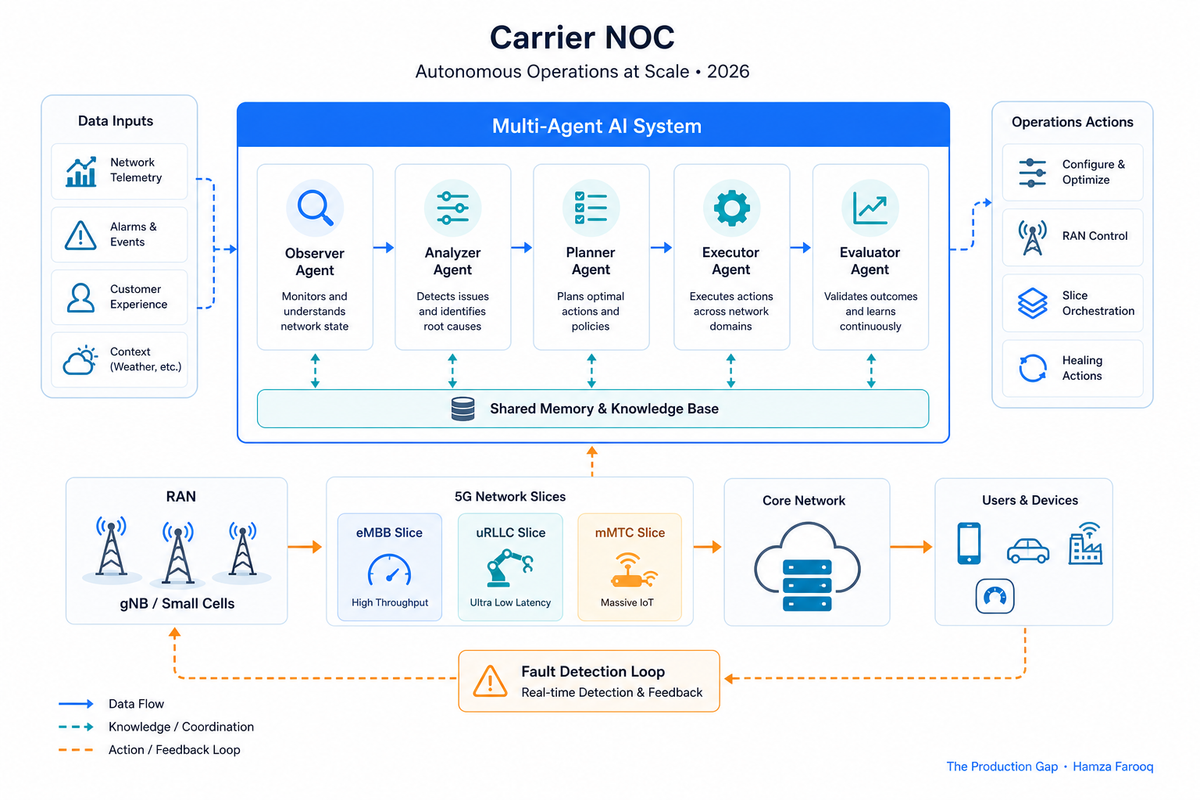
TL;DR: Major tier-1 carriers are running agentic AI in production across 5G network slicing and fault remediation as of 2026. AI agents provision slices, resolve faults autonomously, and operate inside closed loops that complete well within 5G SLA windows. Google Cloud has sized the resulting opportunity at $60 billion for telecom operators. The governance gap, not the technology, is the primary operational risk carriers are underweighting.
Key takeaways
- Carriers are moving agentic AI from pilot to production, not just evaluating it.
- AI agents carve, allocate, and adjust 5G network resources in real time without human sign-off.
- Closed-loop fault detection is resolving outages before customers experience them, in production, today.
- Google Cloud has put a $60 billion number on the agentic AI opportunity for telecom operators specifically.
- The primary risk is organizational, not technical: NOC teams are not yet equipped to govern autonomous systems acting on live infrastructure.
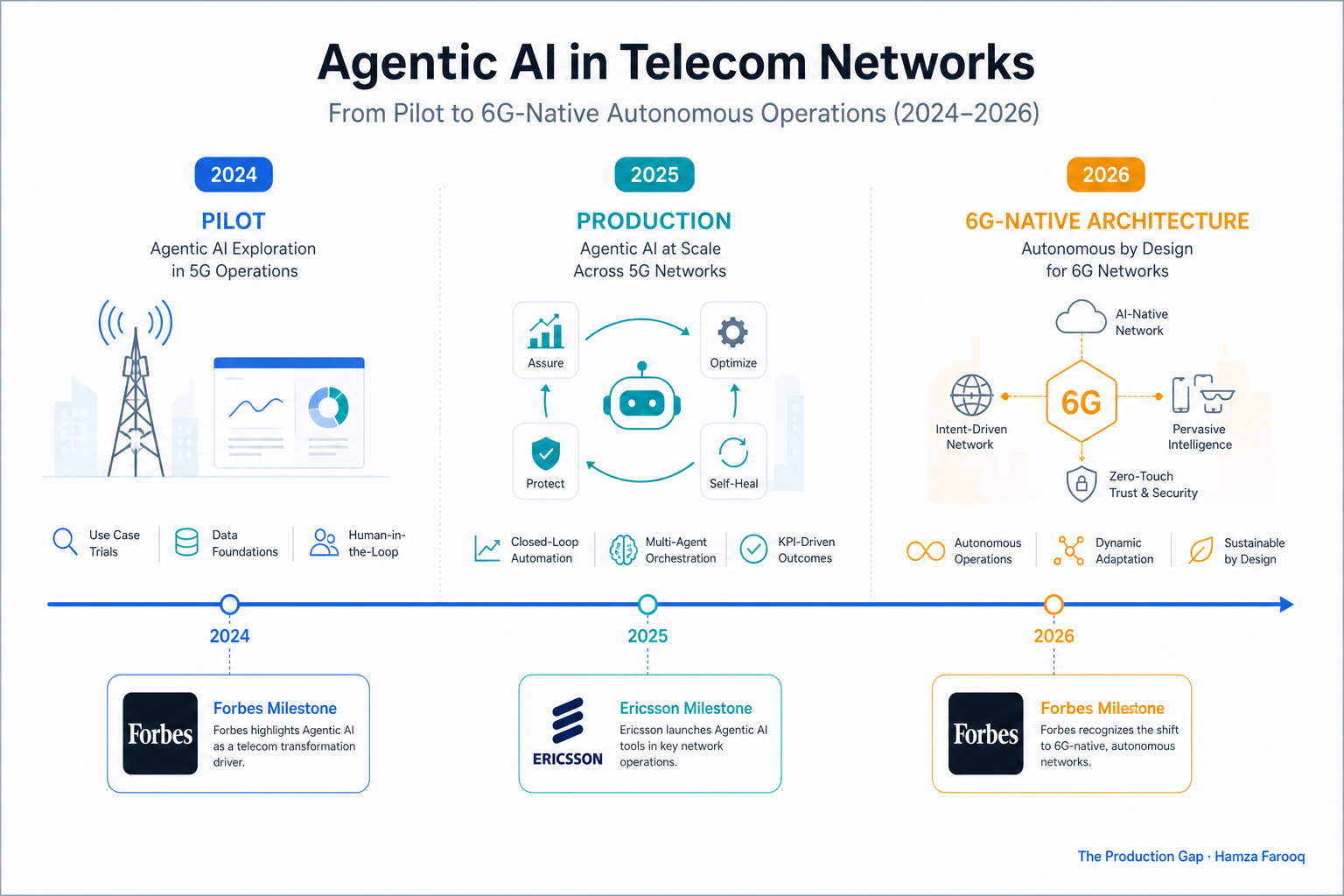
- 6G is being designed with autonomous AI as a native architectural component, not bolted on later.
Why is agentic AI in telecom architecturally different from automation in any other industry?
Agentic AI in telecom is architecturally distinct because carrier networks require closed-loop decisions on live physical infrastructure, at millisecond timescales, with no tolerance for cascading failure.
The core distinction: closed-loop autonomy on live infrastructure
Traditional automation acts on data records. Telecom agents act on live physical infrastructure, RAN nodes, spectrum allocations, and active 5G slices carrying real user traffic. NVIDIA's production architecture documents the pattern: perception agents monitor telemetry, reasoning agents evaluate policy constraints, and action agents execute configuration changes inside a closed loop with no human approval gate. The speed requirement is a hard constraint no human team can meet at carrier scale.
Multi-agent system design specific to NOC and RAN
A single orchestrating agent cannot handle full telecom operations. Carriers deploy hierarchical multi-agent systems: a fleet-level orchestrator delegates to domain-specific agents for RAN, core, and transport. Infovista documents how intent-based networking AI translates high-level business policies, prioritizing video QoS for a specific enterprise slice, into real-time configuration actions without manual translation. These agents are not recommending changes. They are executing them on infrastructure affecting millions of users.
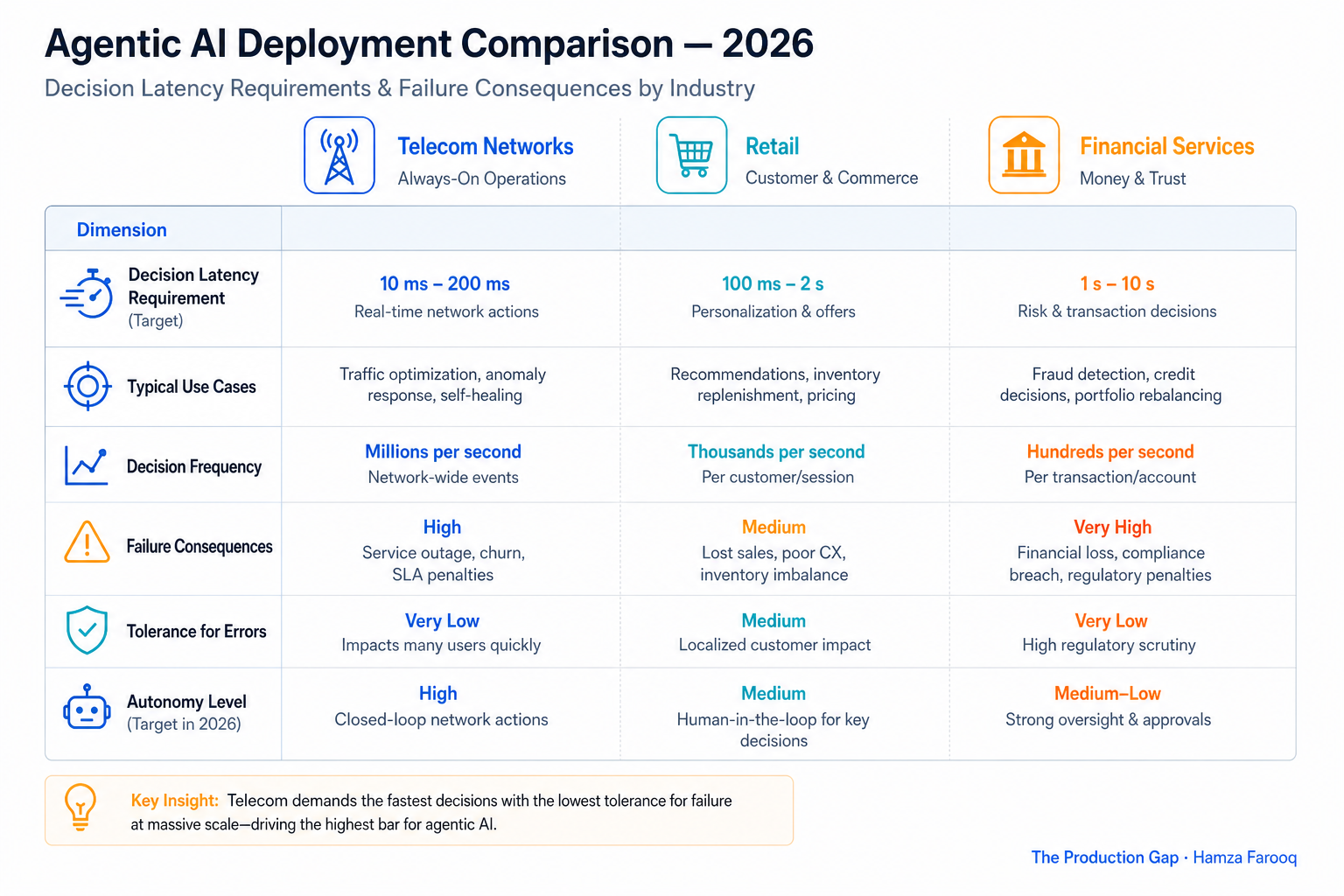
Table 1: agentic AI deployment constraints by vertical, as of 2026.
| Dimension | Telecom | Retail | Financial Services |
|---|---|---|---|
| Decision target | Live 5G network slice / RAN node | Inventory record / pricing engine | Transaction / credit record |
| Required decision latency | Sub-second (ms-level) | Minutes to hours | Seconds to minutes |
| Failure consequence | Network outage, SLA breach, cascade | Stockout, margin error | Fraud loss, compliance flag |
| Human override window | Near-zero in closed loop | Always available | Regulated checkpoint |
| Multi-agent coordination | Required (RAN + core + transport) | Optional | Partial |
| Physical infrastructure risk | Direct | None | None |
Autonomous 5G network slicing: the mechanics
Agents monitor per-slice KPIs, latency, throughput, jitter, and rebalance compute, spectrum, and routing across hundreds of slices simultaneously. No pre-written rule set can anticipate every failure mode at that combinatorial scale. Enterprise 5G slice SLAs cannot be sold or guaranteed without this autonomous rebalancing, that is the economic forcing function driving adoption.
Self-healing networks: fault detection and closed-loop recovery
Agents detect degradation, cross-reference network topology, identify root cause, and execute remediation, rerouting traffic, restarting nodes, isolating fault domains, before a fault becomes something a customer experiences. This is a structural shift from reactive NOC operations to predictive autonomous infrastructure, rewriting the economic model of network management.
Orchestration tooling and deployment speed
Carriers are integrating purpose-built orchestration platforms that handle agent coordination, policy enforcement, and tool access within network operations environments. For carriers without large internal AI engineering teams, platform availability is a material factor in how quickly autonomous operations move from design to deployment.
Why did 5G's complexity accelerate agentic AI adoption in telecom?
5G created specific technical and economic pressures, real-time complexity, dynamic enterprise SLAs, and narrow fault windows, that left no viable alternative to autonomous operations at scale.
Ericsson's four-way framework and the $60 billion signal
Ericsson identifies four vectors reshaping the ecosystem: autonomous network operations, AI-native customer experience, intelligent resource monetization, and network-as-a-platform for third-party agentic services. Google Cloud's $60 billion market sizing and a dedicated sector research report projecting adoption through 2034 point to sustained structural demand. As Table 1 illustrates, the combination of sub-second latency, direct physical infrastructure risk, and mandatory multi-agent coordination places telecom in a category retail and financial services automation does not reach. That structural gap, not vendor momentum, is the defensible explanation for adoption pace.
What governance risk are carriers underweighting in agentic AI deployments?
The real operational risk is not model failure, it is that NOC teams lack the skills to supervise autonomous systems making real-time decisions on live infrastructure.
What functional human-in-the-loop governance requires
Effective NOC oversight requires three things most teams currently lack: intent-based policy authorship to constrain agent behavior within acceptable operating envelopes; reasoning-transparent dashboards so engineers understand why an agent acted, not just what it did; and escalation triggers that pause autonomous action and return human authority before high-consequence changes execute. Missing any one leaves a carrier running unmonitored operations under a different label.
The 6G implication
Forbes reported in February 2026 that carriers are designing agentic AI as a native architectural component of 6G, not a retrofit. Governance frameworks built now either scale into 6G infrastructure or become a systemic liability at the next architectural inflection point.
Frequently asked questions
What is agentic AI in telecom, and how does it differ from traditional network automation? Traditional automation executes fixed rule sets triggered by predefined conditions. Agentic AI perceives network state, reasons across policy constraints, and takes novel actions inside a closed loop. NVIDIA's documented production architecture illustrates this distinction in detail.
How does autonomous 5G network slicing work in production? Agents monitor per-slice KPIs continuously and reallocate compute, spectrum, and routing without human approval at speeds manual NOC operations cannot match. Infovista documents how intent-based networking AI translates business-level policies into real-time configuration actions across active slices.
What is driving telecom's faster adoption of agentic AI compared to other industries? 5G's real-time complexity, dynamic enterprise SLAs, narrow fault windows, and mandatory multi-agent coordination left no viable manual alternative at carrier scale. Table 1 shows these constraints are categorically more severe in telecom than in retail or financial services.
What governance controls do carriers need when AI agents act on live network infrastructure? Three layers: intent-based policy authorship, reasoning-transparent dashboards, and escalation triggers that return human authority before high-consequence changes execute. Ericsson identifies organizational adaptation as the underweighted element in most deployments.
Conclusion
Autonomous systems are managing 5G slices, running self-healing loops, and operating inside carrier NOCs at tier-1 scale. Google Cloud's $60 billion market sizing, Ericsson's operational frameworks, and NVIDIA's documented production architectures confirm the transition from pilot to production is underway. Forbes confirmed in February 2026 that 6G is being designed around agents from the start.
The constraint that doesn't appear in vendor decks is organizational. Before evaluating a single platform, map your NOC team's current capability against the three governance requirements in this guide. That gap is where an agentic AI investment case either holds up or falls apart on a live network.
Your agents are only as safe as the humans governing them.
Learn from me
Agentic AI for Product Managers, my Maven cohort. Learn how to design, evaluate, and ship reliable AI systems: the technical fluency PMs need to lead agentic products, no engineering background required. Join the next cohort →
Hire us
Traversaal.ai. We're a team of forward deployed engineers solving the toughest AI problems for Fortune 100 companies: document intelligence, agentic data platforms, and real-time web intelligence, deployed in production. Work with our team to deploy your next agentic ecosystem. Talk to Traversaal.ai →
Join us
Want to solve these problems with us? We're always looking for forward deployed engineers who want to ship production AI. jobs@traversaal.ai