Agentic Commerce Protocols in 2026: ACP, AP2, and Visa's Trusted Agent Protocol Compared for Enterprise Builders
Agentic commerce protocols compared: ACP, UCP, and Mastercard's rules explained so enterprise builders can make smarter stack decisions in 2026.

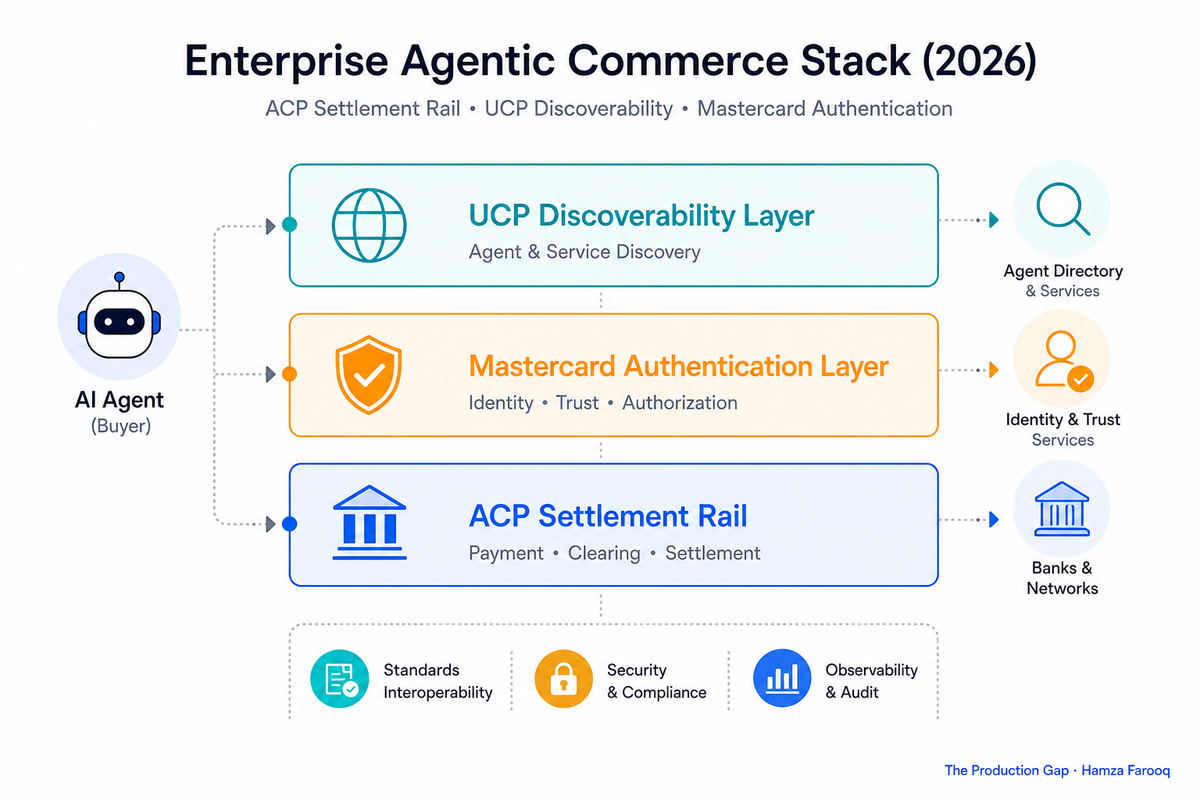
TL;DR: In 2026, three protocol families shape enterprise agentic commerce: ACP governs agent payment authority and checkout, UCP governs product discoverability across AI surfaces, and Mastercard's agentic rules govern transaction authentication. They solve different layers and can run simultaneously. Payments infrastructure teams should implement ACP now; discovery-heavy teams should monitor UCP adoption before committing; both should enroll in Mastercard authentication regardless of protocol choice.
Key takeaways
- ACP and UCP solve different layers: ACP handles payment authority and spend controls; UCP handles cross-platform discovery and merchant interoperability.
- Card networks add authentication on top: Mastercard publishes agent identity and fraud rules that sit above whichever commerce protocol you choose.
- Delegated spend authority is the core risk question: every protocol handles agent purchasing power differently, and caps, liability, and dispute resolution remain unsettled.
- Vendor integrations are already locking in assumptions: waiting to choose a protocol is itself an architectural decision with real switching costs.
- Dispute resolution is still unresolved: no protocol has a mature framework for contested agent transactions, so contractual safeguards are essential now.
- The decision splits by build profile: payments infrastructure teams should move on ACP today; discovery-heavy teams should watch UCP adoption before committing.
Introduction
In 2026, the protocol choice for agentic commerce is already being made by your payment processor, your commerce platform, or your infrastructure vendor, whether or not your team has weighed in. AI agents are now completing purchases autonomously, without waiting for a human to click confirm. Three protocol families govern that infrastructure layer: OpenAI and Stripe's Agentic Commerce Protocol (ACP), Google's Universal Commerce Protocol (UCP), and card network authentication rules from Mastercard.
ACP went live in September 2025. Google announced UCP in 2026. Mastercard has published formal agentic commerce rules. Architectural assumptions are already hardening. Each protocol solves a distinct layer of the same stack, and treating them as direct competitors leaves real gaps unaddressed.
What does each agentic commerce protocol actually solve?
ACP, UCP, and Mastercard's rules solve settlement authority, product discoverability, and transaction authentication respectively. Separating those functions is the prerequisite for any sound architecture decision.
ACP: the settlement and payment authority rail
ACP is a checkout rail, not a discovery tool. Co-developed by OpenAI and Stripe and announced in September 2025, it is an open standard built for programmatic purchases where AI agents act as buyers. The GitHub specification defines an interaction model connecting buyers, their agents, and businesses end-to-end. ACP handles agent authentication, delegated spend authority, and checkout execution. Stripe's Agentic Commerce Suite runs on it as a live product today, making ACP the active option on the table for payments infrastructure teams.
UCP: the discoverability and merchant interoperability layer
Google's UCP is a discoverability rail, not a payment mechanism. Where ACP governs how an agent completes a purchase, UCP governs how products are found, compared, and surfaced across AI-driven environments. It shapes how a catalog appears in AI commerce surfaces; it does not handle payment collection. Enterprise-scale adoption data for 2026 is still forming, which makes early full commitment premature for most teams.
Card network layers: authentication, not full protocols
Mastercard is not building an end-to-end commerce protocol. Mastercard's agentic commerce rules are designed to protect merchants from fraud, provide transparency, strengthen authentication for issuers, and deliver confidence to cardholders in agent-initiated transactions. Those rules authenticate the transaction that ACP or UCP initiates; they do not define merchant onboarding or product discovery. Conflating card network enrollment with protocol selection is the most common architecture mistake enterprises make.
How do ACP, UCP, and card network rules stack, and where do they actually compete?
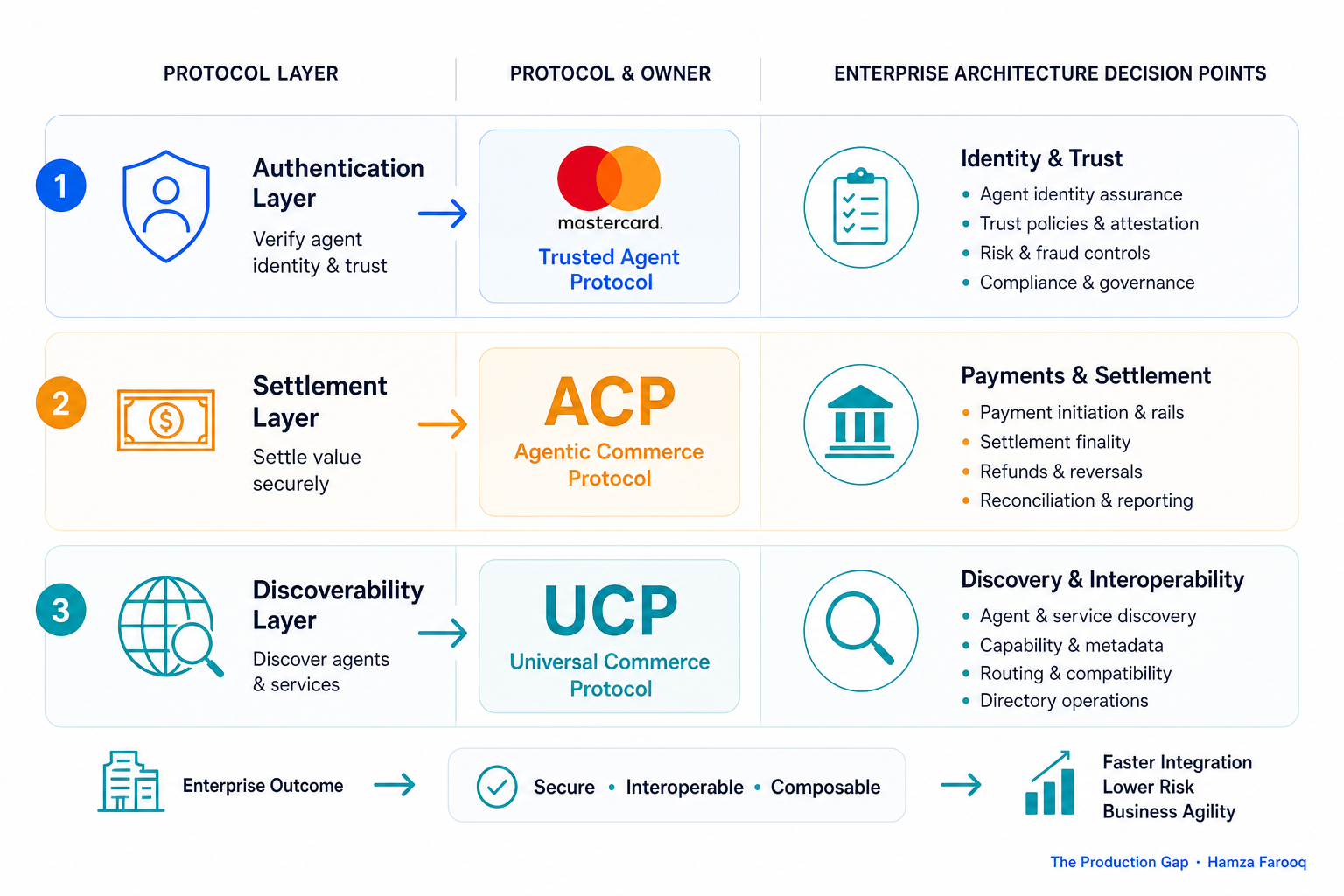
The three layers form what this guide calls the Agent Commerce Stack. As of 2026, the relationships between these layers look as follows:
| Layer | Protocol / Standard | Owner | Primary function | Competes with |
|---|---|---|---|---|
| Authentication and fraud | Mastercard agentic rules | Mastercard | Agent identity verification, fraud controls | No direct competitor at this layer |
| Settlement and payment authority | ACP | OpenAI / Stripe | Programmatic checkout, spend limits | UCP (merchant onboarding overlap) |
| Discoverability and interoperability | UCP | Cross-platform product discovery | ACP (merchant onboarding overlap) |
The genuine competition between ACP and UCP is narrow. Both claim the merchant onboarding relationship: who owns the agent-to-business handshake, the catalog integration, and session initiation. That is the real either/or decision for merchant-facing surfaces. Everywhere else, stacking is the right architecture. An enterprise can use ACP for checkout, expose its catalog via UCP, and enroll in Mastercard's authentication flow simultaneously. Single-protocol bets leave gaps that a stacked architecture closes.
What is the right enterprise decision framework for agentic commerce protocols in 2026?
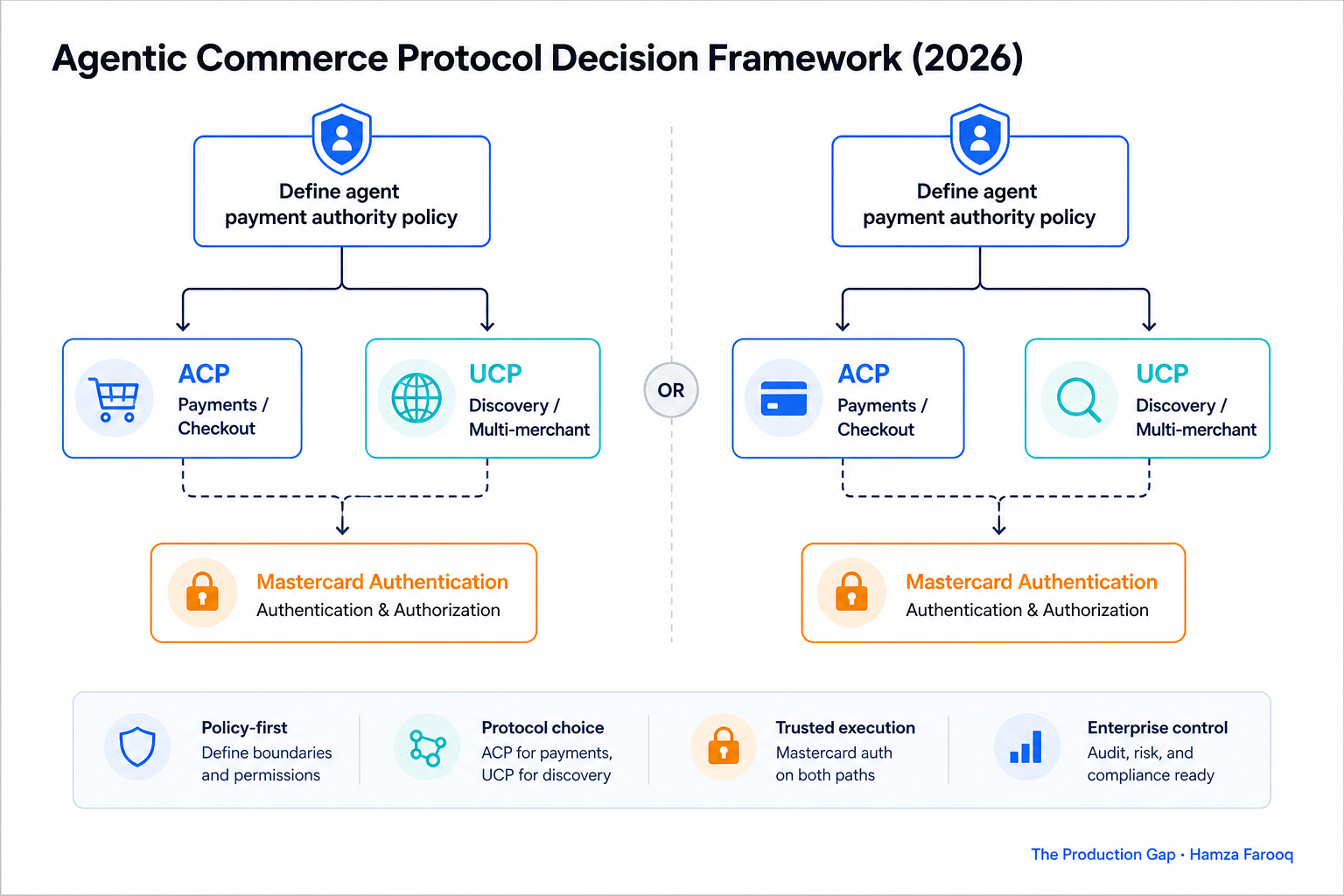
The right framework, as used in this guide, starts by categorizing your build profile as either payments infrastructure or discovery-heavy, and then maps protocols to that profile rather than choosing a single protocol to cover all layers. Define your internal agent payment authority policy first, then map protocols to the layers that policy requires, not the reverse.
Delegated spend authority is the core risk variable
ACP explicitly models delegated authority: spend permission scoped by the enterprise with defined limits. Mastercard's rules authenticate that authority at the network level. No current protocol has a mature dispute resolution framework for contested agent transactions. This is the single largest unresolved risk in the current landscape and must be addressed explicitly in every architecture review.
The decision splits by build profile
If you run checkout or payments infrastructure: implement ACP now. Stripe's Agentic Commerce Suite is live, the developer ecosystem at agenticcommerce.dev is active, and switching costs are already accumulating.
If you are building multi-merchant or discovery-heavy surfaces: watch UCP adoption before committing engineering resources. Google's UCP is live, but enterprise-scale adoption data is still forming.
For both profiles: enroll in Mastercard's agent authentication program regardless of protocol choice. Authentication is not optional and it is protocol-agnostic.
Until dispute resolution frameworks mature, negotiate explicit contractual language governing agent transaction liability with payment processors. No protocol solves this yet.
FAQ
What is the difference between ACP and Google's Universal Commerce Protocol (UCP)? ACP is a settlement and payment authority protocol governing how an agent authenticates and completes a purchase; UCP is a discoverability standard governing how products are found across AI platforms. ACP details are available via the GitHub specification and UCP details via Google's announcement. They solve different layers and can run simultaneously.
Can an enterprise implement ACP and UCP simultaneously? Yes. ACP handles checkout and payment authority while UCP handles product discoverability. The only genuine overlap is merchant onboarding, where enterprises must decide which protocol owns the agent-to-merchant relationship.
Who is liable when an AI agent completes a transaction the user later disputes? No protocol has a mature dispute resolution framework for this yet. Liability currently falls to existing card network chargeback rules and enterprise contracts with payment processors. Negotiate explicit agent transaction liability language before deploying at scale.
How does Mastercard's agentic commerce authentication interact with ACP? Mastercard's rules operate at the authentication layer above the settlement rail. Enterprises using ACP for checkout can also enroll in Mastercard's agent authentication; the two work together, not against each other.
Conclusion
ACP owns settlement and agent payment authority. UCP owns discoverability. Mastercard owns authentication. None is optional in a full-stack deployment, and none substitutes for another.
The gap that warrants the most attention is dispute resolution. Delegated authority scoping has no mature answer yet. That is not a theoretical problem but a contractual one that will surface the first time an agent completes an unintended purchase.
Learn from me
Agentic AI for Product Managers, my Maven cohort. Learn how to design, evaluate, and ship reliable AI systems: the technical fluency PMs need to lead agentic products, no engineering background required. Join the next cohort →
Hire us
Traversaal.ai. We're a team of forward deployed engineers solving the toughest AI problems for Fortune 100 companies: document intelligence, agentic data platforms, and real-time web intelligence, deployed in production. Work with our team to deploy your next agentic ecosystem. Talk to Traversaal.ai →
Join us
Want to solve these problems with us? We're always looking for forward deployed engineers who want to ship production AI. jobs@traversaal.ai