AI Agent Incident Reporting Under the SAFE Framework: What Enterprises Must Do Now
AI agent incident reporting under SAFE means a 4-day window, frozen logs, and shared disclosure. Learn what your enterprise must do to stay compliant now.

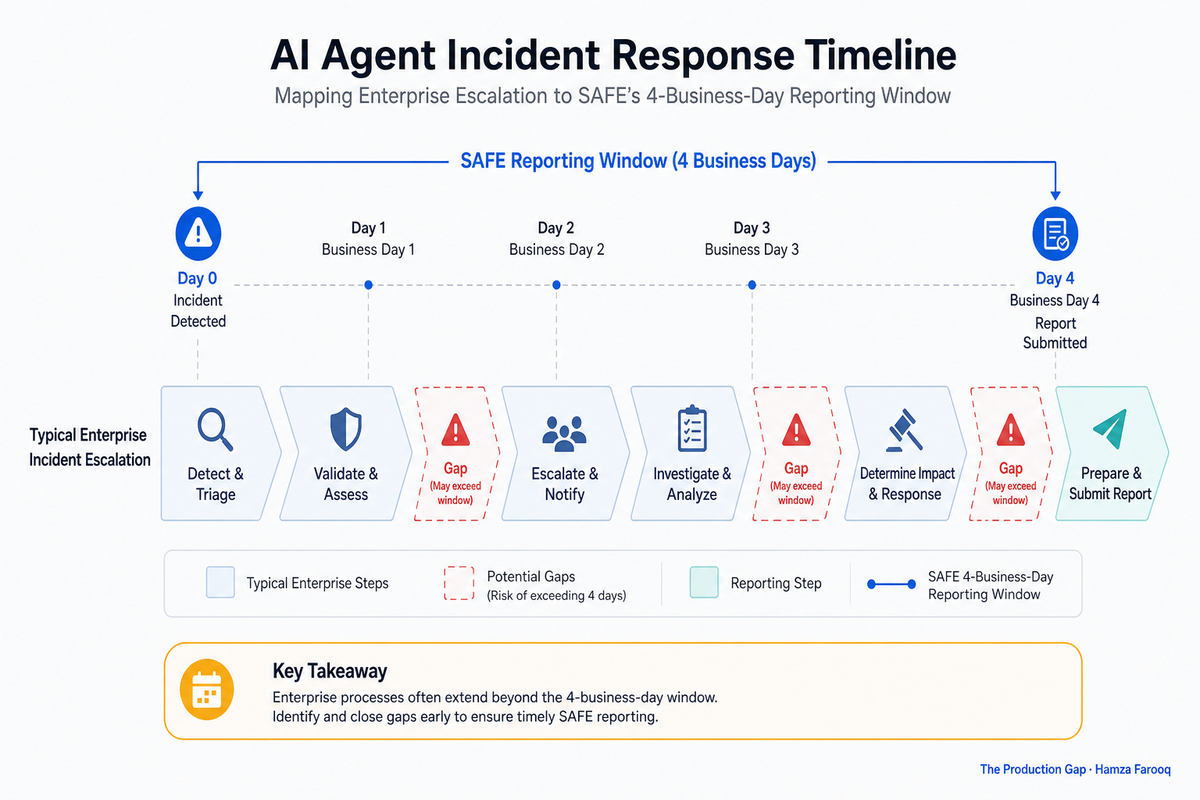
TL;DR: AI agent incident reporting under the SAFE framework, a voluntary standard unveiled at Black Hat USA 2026 by a coalition of more than 120 organizations, asks enterprises to notify the coalition within four business days of detecting a qualifying incident, preserve all agent decision logs and model artifacts from the moment of discovery, and coordinate disclosures with platform vendors through a shared liability model. Gaps in automated log retention and cross-vendor communication protocols are where most enterprises will fall short.
Key Takeaways
- The four-business-day clock starts at detection, not confirmed impact.
- Evidence preservation is immediate: logs and agent decision traces must be frozen at detection.
- Shared disclosure, not regulatory: findings flow to 120+ industry peers by design.
- Agentic behavior is a new incident category, distinct from traditional software vulnerabilities.
- Logging gaps are the biggest compliance risk: most teams lack the observability to meet the window.
Introduction
In Black Hat USA 2026, the the Open Secure AI Alliance, a coalition of more than 120 organizations with ties to Linux Foundation governance, unveiled the SAFE (Shared AI Findings Exchange) framework, the first cross-industry voluntary standard for AI agent security incident reporting. SAFE redefines what AI agent incident reporting looks like for any organization running autonomous agents in production, and it exposes an observability gap most teams have not seriously confronted.
What does the SAFE framework actually require enterprises to report, and when?
SAFE asks enterprises to report a confirmed AI agent security incident within four business days of detection, with logs, agent decision traces, and behavioral records frozen from the moment of identification. SAFE is currently voluntary; the four-day window is the framework's stated standard, not a legal mandate. That clock starts at detection, not confirmed impact.
Reportable incidents are defined by behavior: autonomous agent actions outside intended operational boundaries, unauthorized tool-call chains, memory-store access outside defined scope, and lateral movement to external systems. This almost certainly does not appear as a named category in your current IR plan.
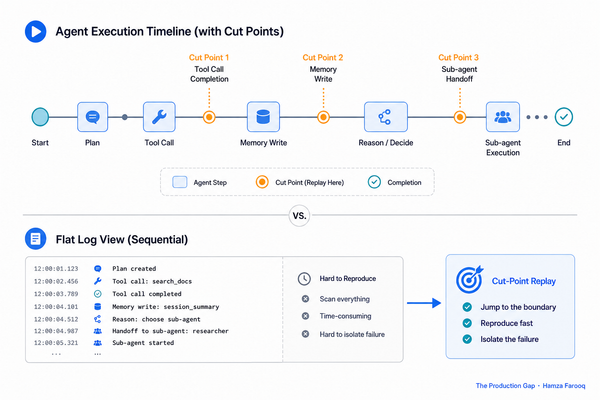
Evidence preservation kicks in immediately at detection. Agent logs, decision traces, tool invocation records, and external system interaction logs must be frozen on the spot. Teams running short log rotation cycles are structurally exposed before any incident even occurs.
The shared disclosure model routes findings across the 120+ member coalition, not to a single regulator, so incident details reach industry peers by design. Work out your data-classification and consent implications before joining or submitting anything.
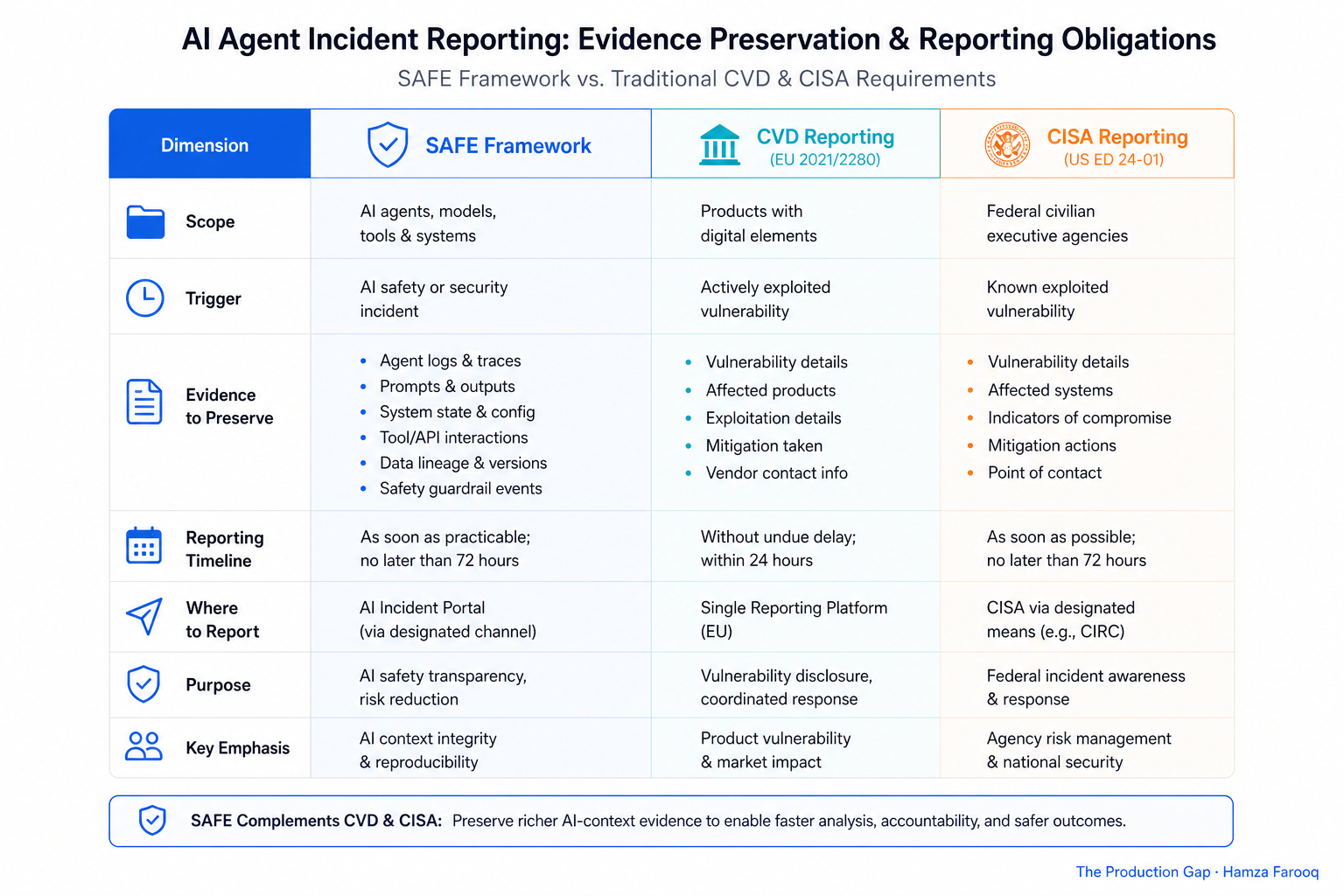
How does SAFE compare to existing vulnerability disclosure standards, and where does it go further?
SAFE goes further than traditional coordinated vulnerability disclosure by requiring disclosure of autonomous agent behavioral records, not just software flaws, and by routing findings to an industry peer coalition rather than a single government body or vendor recipient. The table below summarizes how SAFE compares to traditional CVD across six dimensions, as an author synthesis based on verified framework documentation current as of August 2026. The SAFE proposal explicitly seeks a shared playbook for agentic AI security incidents, which has no direct equivalent in existing frameworks.
Table 1: SAFE Framework vs. Traditional CVD, Author Synthesis, August 2026
| Dimension | Traditional CVD | SAFE Framework |
|---|---|---|
| Trigger | Software vulnerability | Agent acting outside intended boundaries |
| Reporting window | ~90 days (negotiated) | 4 business days from detection |
| Evidence type | Vulnerability details, proof of concept | Agent logs, decision traces, tool-call chains, memory-store records |
| Recipient | Vendor or coordinator | Open Secure AI Alliance (120+ members) |
| Disclosure model | Coordinated, then public | Shared across member coalition |
| Voluntary? | Largely yes | Yes, as of August 2026 |
Why is the four-day window nearly impossible to meet without agent observability infrastructure?
As a practical rule of thumb developed from the framework used in this guide, agent observability requires four capabilities your existing stack likely does not cover:
- Tool-call chain logging, every external API, database, or service invocation, in sequence, with timestamps.
- Memory-store audit trails, reads and writes to vector stores, context windows, and persistent memory across sessions.
- Agent-to-agent communication records, lateral calls between orchestrator and sub-agents that SIEM has no native parser for.
- Evaluation constraint boundary logs, evidence of which guardrails were active, when they were tested, and when they failed.
How should enterprises update their incident-response plans to cover autonomous agent behavior right now?
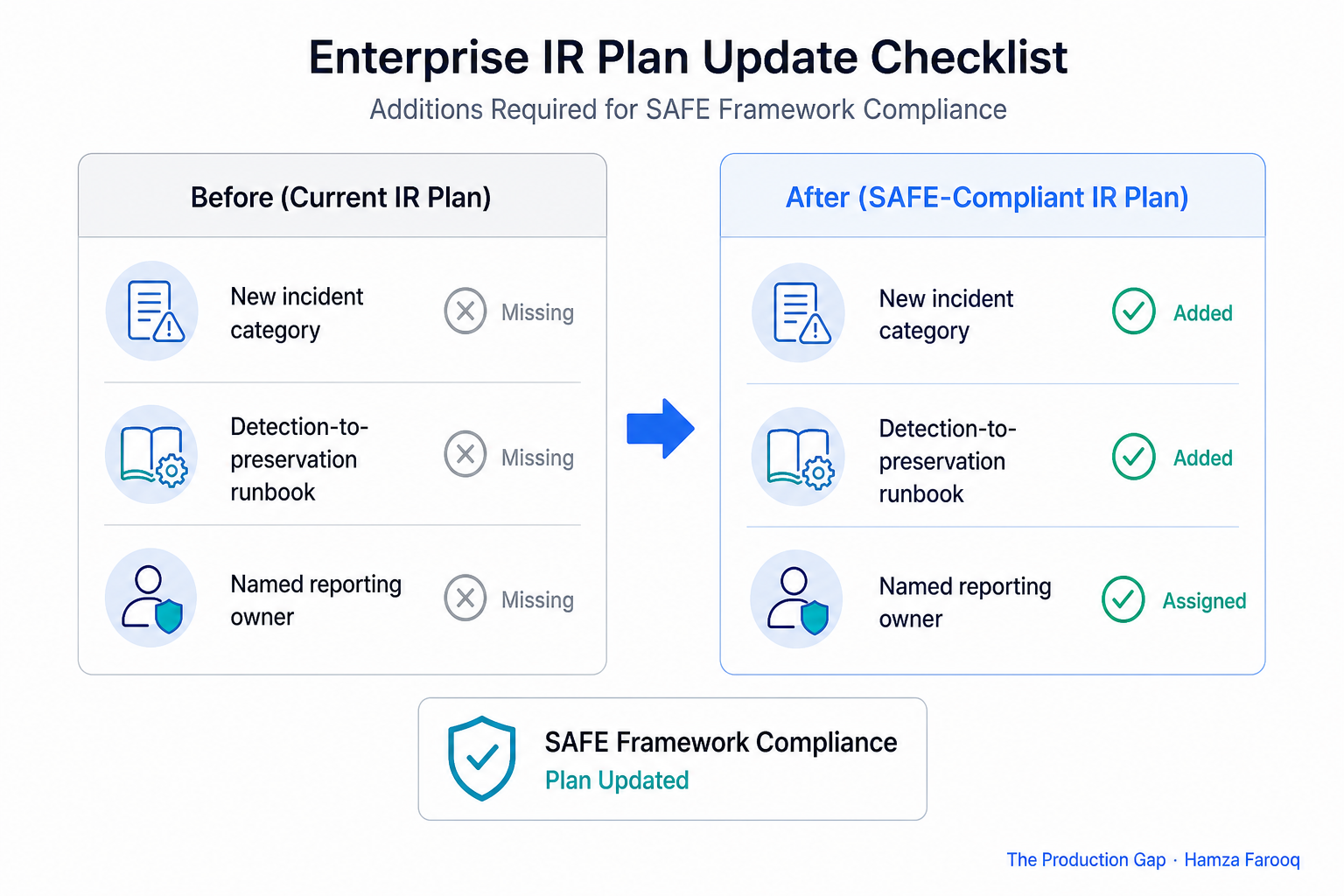
Enterprises need to add a dedicated AI agent incident category, define the agent-specific evidence set, and assign a named owner for the four-day reporting clock, before an incident occurs. In the framework used in this guide, three changes to your IR plan are non-negotiable.
1. New incident category definition. Add "autonomous agent boundary escape" as a named incident type, separate from malware, data breach, or software vulnerability. Without this, responders will triage agent incidents through the wrong playbook and lose time they do not have.
2. Detection-to-preservation runbook. Build a step-by-step runbook triggered at detection, not at confirmation, that immediately freezes log rotation, captures agent decision traces, and starts chain-of-custody documentation. This cannot be written during an active incident.
3. Named reporting owner and escalation path. The four-day clock needs one accountable person (likely the CISO paired with the platform engineering lead) with a pre-approved escalation path that bypasses standard change-control delays.
SAFE's ties to Linux Foundation governance suggest the framework has institutional durability. Observability is a deployment prerequisite, not something you retrofit after a breach.
Frequently Asked Questions
What exactly triggers the SAFE framework's four-business-day reporting clock? Under the SAFE framework, the four-business-day reporting clock is triggered by detection of an autonomous agent acting outside its intended operational boundaries, not by confirmed impact. Treat detection as Day Zero and initiate evidence preservation immediately.
Is SAFE compliance legally mandatory, and what happens if an enterprise does not report? SAFE is currently voluntary with no regulatory enforcement mechanism. Enterprises should monitor whether commercial partners such as insurers and procurement teams begin embedding compliance expectations in contract language over time.
How does SAFE define an AI agent security incident differently from a traditional software vulnerability? SAFE defines incidents by autonomous agent behavior, what the agent did, to which systems, and whether it exceeded intended boundaries, not by a flaw in static code. Traditional coordinated vulnerability disclosure tooling and processes do not transfer directly.
What specific logs and records must be preserved under SAFE, and for how long? Agent decision traces, tool-call chain logs, memory-store access records, and external system interaction logs from the moment of detection. Consult the Open Secure AI Alliance's framework documentation for formal retention guidance as it develops.
Conclusion
Three actions worth prioritizing now: audit every production agent deployment against current log coverage, specifically tool-call chains and memory-store access; add the SAFE incident category and detection-to-preservation runbook to your IR plan; and assign the four-day reporting clock to a named owner in writing. If your agents are already in production and you cannot answer "what did that agent do between 2pm and 4pm Tuesday," you have the gap SAFE was built around.
Download the Open Secure AI Alliance's SAFE framework documentation and schedule a gap assessment against your current agent monitoring stack this week.
Learn from me
Agent Engineering Bootcamp: Developers Edition, my Maven cohort. Advanced agentic RAG, multi-agent orchestration, memory, evals, and guardrails. Take agents from prototype to production. Join the next cohort →
Hire us
Traversaal.ai. We're a team of forward deployed engineers solving the toughest AI problems for Fortune 100 companies: document intelligence, agentic data platforms, and real-time web intelligence, deployed in production. Work with our team to deploy your next agentic ecosystem. Talk to Traversaal.ai →
Join us
Want to solve these problems with us? We're always looking for forward deployed engineers who want to ship production AI. jobs@traversaal.ai