AI agent pricing credits: what PMs should copy and avoid from HubSpot's seats-and-credits pilot
HubSpot's seats-and-credits pilot shows 2x to 3x credit use but also a warning that credits may replace seat spend. Here is what PMs should copy and avoid.

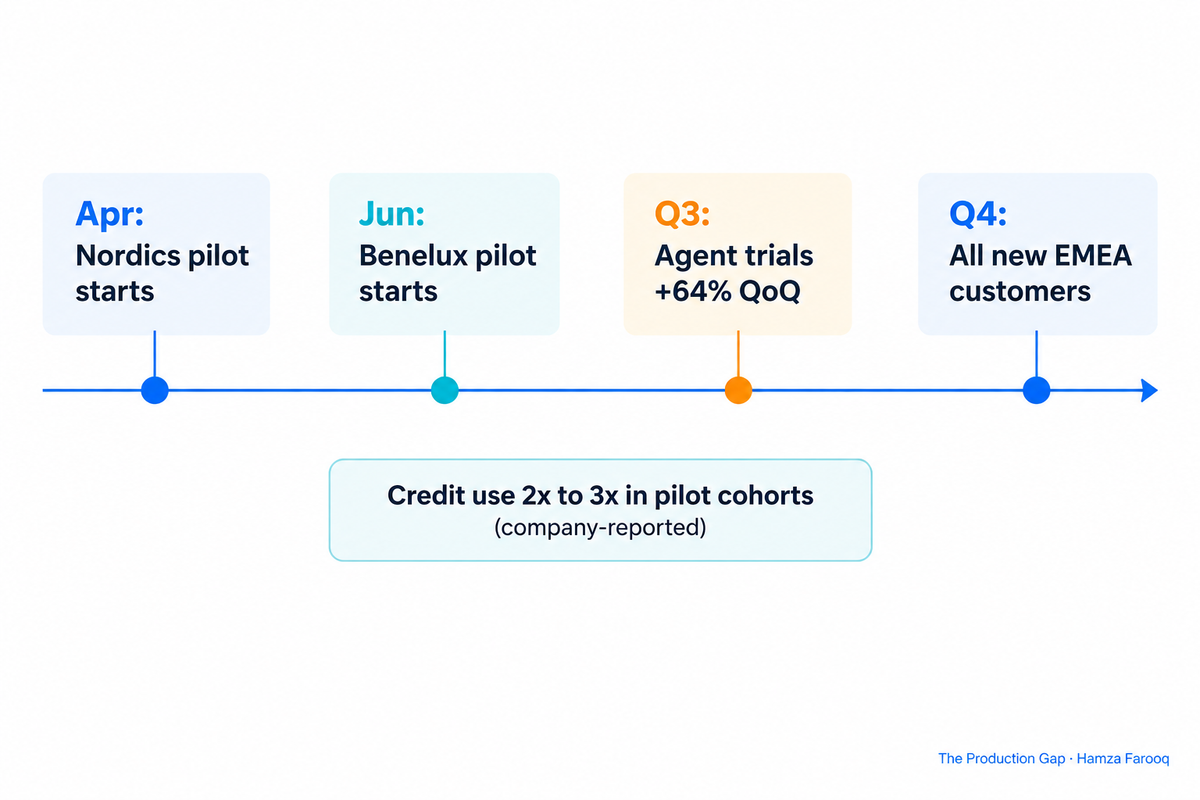
HubSpot's seats-and-credits pilot is an early public test of how to price AI agents, and its first results cut both ways. The company reports credit consumption of 2x to 3x in pilot cohorts and agent trials up 64% quarter over quarter, yet its own quarterly report warns that credit spend may replace seat spend and that credits-based and outcome-based pricing have lengthened sales cycles. For a PM, the lesson is to copy the hybrid structure and the free proof of value, and to avoid launching without a model of cannibalization and deal length.
TL;DR: HubSpot paired seats with usage credits in the Nordics and Benelux, then extended the pilot to all new EMEA customers. Credit use ran 2x to 3x higher and agent trials rose 64% in a quarter. The same quarterly report warns credits may substitute for seat spend and lengthen sales cycles. Copy the hybrid model and the trials. Model cannibalization and deal length before you ship, and treat vendor-reported figures as claims.
Key Takeaways
- HubSpot is betting on a hybrid: its stated vision is a hybrid of seats and credits, but no source shows yet that a hybrid earns more than pure usage pricing.
- Usage is not the same as revenue: credit consumption of 2x to 3x says customers use the agents, and says nothing yet about whether total spend rose.
- Cannibalization is a disclosed risk: the quarterly report says credit spend may substitute for, rather than add to, existing seat spend.
- Pricing changes slow deals: HubSpot says credit-based and outcome-based pricing have lengthened sales cycles, so forecast longer cycles.
- Trials show interest, and buyers want proof: agent trials grew 64% quarter over quarter, and HubSpot says buyers want proof of AI value before buying.
What did HubSpot's seats-and-credits pilot actually show?
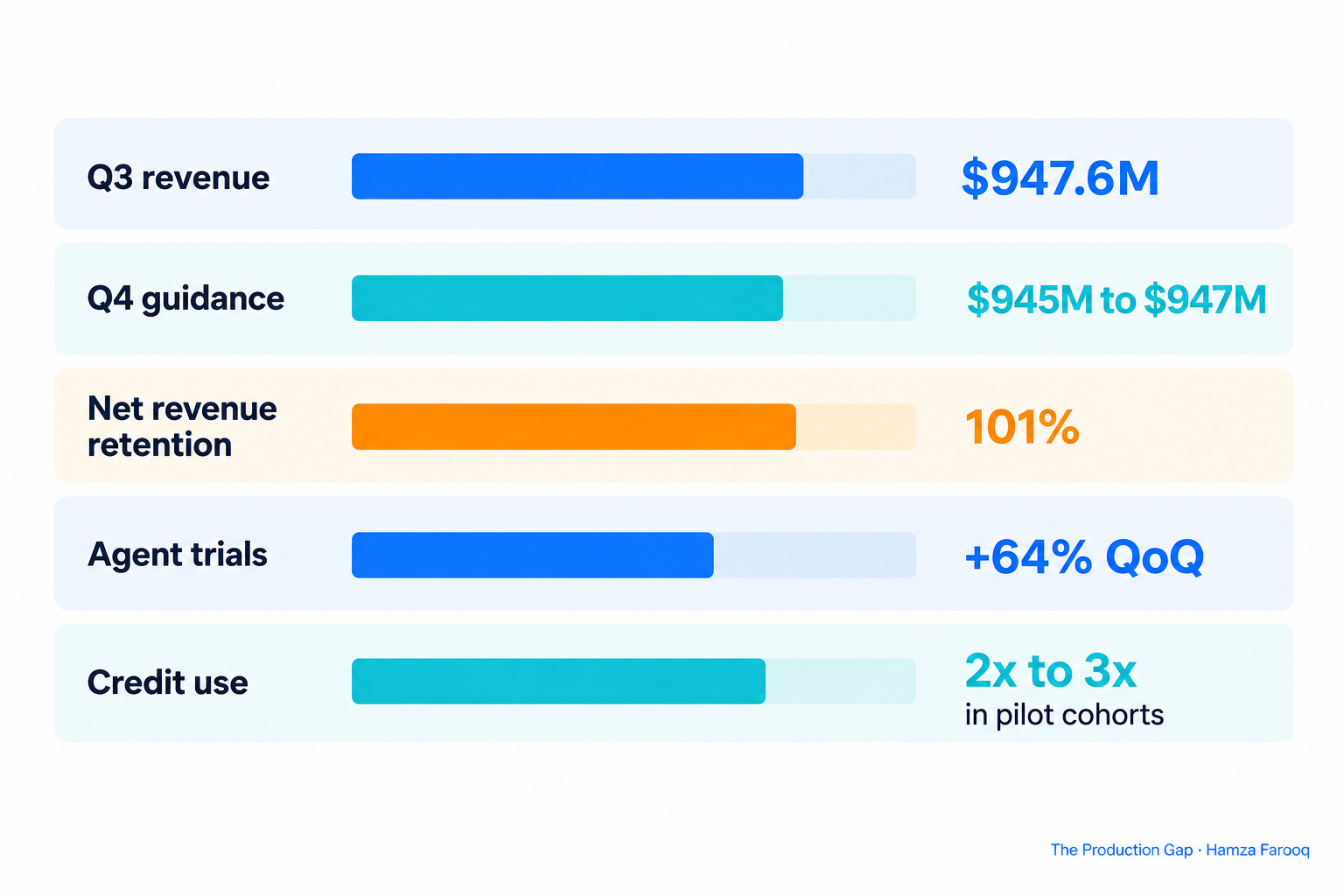
The pilot showed strong credit usage and growing trial interest, but the company has not yet shown that the new model raises total revenue. According to PPC Land's report on the quarter, the pilot began in the Nordics in April and in Benelux in June, and agent trials grew 64% quarter over quarter in the third quarter. On the earnings call, CEO Yamini Rangan said the company has seen 2x to 3x more credit consumption in the pilot cohorts, and that in Q4 it expanded the pilot to all of EMEA for new customers only.
The wider numbers are less rosy. HubSpot's November 4 press release reports Q3 revenue of $947.6 million, up 17%, and guides Q4 to a range of $945.0 million to $947.0 million. That range sits about $1.6 million below Q3 at the midpoint and implies roughly 12% growth, according to PPC Land. Net revenue retention was 101%, according to the CFO on the earnings call.
These are company-reported figures. I also could not open HubSpot's own quarterly filing, so the risk language below is quoted through PPC Land. Treat the pilot as an early signal about behavior, not proof about revenue.
Why does credit spend replacing seat spend matter to a PM?
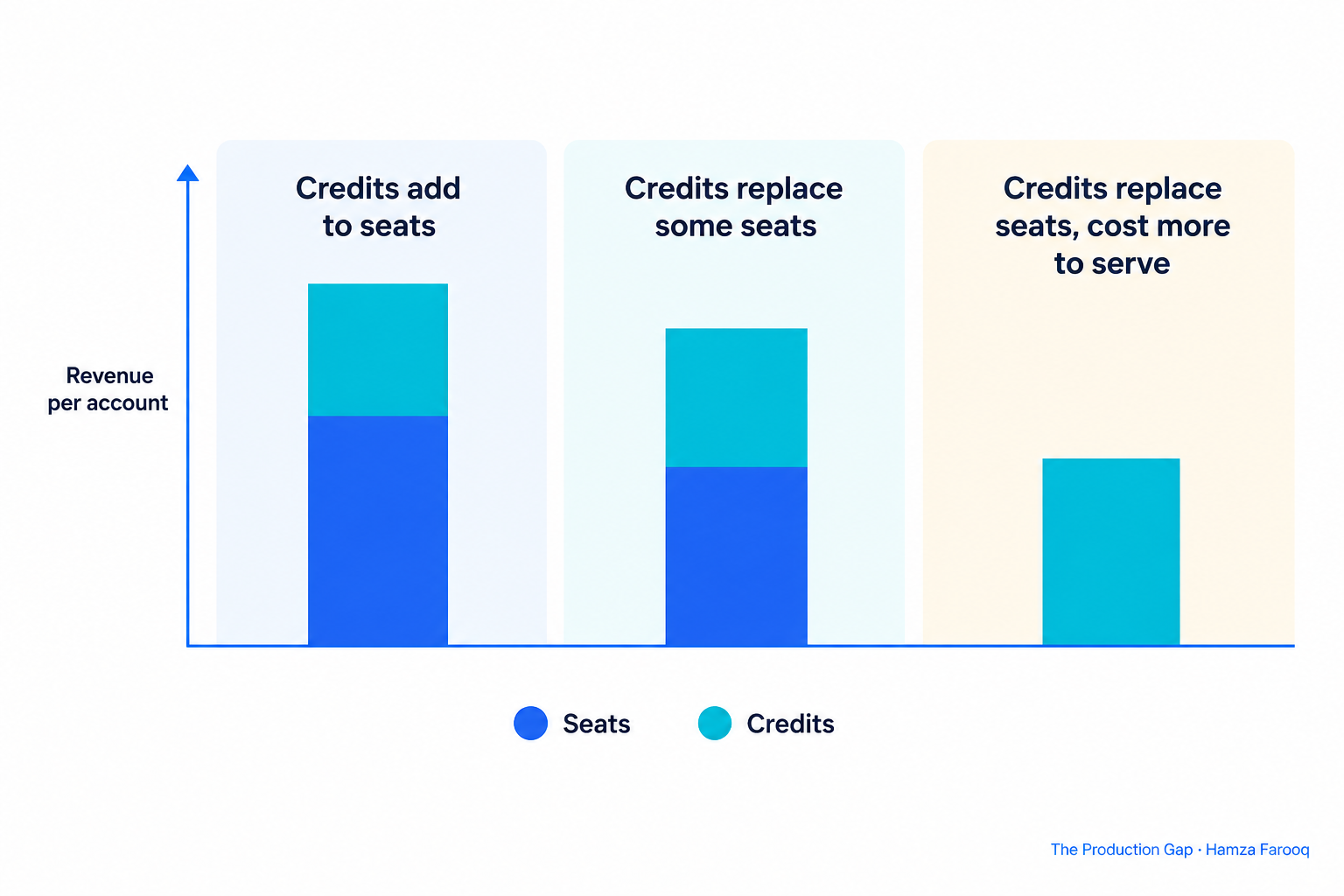
If credits replace seats instead of adding to them, higher usage can coexist with flat or falling revenue per customer. The quarterly report, as quoted by PPC Land, warns that credit spend may substitute for, rather than add to, existing seat and hub spend.
My analysis, not HubSpot's: a seat price pays for a human to log in, and an agent works without logging in, so a team that deploys agents may need fewer seats. If the credit price per task is lower than the seat cost it displaces, the customer saves money and the vendor loses it.
So 2x to 3x credit usage is ambiguous on its own. It could be paid agent work replacing manual work, which is expansion. It could also be bundled or discounted credits, which is a cost to you. Combined seat and credit revenue per account, compared with a matched group on the old plan, settles it. HubSpot has not published that comparison.
Did free agent trials lengthen HubSpot's sales cycle?
HubSpot says credits-based and outcome-based pricing have lengthened sales cycles, and it also introduced free agent trials in the same period, but I found no source that ties longer cycles to the trials alone. On the call, Rangan said the company introduced free trials and pricing tied to value and outcomes, and CFO Kathryn Bueker said that upmarket, HubSpot is seeing more decision-makers and longer sales cycles.
A Yahoo Finance summary of the call adds a buyer-side reason: customers want proof of AI value in their own environment before buying, which is extending buying cycles. None of these sources says how much of the delay comes from trials, from credits, or from selling to larger buyers. HubSpot does not break out the cause. One possibility, which is my reading and not a HubSpot statement, is that a credit pool needs a usage forecast, a budget owner and a cap, while a seat price fits an existing procurement line.
What should PMs copy and avoid when packaging AI agents?
| Design choice | What HubSpot reports | Risk named or implied | PM action |
|---|---|---|---|
| Hybrid of seats and credits | Stated vision is a hybrid model | Credits may substitute for seat spend | Track combined seat and credit revenue per account |
| Regional pilot | Nordics in April, Benelux in June, then all new EMEA customers in Q4 | Pilot regions may not represent your base (my analysis) | Pilot in a few segments and compare to a control group |
| New customers only for the wider rollout | EMEA expansion applies to new customers only | Results come from new customers, not the installed base | Keep cohorts separate when you read results |
| Free agent trials | Agent trials up 64% quarter over quarter | Buyers want proof of AI value before buying, which HubSpot says extends buying cycles | Set a trial length and success criteria up front |
| Credits and outcome pricing | Credit use 2x to 3x in pilot cohorts | Filing says these strategies have lengthened sales cycles | Add buffer to the forecast for priced-by-usage deals |
The expansion applies to new customers only, so the results say little about how credits behave inside the installed base.
How should a PM model the trade-off before launch?
Model three scenarios for the same account, additive, substitutive and cost-heavy, and decide in advance which one triggers a pricing change. Write the formula down: net change in account revenue equals new credit revenue minus the seat revenue that goes away, minus any discounts or free credits you grant.
Then set review points: combined revenue per account against a matched group on the old plan, the share of credits that are free or bundled, and days from first trial to signed contract. Give credits a floor and a cap. A floor keeps a predictable base, and a cap lets a finance owner approve a budget, which may ease the longer conversations HubSpot describes.
Frequently Asked Questions
What is HubSpot's seats-and-credits pricing pilot?
It is a test of a hybrid price that combines per-user seats with usage credits for AI agents. According to PPC Land, it began in the Nordics in April and in Benelux in June, and in Q4 it expanded to all new EMEA customers. HubSpot describes the vision as a hybrid model of seats and credits.
Are credits better than seats for pricing AI agents?
Neither wins alone. Seats give predictable revenue but charge for humans, while credits track agent work but make revenue less predictable. HubSpot chose a hybrid, so measure combined revenue per account.
How much did credit usage rise in HubSpot's pilot?
The CEO said the company has seen 2x to 3x more credit consumption in the pilot cohorts. That is a vendor-reported usage figure and does not show whether total spend per customer rose.
Do free trials slow down AI product sales?
HubSpot has not said. It reports longer sales cycles from credits-based and outcome-based pricing, and says buyers want proof of AI value before buying, but no source ties the delay to trials alone.
Conclusion
Package AI agents as a hybrid of a seat base and usage credits, offer a trial with clear success criteria, and expect longer deals. Before launch, decide how you will detect cannibalization and what you will change if credits replace seats. HubSpot's pilot shows demand for agents, not yet that the pricing grows revenue, so build your own measurement.
Learn from me
Agentic AI for Product Managers, my Maven cohort. Learn how to design, evaluate, and ship reliable AI systems: the technical fluency PMs need to lead agentic products, no engineering background required. Join the next cohort →
Hire us
Traversaal.ai. We're a team of forward deployed engineers solving the toughest AI problems for Fortune 100 companies: document intelligence, agentic data platforms, and real-time web intelligence, deployed in production. Work with our team to deploy your next agentic ecosystem. Talk to Traversaal.ai →
Join us
Want to solve these problems with us? We're always looking for forward deployed engineers who want to ship production AI. jobs@traversaal.ai