The AI Agent RFP Checklist: 8 Categories Enterprise Procurement Must Evaluate in 2026
AI agent RFP checklist for 2026: evaluate vendors on security, autonomy, audit logs, and cost controls before you sign—not after deployment goes wrong.

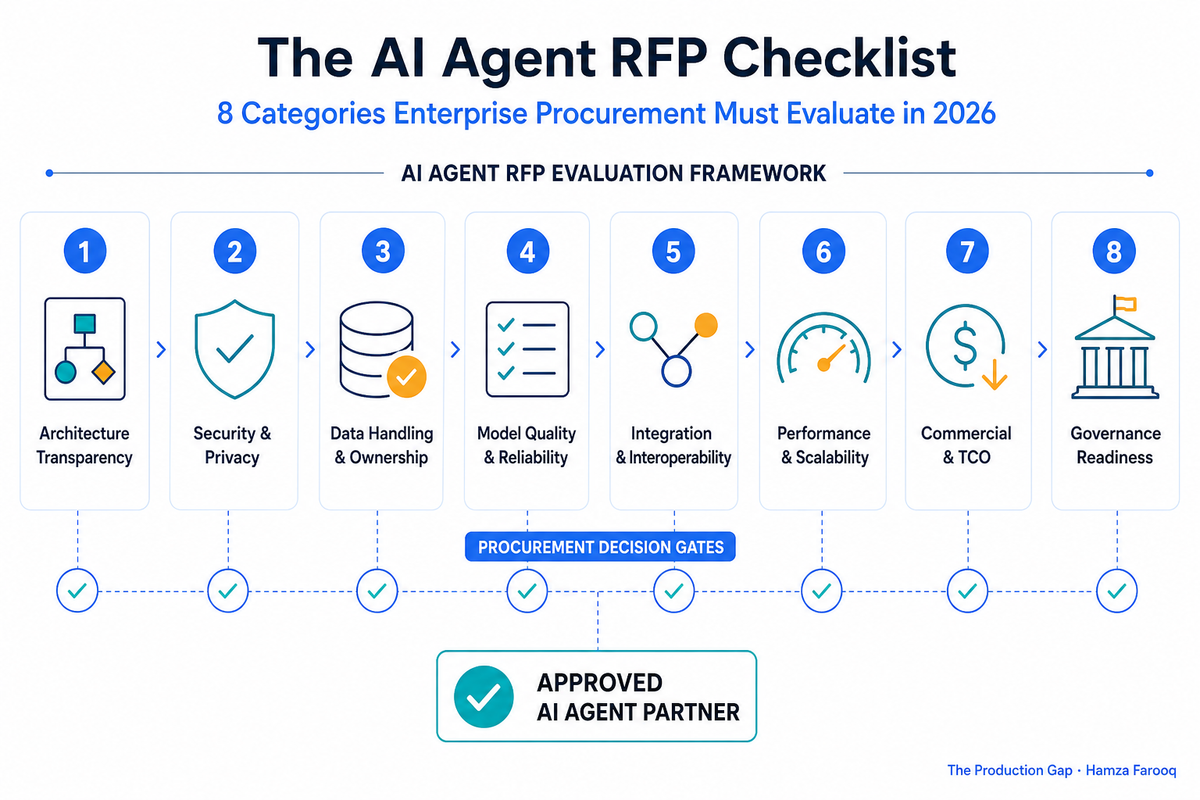
TL;DR: An AI agent RFP checklist for 2026 enterprise procurement must cover eight categories: autonomy boundaries, tool and API integration, memory and state management, observability, security and compliance, human-in-the-loop controls, cost and latency benchmarks, and vendor accountability. Evaluating vendors against testable criteria in each category replaces marketing claims with verifiable evidence and shortens the path to governed production deployment.
🔑 Key Takeaways
- Eight categories beat gut instinct: A structured checklist gives procurement teams concrete evidence instead of sales pitches.
- Kill-switch controls are non-negotiable: Every deployment needs a documented, testable override before harm or runaway spend occurs.
- Data residency carries legal weight: Data location is a compliance requirement, not a preference.
- Loop-spend limits belong in the contract: Cost caps and loop-termination clauses must be written into vendor agreements before signing.
- Audit logs make governance provable: Immutable, time-stamped, exportable logs must be built in from day one.
- Benchmark reproducibility exposes vendor hype: If you cannot recreate results in your own environment, those numbers do not count.
Introduction
This guide presents eight testable procurement categories drawn from verified enterprise AI agent evaluation practice. Deployment model, data residency, RBAC, and audit logging are baseline non-negotiables for any governed production deployment.
What are the eight core categories every AI agent RFP must cover?
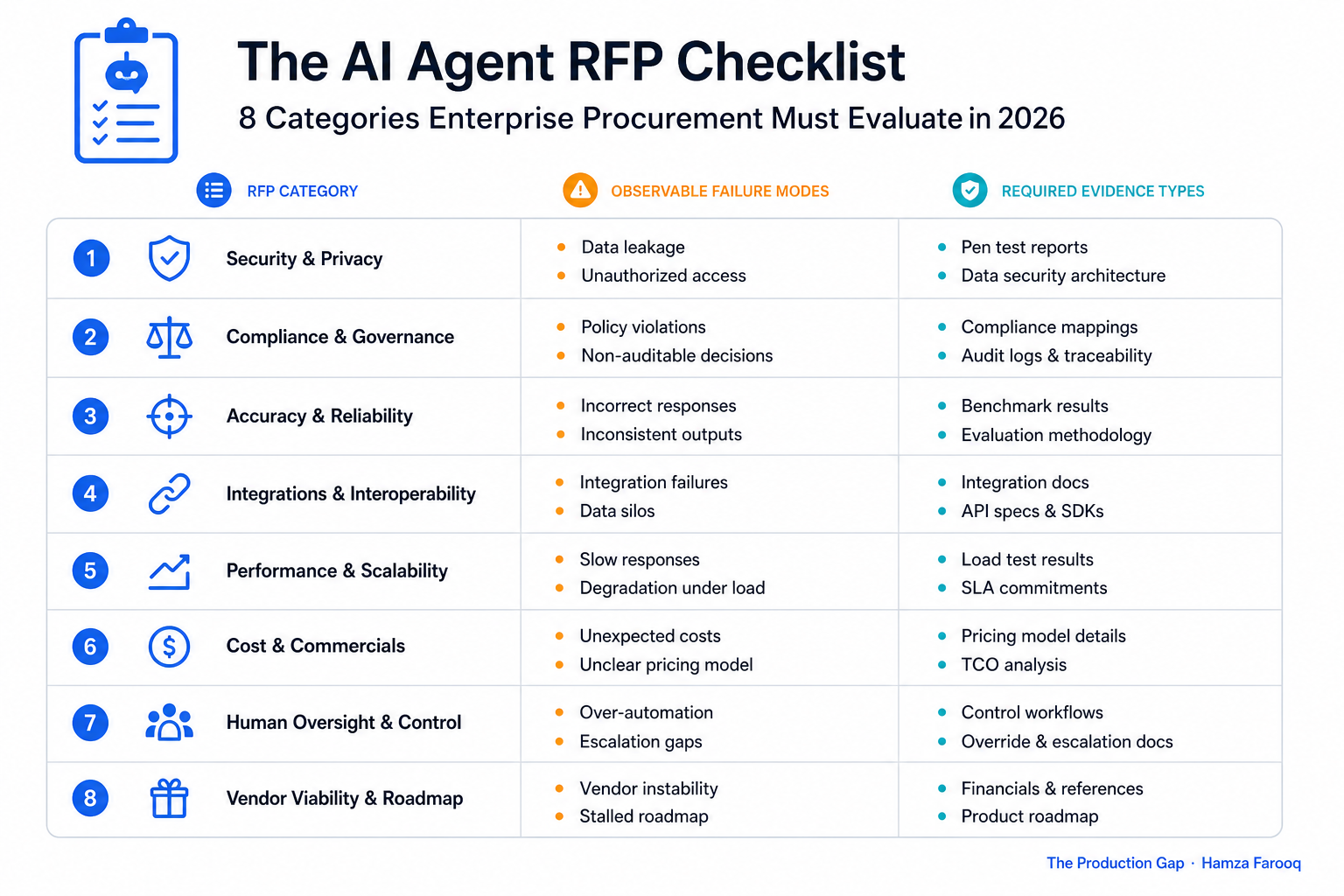
Eight categories form the foundation of this guide's evaluation framework: architecture transparency, security and access controls, data residency and sovereignty, evaluation and benchmark reproducibility, cost model and loop-spend limits, audit logging and compliance traceability, human-in-the-loop override mechanisms, and multi-agent orchestration visibility.
Each category maps to a real failure mode. Architecture opacity causes cascading failures. Missing RBAC enables privilege escalation. Absent cost caps expose organizations to runaway loop spend. Procurement teams should treat this as a buyer-controlled pre-qualification harness, not a checklist handed to a vendor to self-certify.
| # | Category | Core RFP question | Failure mode prevented | Buyer-controlled evidence artifact |
|---|---|---|---|---|
| 1 | Architecture transparency | Can you show full agent call graphs? | Cascading orchestration failure | Live architecture diagram plus tool-call logs |
| 2 | Security and RBAC | How is least-privilege enforced per agent role? | Privilege escalation | RBAC policy doc plus red-team report |
| 3 | Data residency and sovereignty | Where does data rest, process, and transit? | Regulatory violation | Data flow diagram plus DPA |
| 4 | Eval and benchmark reproducibility | Can we re-run your benchmarks in our environment? | Inflated vendor claims | Reproducible eval harness |
| 5 | Cost model and loop-spend limits | What hard caps exist on agent loop iterations? | Unbounded compute spend | Contract cost cap clause |
| 6 | Audit logging and compliance | Are logs immutable, time-stamped, and exportable? | Governance gap | Sample log schema plus retention policy |
| 7 | Human-in-the-loop override | What is the documented kill-switch procedure? | Unchecked harmful action | Override runbook plus test result |
| 8 | Multi-agent orchestration visibility | How are inter-agent dependencies mapped? | Silent task-chain failure | Orchestration topology plus failure playbook |
Every item in the "Buyer-controlled evidence artifact" column should be in hand before a live pilot begins, not after.
Which three categories carry the highest legal and operational risk in 2026?
Data residency and sovereignty, human-in-the-loop override controls, and audit logging carry the highest risk because failures in any of them can produce direct regulatory and compliance consequences under emerging AI governance requirements.
Data residency makes data location a compliance requirement, not a preference. Demand a data flow diagram covering prompt data, retrieved context, tool outputs, and model inference, not just the primary database location. Air-gapped deployment support is a separate, explicit question, and vague answers are a disqualifying signal.
Human-in-the-loop override is not a product feature. It is a documented, testable procedure. Require vendors to demonstrate override activation during pre-pilot evaluation under a realistic failure scenario. A vendor who can only describe the kill-switch verbally has not met the requirement.
Audit logging must capture agent intent (the instruction), action (the tool call), and outcome (the result). System-level HTTP request logs alone do not clear the bar.
Consider what happens when an agent authorized to submit purchase orders encounters a timing-out API. Without a tested override and a complete audit trail, the organization cannot prove the sequence of events to its own finance team, let alone a regulator. A vendor who cannot produce a live kill-switch demonstration and an exportable sample log schema before contract signature has presented disqualifying gaps.
Why is benchmark reproducibility the hidden differentiator in agentic AI vendor selection?
Vendor benchmarks frequently run on curated datasets that do not reflect buyer environments, making replication a pre-contract requirement, not an optional step.
Build three to five realistic task scenarios from actual organizational use cases before the first vendor demo. Include at least one adversarial case: an ambiguous instruction, conflicting tool outputs, or a permission boundary the agent should not cross. AI agents capable of genuine evaluation read RFP requirements by understanding context rather than matching keywords; buyers should apply the same standard in reverse when testing vendors.
Require vendors to provide the exact dataset and prompt set used in published benchmarks, the infrastructure specifications, and written consent to buyer-executed replication. A vendor who declines that third item has answered a key question about transparency.
What does cost model transparency look like in a defensible AI agent contract?
Require each of the following as a practical rule of thumb drawn from this guide's framework:
- Hard cap on maximum loop iterations per task, with human escalation triggered at the limit
- Per-task token spend limits with automatic task suspension at threshold
- Cost anomaly alert SLA requiring vendor notification when spend exceeds a defined multiple of baseline
- Contractual right to inspect tool-call logs when anomalies occur
Model worst-case loop scenarios at ten times expected task volume and require vendors to validate projections in writing. A contract with only per-seat pricing and no loop-termination clause is a risk the buyer absorbs directly.
How should procurement teams structure a pre-pilot AI agent evaluation harness?
A pre-pilot evaluation harness should consist of five task scenarios built from real organizational data, executed in a buyer-controlled environment before any vendor is shortlisted for contract negotiation.
Using the framework used in this guide, structure the harness as follows:
- Baseline task: A representative, well-defined task with a clear success criterion the agent should complete without escalation.
- Ambiguous instruction task: A prompt with missing or conflicting parameters that should trigger clarification behavior rather than a hallucinated assumption.
- Permission-boundary task: An instruction that requires the agent to access a resource outside its authorized scope, testing whether RBAC enforcement holds.
- Adversarial loop task: A scenario designed to surface loop-termination behavior when a dependency fails or returns unexpected output repeatedly.
- Multi-agent handoff task: A task requiring coordination between at least two sub-agents, validating orchestration visibility and failure propagation behavior.
Score each scenario against the buyer-controlled evidence artifacts listed in the eight-category table. Any vendor who cannot complete all five scenarios in a buyer-controlled environment before the pilot is not operationally ready for enterprise deployment.
Frequently asked questions
What categories should an enterprise AI agent RFP cover in 2026? Eight categories form the complete framework used in this guide: architecture transparency, security and RBAC, data residency, benchmark reproducibility, cost model and loop-spend limits, audit logging, human-in-the-loop override controls, and multi-agent orchestration visibility. Treating these as a named internal evaluation artifact helps stakeholders anchor discussions consistently rather than negotiating against vendor-supplied checklists.
What is a kill-switch requirement in an AI agent RFP, and how should it be tested? A kill-switch is the documented procedure for pausing or overriding an AI agent before it causes harm or runaway spend. It must be activated during pre-pilot evaluation under a realistic failure scenario. A vendor who can only describe it verbally has not demonstrated the requirement and should not advance past the pre-qualification stage.
Why should procurement teams run their own benchmarks instead of relying on vendor-supplied results? Buyer-controlled eval harnesses using real organizational scenarios surface gaps that paper reviews miss because vendor benchmarks run under controlled conditions that may not match actual buyer data or task complexity. Running adversarial cases and permission-boundary tests in a buyer-controlled environment creates defensible evidence before signing and limits contractual exposure after deployment.
Conclusion
The RFP is a pre-qualification instrument. The live evaluation harness is the actual procurement tool. Before the first vendor call, build a minimum viable harness of five task scenarios using the structure in this guide, including one permission-boundary test and one adversarial loop scenario, and require every shortlisted vendor to run it in a buyer-controlled environment. Vendors who produce all eight buyer-controlled evidence artifacts and pass all five harness scenarios have earned the right to a contract conversation.
The RFP gets you to the table. The test suite earns you the right to sign.
Learn from me
Agentic AI for Product Managers, my Maven cohort. Learn how to design, evaluate, and ship reliable AI systems: the technical fluency PMs need to lead agentic products, no engineering background required. Join the next cohort →
Hire us
Traversaal.ai. We're a team of forward deployed engineers solving the toughest AI problems for Fortune 100 companies: document intelligence, agentic data platforms, and real-time web intelligence, deployed in production. Work with our team to deploy your next agentic ecosystem. Talk to Traversaal.ai →
Join us
Want to solve these problems with us? We're always looking for forward deployed engineers who want to ship production AI. jobs@traversaal.ai