AI Agent Runaway Costs Are a Deployment Risk, Not a Dashboard Problem; You Need a Spend Circuit Breaker
AI agent runaway costs spiral fast. Learn how a spend circuit breaker stops agent loops before they blow your budget—not after.

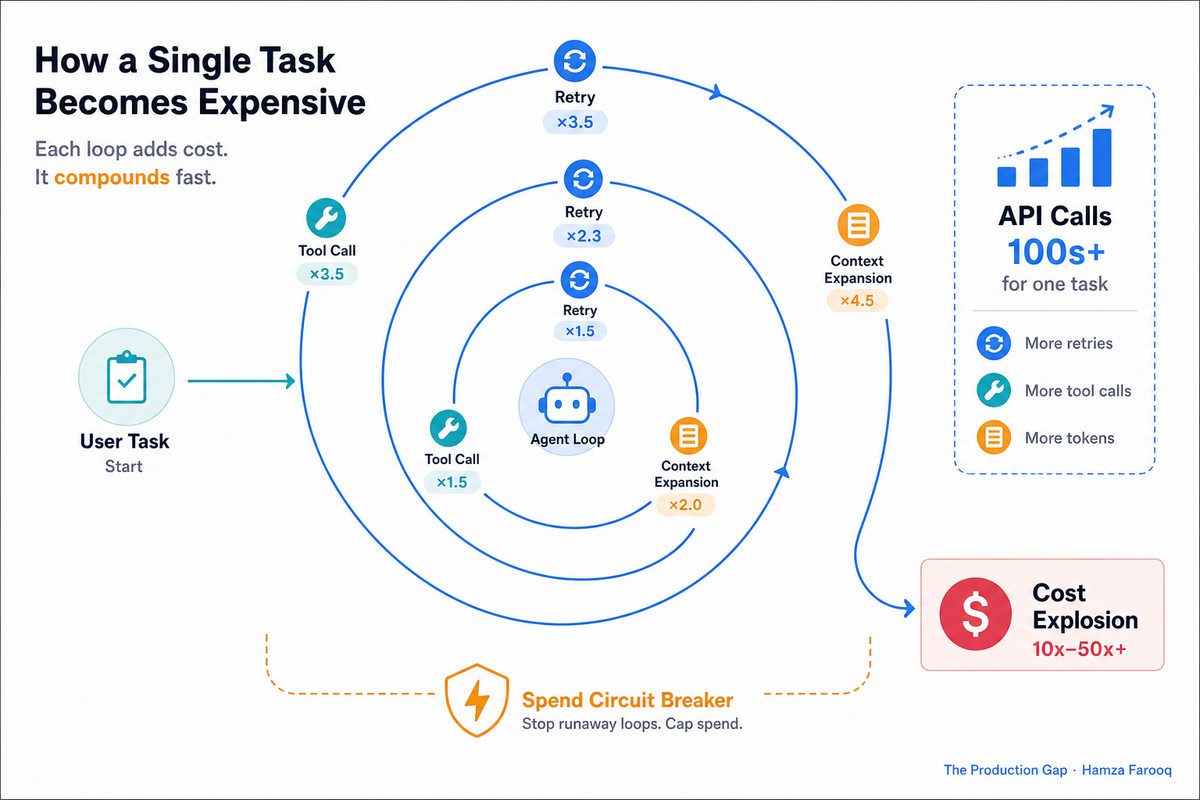
AI agent runaway costs are a deployment risk that dashboards cannot prevent because dashboards only surface damage after it has already happened.
TL;DR: AI agent runaway costs occur when an autonomous agent loop compounds retries, tool calls, and growing context windows into an uncapped bill. Dashboards report the damage after the fact. The only architectural solution is a hard spend circuit breaker, an automatic kill switch built into the agent runtime that halts execution the moment a defined cost threshold is crossed, before the next call is ever made.
Key Takeaways
- Agent loops compound costs fast: Retries, tool calls, and growing context windows multiply your bill geometrically, not linearly.
- Dashboards report damage, they do not prevent it: A cost alert fires after money is already gone; it cannot reach inside the runtime to stop the process.
- Spend circuit breakers are a hard kill switch: They cut the agent process the moment it crosses a defined threshold, no human action required.
- Cheaper tokens increase exposure: Falling prices encourage more steps with less oversight, making runaway loops more likely at scale.
- OWASP LLM06 names this a top-tier risk: Unbounded token consumption is now classified alongside security vulnerabilities, not billing inconveniences.
- Circuit breakers belong in the architecture now: Any autonomous agent without a hard spend limit is missing a foundational safety primitive.
The agent loop (model calls a tool, spawns a sub-agent, retries a failure, grows its context, repeats) is the default production architecture for autonomous AI systems, and it has created an infrastructure risk most teams are not ready for. The counterintuitive accelerant: the average cost per million tokens has fallen from roughly $10 to $2.50. Cheaper tokens encourage more steps with less scrutiny and no architectural ceiling. Most teams have dashboards. Almost none have the thing that actually stops the loop.
Why Do AI Agent Costs Spiral Out of Control Inside a Loop?
AI agent costs spiral because every failed step multiplies the bill: retries re-send the full growing context, tool schemas add tokens on every call, and verification passes layer on top, turning a single task into compounding API calls with no natural stopping point.
Every failed step can multiply context, tool schemas, retries, and verification calls, making the loop a geometric cost accelerator. Each retry costs what the last call cost plus the weight of everything accumulated before it.
The deeper problem: an agentic system decides at runtime how much of your budget to spend. A REST API call has a fixed payload. An agent loop autonomously decides to keep running if the first result looks ambiguous. It is a process whose resource consumption is determined by conditions you cannot see until it stops.
How Has OWASP LLM06 Formally Classified Unbounded Consumption as a Production Risk?
OWASP's LLM06 covers scenarios where AI agents rack up costs with no ceiling, including adversarial exploitation, not just accidental loops. An attacker who can trigger repeated agent invocations at your cost has a real attack vector: their cost is zero, yours is unbounded.
The formal classification matters operationally. "We violated LLM06 controls" gets executive attention in a way that "we had a large API bill" does not. OWASP placing unbounded consumption alongside prompt injection signals this risk belongs in architecture review and production readiness checklists, not a billing postmortem.
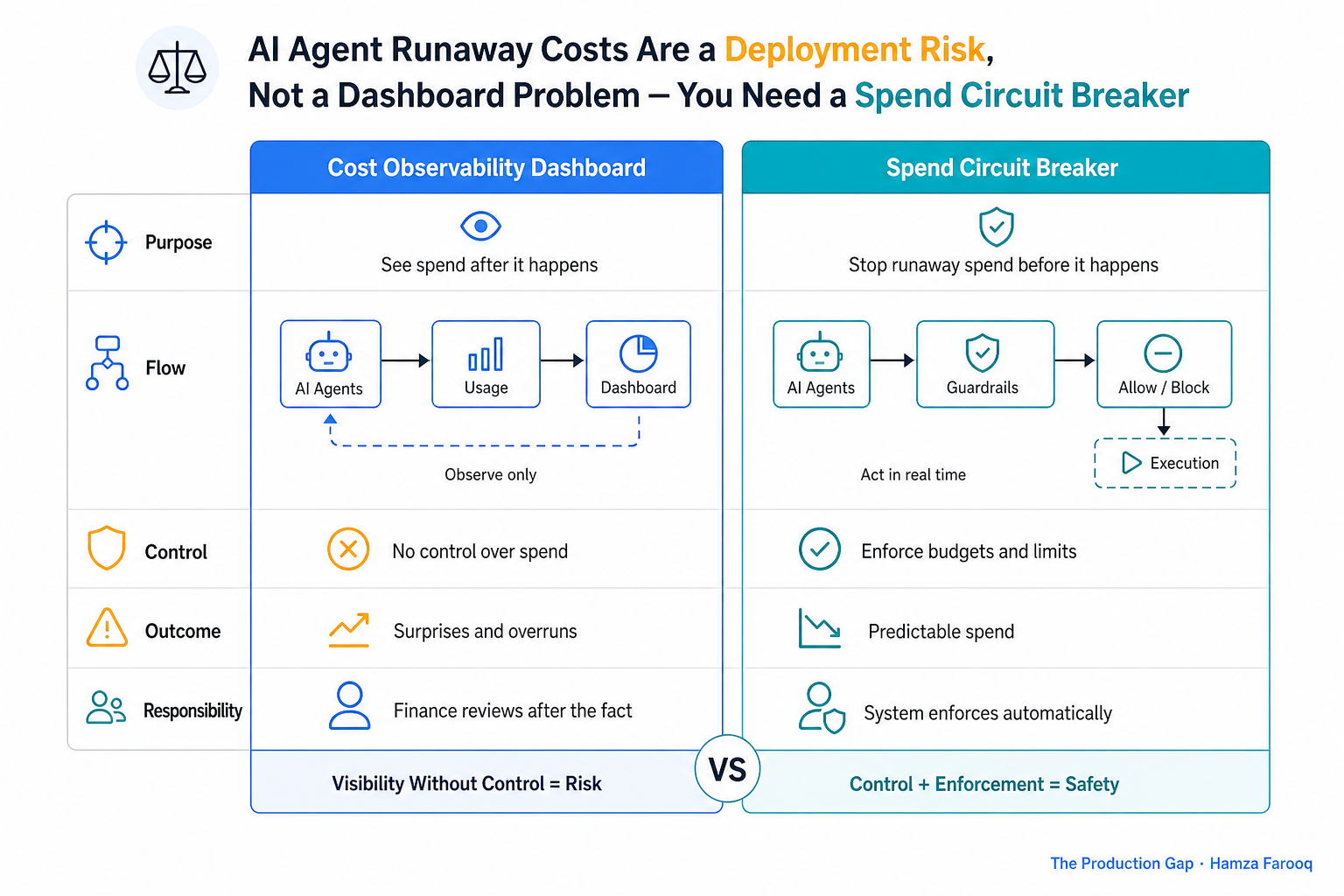
What Is the Architectural Difference Between a Cost Dashboard and a Spend Circuit Breaker?
A spend circuit breaker is an execution primitive inside the agent runtime that kills the process the moment a cost threshold is crossed. A cost dashboard is a reporting layer above the runtime that shows how much has already been spent.
| Dimension | Cost dashboard / alert | Spend circuit breaker |
|---|---|---|
| Where it lives | Monitoring layer, above runtime | Inside the agent runtime loop |
| When it fires | After polling interval (minutes to hours) | After every LLM call or tool invocation |
| What it can do | Notify a human | Halt the agent process automatically |
| Prevents overspend? | No (reports it) | Yes (stops it) |
| OWASP LLM06 mitigation? | No | Yes |
An observability platform used as a cost-control strategy reports the problem after the fact. In the author's view, treating a dashboard alert as a spend control is a category error: by the time the alert fires, the loop has already consumed the budget it was meant to protect. Stopping runaway spend requires a mechanism that acts inside the process, not above it.
What Architectural Primitives Does a Production Agent Actually Need for Hard Cost Control?
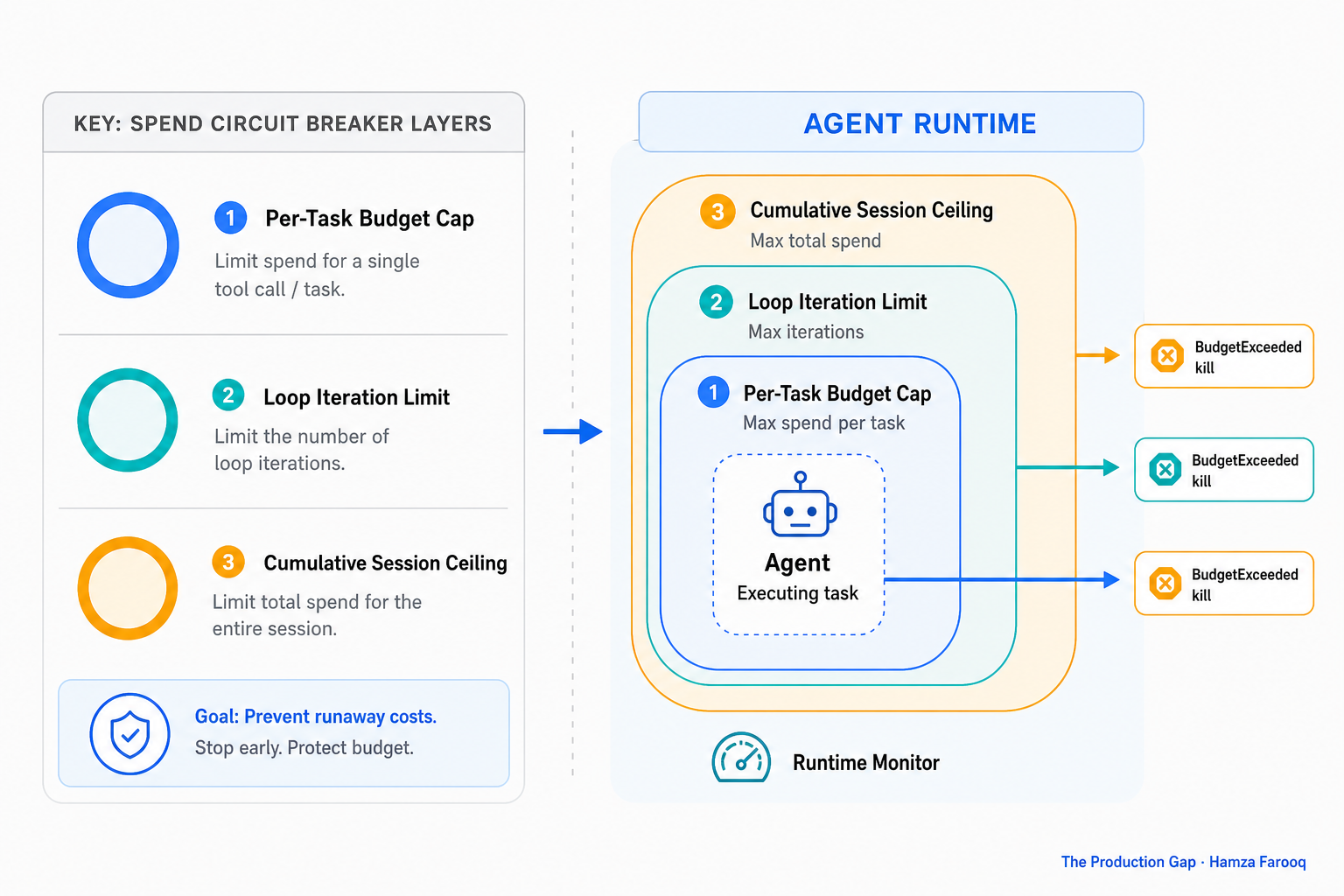
A production AI agent requires three hard cost primitives built into its runtime: a per-task dollar budget cap, a maximum loop iteration limit, and a cumulative session spend ceiling.
Primitive 1: Per-Task Budget Cap A hard dollar or token ceiling assigned at task initialization. When the task hits its limit, the runtime raises a BudgetExceeded exception and terminates without asking the model's permission. Per-task budgets are a proven tactic for cutting AI agent costs and, as a practical rule of thumb used in this guide, a required safety primitive for any production deployment.
Primitive 2: Loop Iteration Limit A cap on the number of tool-call and LLM-inference cycles per task, independent of cost. A model caught in a reasoning loop may not generate expensive individual calls, but a large number of cheap iterations compounds at scale. This primitive catches failure modes the dollar ceiling alone can miss.
Primitive 3: Session and Cumulative Ceiling A rolling total across all tasks in a session or time window. Individual task budgets can each appear within bounds while a multi-agent pipeline bleeds cumulatively. Parallel sub-agents each operating under their own per-task cap can remain technically compliant at every node while the aggregate session total climbs past acceptable limits. The session ceiling stops the pipeline when the rolling total crosses threshold.
These three primitives form the framework used in this guide. None of them replaces the others: each one addresses a failure mode the remaining two can miss.
Frequently Asked Questions
What is a spend circuit breaker for AI agents? A spend circuit breaker is a hard-coded cost threshold embedded in the agent runtime that automatically terminates the process the moment accumulated spend crosses a defined limit. No human notification is required, no polling delay occurs, and the loop stops immediately.
Why do AI agent costs spiral even when individual API calls are cheap? Agent loops compound costs because every failed step re-sends the full accumulated context, making each iteration more expensive than the last. When iteration count is unbounded, cumulative spend can grow quickly even if no single call appears expensive in isolation.
What does OWASP LLM06 Unbounded Consumption mean for production deployments? OWASP LLM06 formally classifies uncontrolled agent token consumption as a security and reliability risk, including adversarial patterns that deliberately exploit agents with no spend ceiling. It is a named architecture gap, not a billing inconvenience.
Does cheaper token pricing reduce AI agent runaway cost risk? No. Cheaper tokens increase runaway risk by encouraging more agent steps with less oversight. Total exposure grows even as per-call cost falls.
Conclusion
Your observability stack is a post-mortem tool, not a cost-control strategy. An autonomous agent with no spend circuit breaker is a process with no ceiling on what it can spend. OWASP has formally named the risk as LLM06. Before your next agent ships, the runtime should include three things: a per-task budget cap, a loop iteration ceiling, and a cumulative session kill switch. Each one addresses a failure mode the others can miss. Build all three in before launch, not after the first unexpected bill arrives.
Learn from me
Forward Deployed Engineering Bootcamp for Full-Stack Developers, my Maven cohort. Build and ship complete AI products end to end, from React and Node.js frontends to deployed models with caching and observability. Join the next cohort →
Hire us
Traversaal.ai. We're a team of forward deployed engineers solving the toughest AI problems for Fortune 100 companies: document intelligence, agentic data platforms, and real-time web intelligence, deployed in production. Work with our team to deploy your next agentic ecosystem. Talk to Traversaal.ai →
Join us
Want to solve these problems with us? We're always looking for forward deployed engineers who want to ship production AI. jobs@traversaal.ai