AI API Pricing Budget Playbook: How to Plan Around an Introductory-Price Expiry Before It Blows Your Agent Feature's Unit Economics
AI API pricing budget got a cliff coming? Learn how to model blended costs, add PRD trigger clauses, and route agents before expiry wrecks your unit economics.

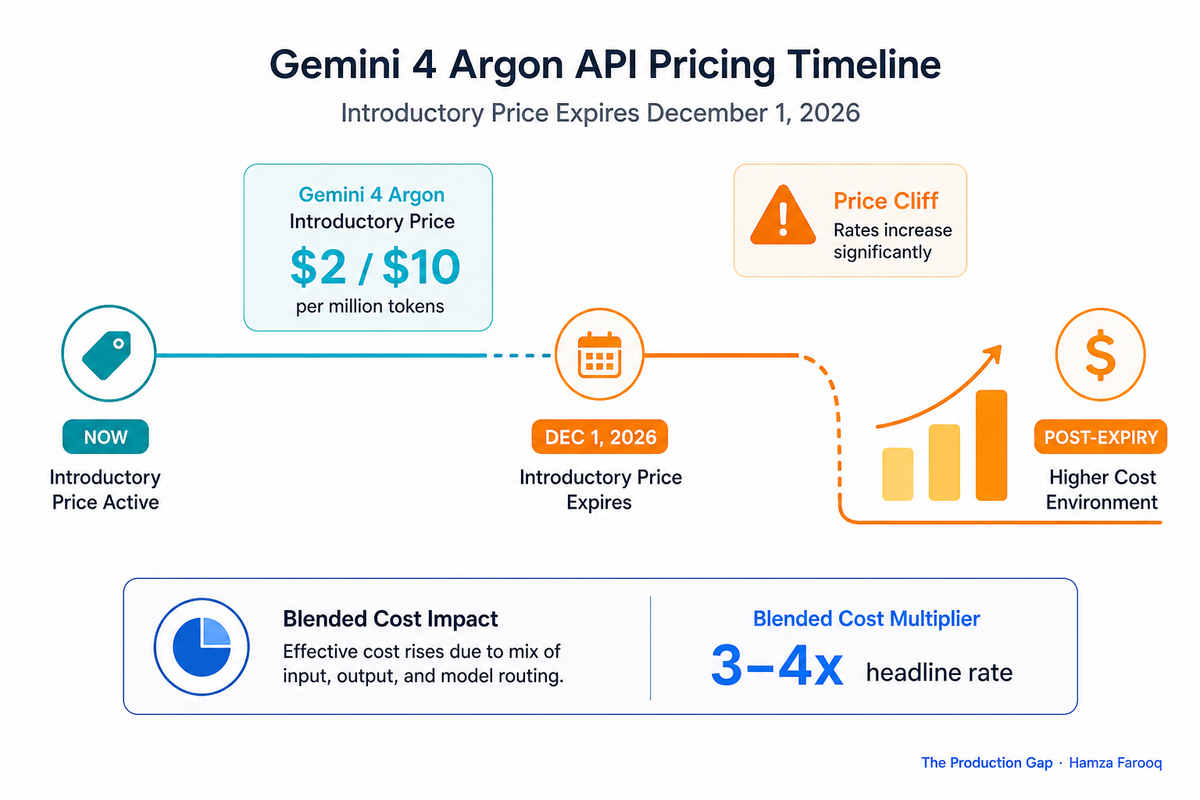
TL;DR: When an introductory AI API price expires, the real budget hit is larger than the sticker rate suggests. Caching discount loss and batch discount removal stack on top of the list-price increase, pushing blended cost well above the headline number. This playbook gives you three tools: a blended-cost model, a PRD re-pricing trigger clause (the API Expiry PRD Template), and a benchmark-adjusted routing framework (the Agent Step Tier Matrix).
Key Takeaways
- Introductory prices have expiry dates: Treat any introductory API price as a time-limited discount, not a permanent rate.
- Headline token rates are misleading: Caching, batching, and mixed-modality inputs shift your real blended cost far from the published rate.
- Model routing is a cost lever: Routing simple steps to Flash-tier models while reserving frontier models for high-value tasks can offset a price increase without touching UX.
- PRDs need re-pricing trigger clauses: Every spec that bakes in an API cost assumption needs a named threshold that forces a budget and architecture review.
- Benchmark delta must be task-specific: Compare quality scores against cost difference on your specific workload, not the market's average task.
- Q4 timing compounds the danger: A price change inside quarter-close means budget exposure can grow before finance teams can correct it.
Introduction
When an introductory API price expires mid-quarter, the budget impact compounds fast. AI API pricing ranges from $0.01 to $30 per million input tokens, and the headline rate is not what you actually pay. This playbook gives you three tools: a blended-cost model, a PRD re-pricing trigger template, and a benchmark-adjusted switching rule. Running them before expiry turns a pricing event into a planned decision rather than an unplanned opex spike.
Why Can a Price Cliff Be Significantly Worse Than the Sticker Says?
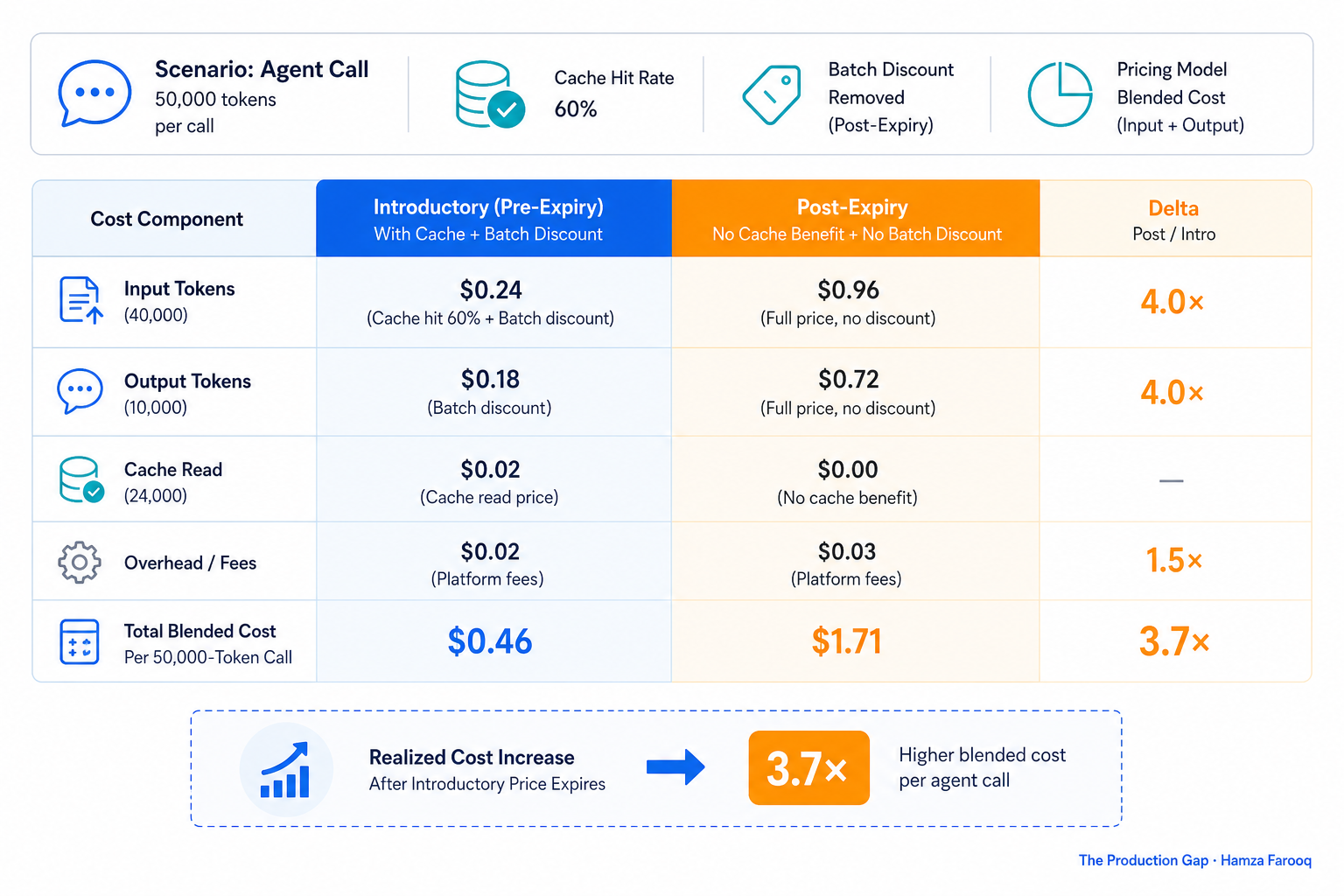
A price cliff costs more than the sticker rate because caching discount loss and batch discount removal stack on top of the list-price increase, pushing realized blended cost materially above the headline number. Understanding each layer separately is the first step to sizing true exposure.
Mixed-Modality Cost Opacity
Audio, image, or video inputs push blended token cost further from the text-only headline. The table below provides a structure for thinking through the realized delta, fill in your own call profile before using it for budget decisions.
| Cost Component | Introductory Tier | Post-Expiry Tier | Delta |
|---|---|---|---|
| List price per 1M output tokens | Your baseline | Your confirmed post-expiry rate | Depends on provider |
| Effective rate after cache hit adjustment | Lower than list | Higher if cache discount narrows | Varies by hit rate |
| Effective rate after batch discount removal | Lower than list | Full list price | Stacks with above |
| Mixed-modality blended rate adjustment | Modality-dependent | Modality-dependent | Requires your mix |
What Does a PRD Re-Pricing Trigger Clause Actually Look Like?
A PRD re-pricing trigger clause is a named threshold that automatically forces a budget review and architecture decision before a cost change hits production spend. The four-field structure below is the API Expiry PRD Template.
Add these four fields to every agent-feature PRD:
- Trigger condition: Define a blended-cost increase threshold relative to the baseline in this PRD, for example, "If blended cost per 1,000 agent calls increases by a set percentage, a re-pricing review is scheduled within 5 business days." Calibrate to your margin structure.
- Baseline cost record: Document today's blended cost (not list price) including cache hit rate, batch share, and modality mix. This is the number the trigger fires against.
- Named expiry dates: List every known introductory-price expiry for every API dependency, by provider, product name, and confirmed date. Verify each directly with the provider.
- Decision authority: Name who owns the make/route/switch decision when the trigger fires, typically the PM and engineering lead, not finance alone.
An expiry date not pre-flagged in the PRD hits finance as an unforecasted quarterly variance, a difficult moment to seek approval for an architecture change.
At What Benchmark Delta Does Switching Models Beat Absorbing the Price Increase?
A model switch is economically justified when cost savings from routing to a cheaper model exceed the quality degradation penalty, measured on your specific task. Two variables drive the decision.
Variable 2, Benchmark performance gap on your task: Does routing a given step to Flash-tier increase escalation rate, reduce task completion rate, or trigger output review? If the answer is no for the majority of call volume on that step type, routing is worth evaluating regardless of leaderboard rankings.
The Agent Step Tier Matrix
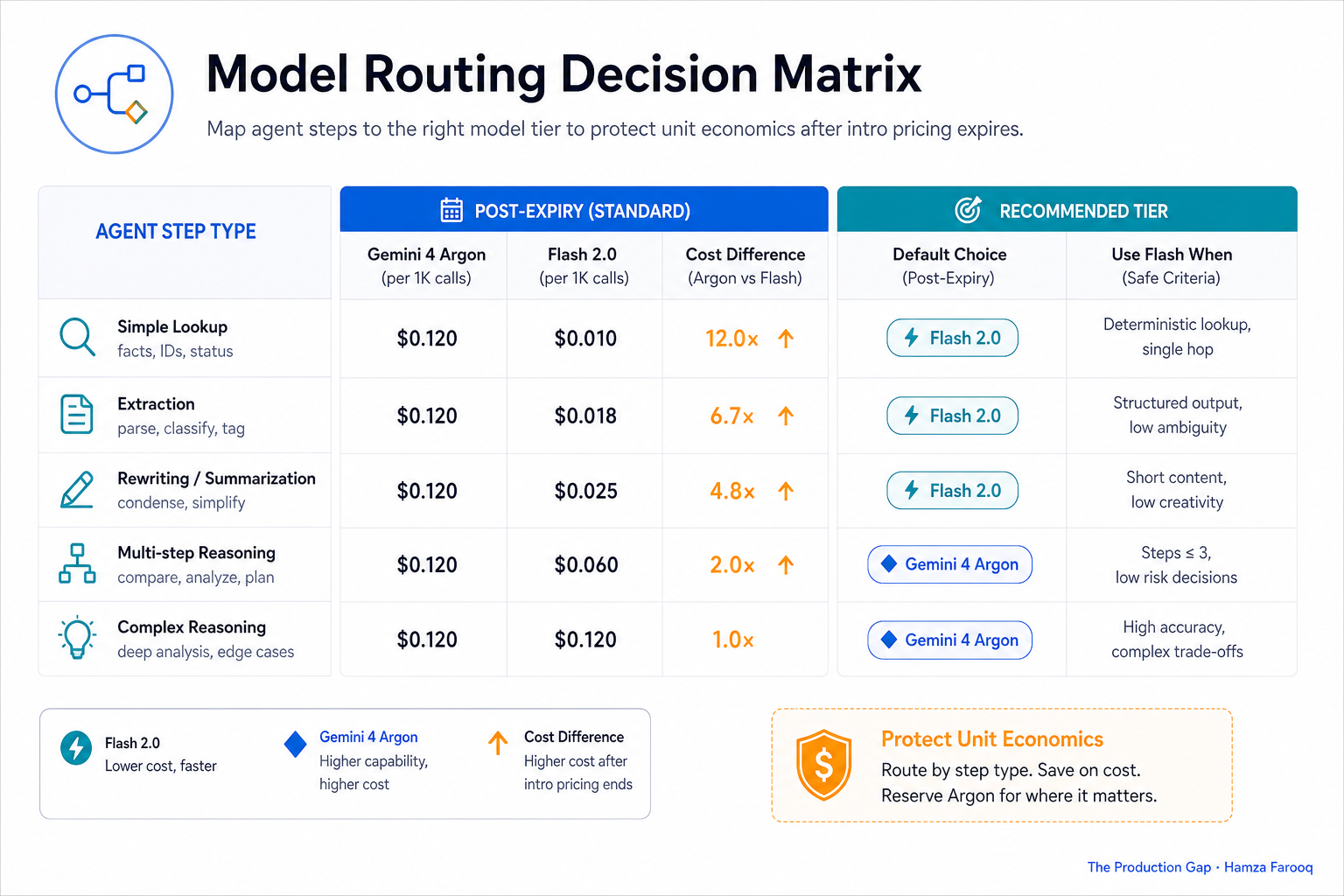
The Agent Step Tier Matrix maps agent step types to model tiers based on quality sensitivity and cost dominance.
| Agent Step Type | Suggested Tier | Rationale |
|---|---|---|
| High-stakes output (contract draft, financial summary) | Frontier | Quality threshold non-negotiable |
| Structured extraction, classification | Flash-tier | Measurable quality parity at materially lower cost |
| Routing/orchestration calls | Flash-tier | No user-facing output; cost dominates |
| Summarization of internal context | Flash-tier | Quality delta may fall below user-perception threshold |
Audit your agent's call volume by step type. If a large share of calls are classification, extraction, or orchestration, a routing split may offset a significant portion of any introductory-price increase.
Frequently Asked Questions
Q: What is an introductory API price and when does it expire? An introductory API price is a time-limited launch discount with a confirmed end date set by the provider. Verify the exact expiry date and post-expiry rate directly with your provider before building it into unit economics.
Q: How do I calculate blended cost instead of using the list price? Weight your token count by modality mix, apply your confirmed post-expiry cache discount across cached and uncached call share, subtract any surviving batch discount, then divide total cost by revenue per agent call. Compare that figure against your revenue-per-agent-call, not the pricing page number.
Q: What should the API Expiry PRD Template trigger threshold be set at? Set it to reflect your feature's margin sensitivity, lower for thin-margin features where the API is a significant share of COGS, higher where you have more buffer. Document and justify the specific percentage in the PRD so the rationale is preserved when the trigger fires.
Q: How do I know if Flash-tier quality is good enough for my workload? Route a small slice of production traffic to Flash-tier for non-user-facing steps and measure task completion rate, escalation rate, and output review flags against your frontier baseline. If the delta is acceptable for most of that call volume, expand the routing split using the Agent Step Tier Matrix.
Conclusion
An introductory-price expiry is a predictable event. The budget damage it causes is not inevitable. The blended-cost model, the API Expiry PRD Template, and the Agent Step Tier Matrix convert a pricing event from an unplanned opex spike into a documented, pre-authorized decision.
Your next step: Open your live agent-feature PRD today. Add the four fields from the API Expiry PRD Template. Set a calendar reminder to run your blended-cost model before the expiry date arrives. The teams that absorb price changes without incident are the ones that planned before the quarter closed.
Learn from me

Agentic AI for Product Managers, my Maven cohort. Learn how to design, evaluate, and ship reliable AI systems: the technical fluency PMs need to lead agentic products, no engineering background required. Join the next cohort →
Hire us
Traversaal.ai. We're a team of forward deployed engineers solving the toughest AI problems for Fortune 100 companies: document intelligence, agentic data platforms, and real-time web intelligence, deployed in production. Work with our team to deploy your next agentic ecosystem. Talk to Traversaal.ai →
Join us
Want to solve these problems with us? We're always looking for forward deployed engineers who want to ship production AI. jobs@traversaal.ai