Air-Gapped Coding Agents: Benchmark Data, Hardware Reality, and Why Harness Choice Matters More Than Model Quality
Air-gapped coding agents now rival cloud models—if your harness is right. Get benchmark data, hardware sizing tips, and on-prem deployment insights here.

TL;DR: In 2026, air-gapped coding agents on on-premises hardware perform competitively with cloud models at the 7B–34B parameter class when paired with an efficient inference harness. Harness selection and token efficiency determine real-world throughput far more than marginal model quality differences. Size hardware around weight storage and KV-cache headroom first, then optimize prompt pipelines second.
Key Takeaways
- The "can we do this offline?" question is settled: Teams are already in vendor selection, not research.
- Harness beats model: The orchestration layer determines whether tasks complete in practice.
- Token efficiency is a capacity number: Harness variance in token consumption sets how many developers your hardware supports concurrently.
- Weight distribution is a logistics problem: Moving tens of gigabytes to every node without internet requires a transfer plan before vendor selection.
- Compliance is the forcing function: Regulatory mandates in defense, finance, and healthcare leave no room for data egress.
Introduction
"Can we run AI code assistants offline?" is a settled question as of Q2 2026. A 60-developer team on LocalLLaMA is already scoping a C#/.NET/SQL air-gapped coding agent that sends zero queries to external servers, this is vendor selection, not a research project. The real questions are now concrete: which hardware, which model, which harness, what does it cost per seat?
The finding that consistently reshapes evaluations: harness selection, not model quality, determines whether the agent completes tasks at all. Getting that variable wrong means evaluation looks fine while production quietly fails.
What hardware does a 35B air-gapped coding model actually require?
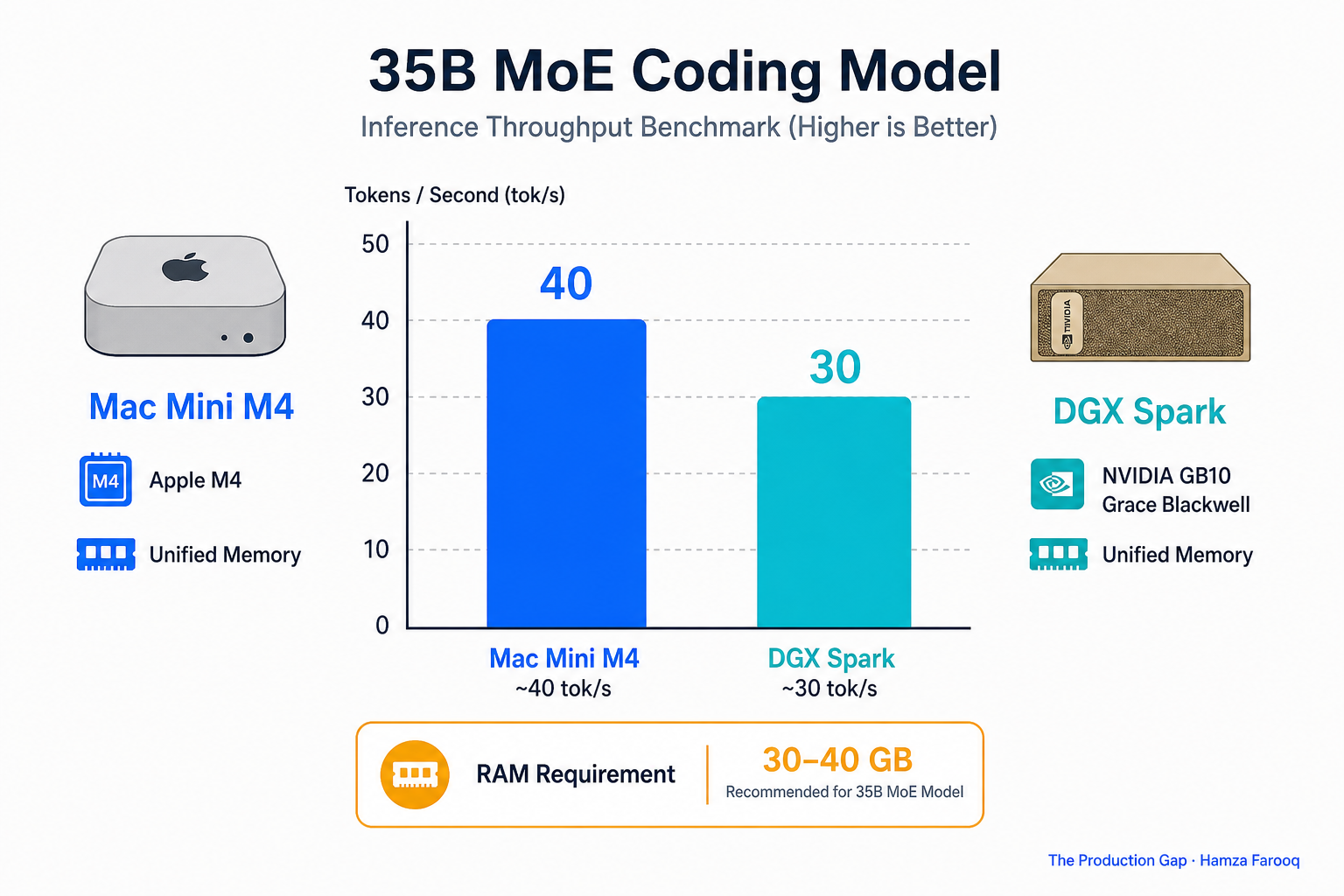
A 35B MoE coding model requires enough RAM to hold full model weights plus KV-cache headroom for peak concurrent users, single-user operation is feasible on high-memory consumer hardware; 60-developer deployments require server-class nodes with substantially more aggregate memory. Weight distribution is the logistics problem procurement teams consistently underestimate: tens of gigabytes transferred to every inference node with zero internet access, closer to OS image distribution than software deployment. Solve the transfer plan before selecting a vendor.
Insufficient memory forces quantization that degrades output quality, visible as lower task completion rates, not just slower responses. A slow agent is tolerable; one that silently produces incorrect completions is not.
How do open-weight 35B models benchmark against proprietary alternatives for coding tasks?
| Dimension | Open-Weight 35B MoE (Q2 2026) | Proprietary Cloud Equivalent | Practical Gap |
|---|---|---|---|
| Coding task completion (SWE-bench Verified class) | Competitive per community evaluation | GPT-4o / Claude 3.5 class | Narrowed; verify at procurement |
| Instruction following | Comparable | Comparable | Negligible for most coding workflows |
| Data egress risk | None (on-premises) | High (cloud inference) | Determinative for regulated environments |
Cloud-native tools like Claude Code and Codex create unacceptable egress risk for air-gapped environments. Goose (Block's 2025 open-source release) is evaluated specifically for offline industrial operation. Tabnine markets itself as the only major platform with full air-gapped agentic capability and no external network dependency.
Why does harness selection matter more than model quality for air-gapped deployments?
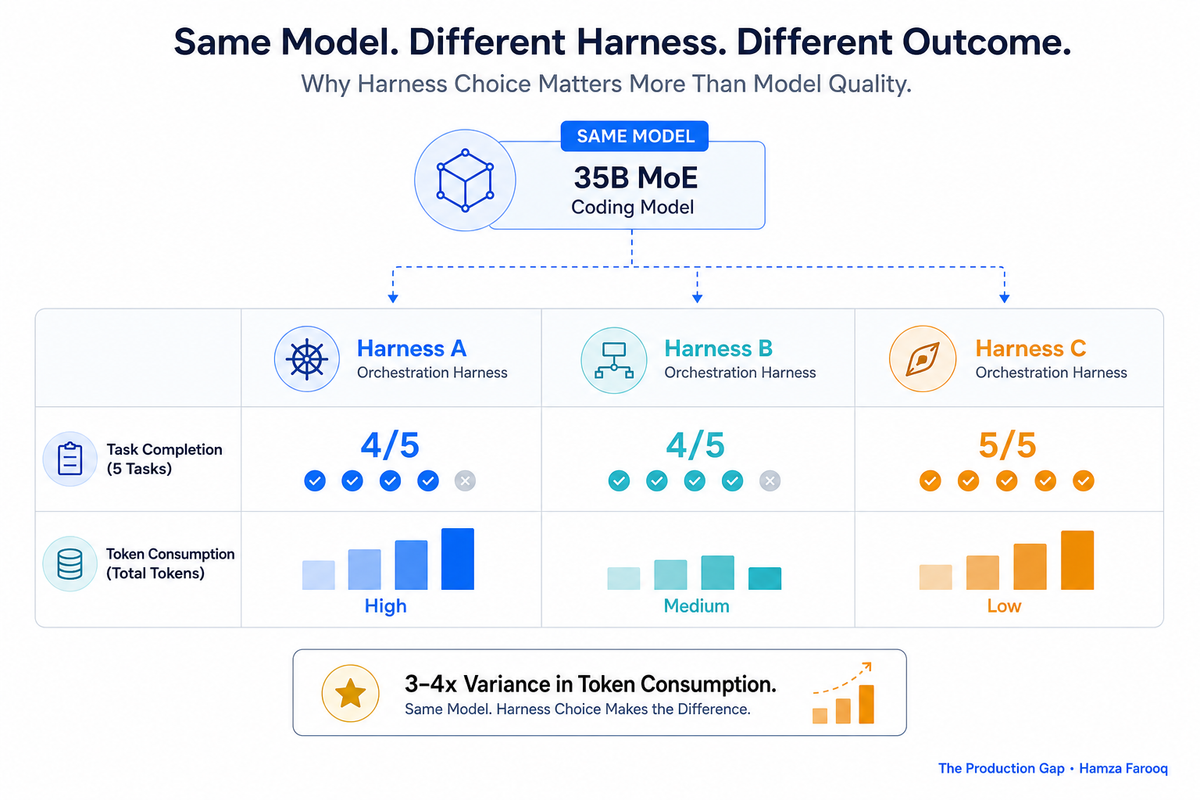
The orchestration harness, not the model, is the binding constraint in most air-gapped deployments, harness maturity determines task completion rate and token consumption independently of model capability. Community experience with multi-harness deployments running the same model reports meaningful variance across both dimensions. Validate against your own representative task suite.
| Harness | Task Completion (5-task suite) | Relative Token Consumption | Config Complexity | Best Fit |
|---|---|---|---|---|
| Continue v0.9, 2025 | Strong when fully configured | Baseline | Medium, 5 agents to configure | Teams comfortable with manual configuration |
| Goose (Block, 2025 open-source) | Strong | Low to moderate | Low to medium | Industrial and OT environments |
| Underconfigured harness (illustrative) | Degraded | Significantly higher | High | Not recommended for production |
| Custom harness | Variable | Variable | High | Organizations with dedicated MLOps capacity |
Continue v0.9 requires configuring five distinct agents: Chat, Edit, Apply, Autocomplete, and Embed. Each misconfiguration is a silent failure. Token consumption variance is a capacity planning number, not a performance footnote: a harness burning significantly more tokens per task means proportionally fewer concurrent developers on the same hardware.
AirgapAI Code is built for fully disconnected operation with no license-server dependency, critical where even a license validation ping is a compliance violation. Tabnine bundles harness and model management together, cutting configuration risk for regulated environments.
How do you structure an air-gapped coding agent evaluation for a regulated environment?
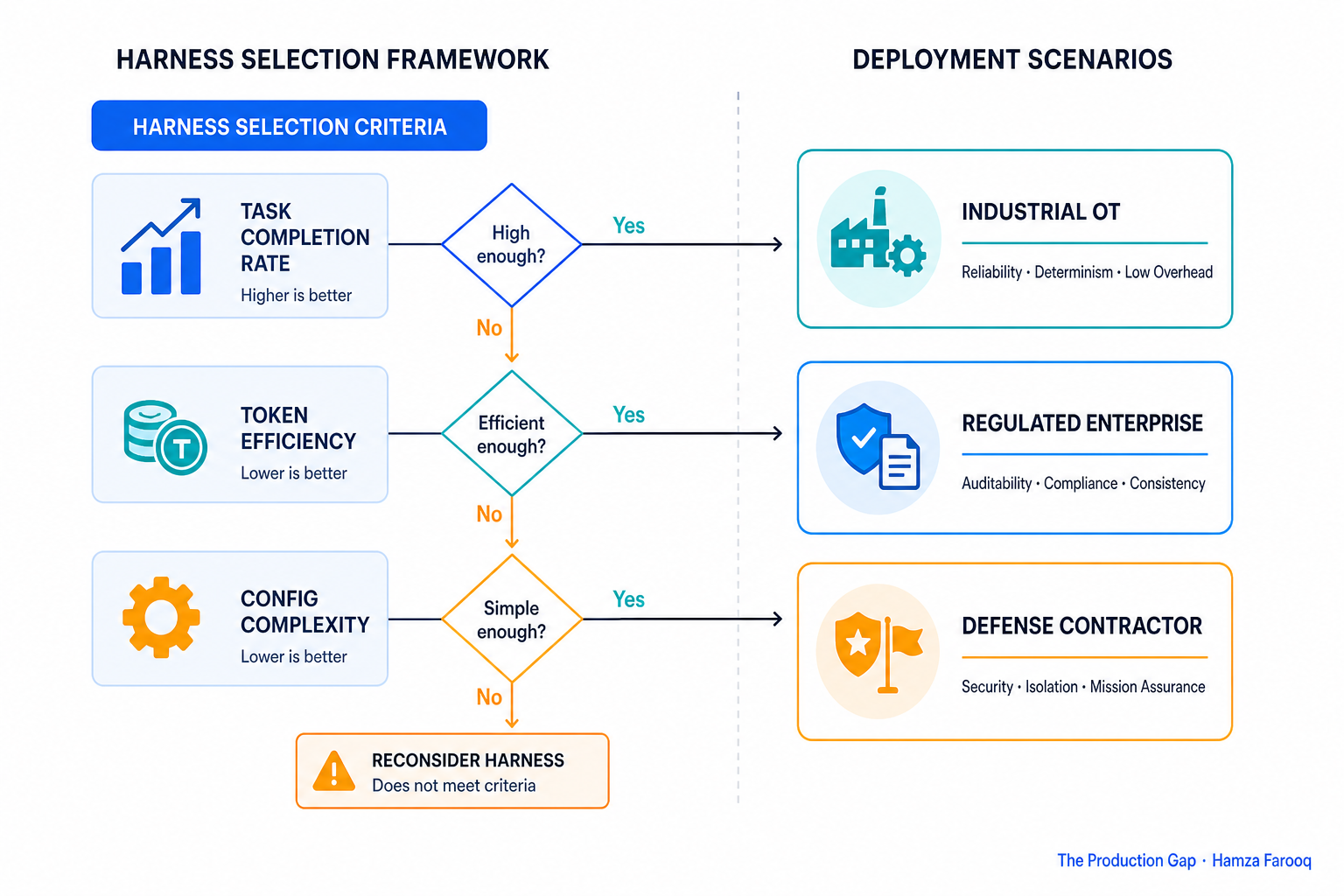
A rigorous evaluation tests at least three harnesses against the same model on a representative 5-to-10 task suite, measures token consumption per task, and treats weight distribution as a day-one procurement requirement.
| Evaluation Layer | What to Test | Pass Criteria |
|---|---|---|
| 1. Infrastructure floor | Offline model serving, RAM headroom, tok/s at team concurrency | Sufficient throughput at peak load |
| 2. Weight distribution | Transfer time and method for full model weights to all nodes | Plan exists and is tested before vendor selection |
| 3. Harness task suite | 5–10 representative tasks in your actual languages (C#, Python, SQL) | 4/5 completion rate or better |
| 4. Token efficiency audit | Token burn per task across at least 3 harnesses | Lowest burn at passing completion rate wins |
| 5. Compliance verification | Zero external network calls; license server independence | Hard pass/fail, no exceptions |
Teams that skip to layer 3 without confirming layers 1 and 2 will fail in deployment, not in evaluation. C#/.NET/SQL is a real-world target that cloud-focused evaluations routinely ignore. Layer 5 is non-negotiable for defense, finance, and healthcare. Match vendor to layer, not brand recognition.
Frequently Asked Questions
Can I run a coding agent with no internet connection for enterprise use in 2026? Yes, AirgapAI Code runs entirely disconnected with no license-server requirement, and Tabnine offers a dedicated air-gapped agentic platform for enterprise deployment. Primary requirements are sufficient RAM and a tested plan to distribute model weights without network access.
What is the minimum hardware to support 60 developers on a self-hosted coding agent? Single-node consumer hardware works for proof of concept; 60 developers at realistic concurrency requires multiple nodes or higher-memory server hardware. Plan for aggregate VRAM and system RAM sufficient to hold full model weights plus KV-cache headroom at peak concurrent user count, then adjust for your harness's token consumption profile, which directly scales your hardware requirement.
How do I configure Continue for an air-gapped development environment? Configure five separate agents (Chat, Edit, Apply, Autocomplete, and Embed) each pointed at a local model endpoint with no external API calls. Misconfiguring any one silently degrades task completion across the board; test against a representative suite before declaring production-ready.
How does token consumption variability affect on-premises infrastructure cost? Because token throughput is hardware-bound, a high-consumption harness directly reduces concurrent developer capacity on the same node, token efficiency is a budget variable that determines how much hardware you need, not just how fast responses feel.
Conclusion
Procurement teams spend time optimizing model selection while the real ceiling is harness maturity. The same model under different harnesses produces different task completion rates and meaningfully different token costs. As of Q2 2026, hardware is rarely the primary constraint, the access barrier is logistical: getting model weights to every node in an air-gapped facility before the evaluation even begins.
Run the five-layer stack. Test at least three harnesses against the same model. Measure token burn per task. Confirm zero network egress under load before signing anything.
Learn from me
Claude Code in Practice, my Maven cohort. Master Claude Code from fundamentals to advanced orchestration: skills, subagents, hooks, MCP, and production automation. Join the next cohort →
Hire us
Traversaal.ai. We're a team of forward deployed engineers solving the toughest AI problems for Fortune 100 companies: document intelligence, agentic data platforms, and real-time web intelligence, deployed in production. Work with our team to deploy your next agentic ecosystem. Talk to Traversaal.ai →
Join us
Want to solve these problems with us? We're always looking for forward deployed engineers who want to ship production AI. jobs@traversaal.ai