Claude Code Harness Engineering: How the Agent = Model + Harness Equation Shapes Everything You Build
Claude Code harness engineering shapes agent performance more than model choice. Learn to design memory, tools, and permissions layers that actually move results.

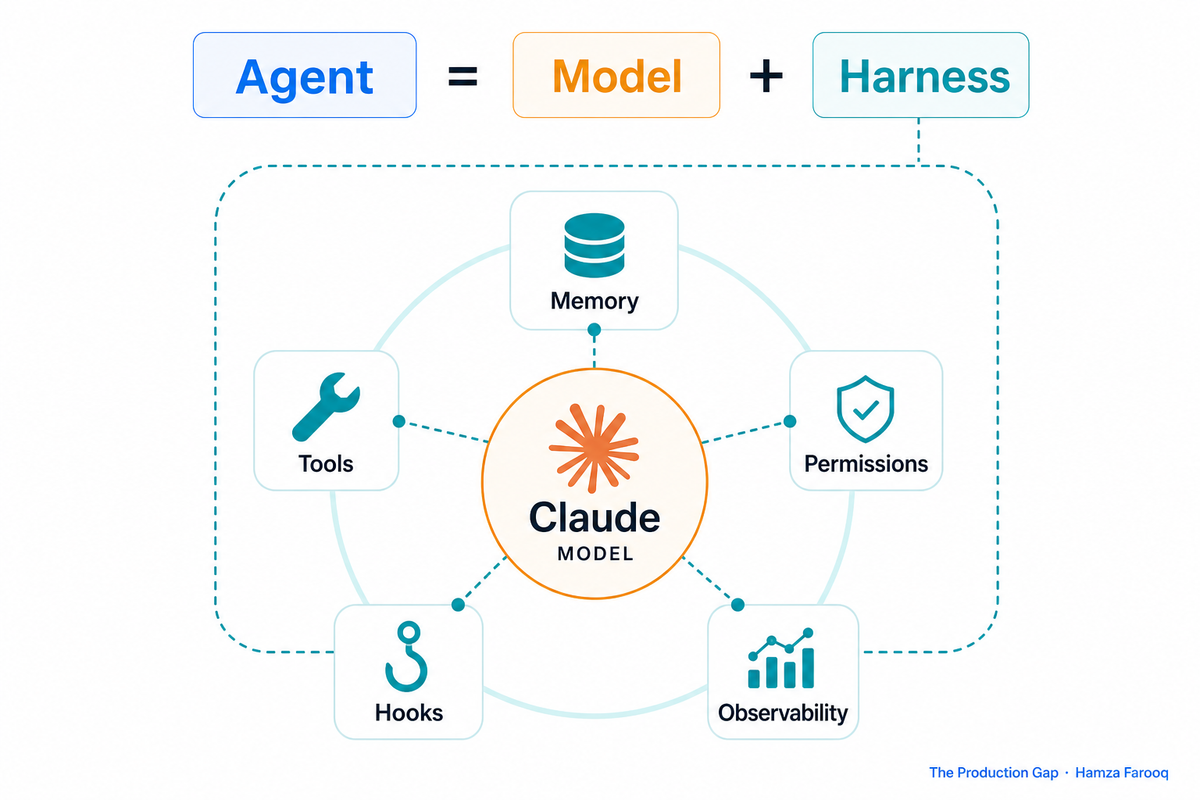
TL;DR: Claude Code harness engineering is the practice of deliberately designing the memory, tools, permissions, hooks, and observability layers that wrap the model, because the agent's capability is determined by that harness as much as by Claude itself. Accepting Claude Code's defaults means accepting someone else's architectural decisions; intentional harness design lets you shape exactly how the agent perceives, acts, and reports.
You've upgraded to Claude Opus 5, tuned your prompts for a week, and your agent still underperforms. What if the model was never the problem?
Key takeawaysAgent = Model + Harness: Output quality depends as much on the environment as the model itself.Five distinct layers: Memory, tools, permissions, hooks, and observability, designed deliberately or inherited as defaults.Harness moves benchmark scores: TerminalBench 2.0 shows measurable gaps between default and custom harnesses running the same model.Permissions and sandboxing are one concern: They belong to a single unified harness layer, not separate bolt-ons.Defaults are a design choice you inherit: Accepting out-of-the-box configuration still shapes what your agent can and cannot do.Blame the harness before the model: The environment is the more likely culprit, and the one you can actually change.
Introduction
Most engineers who've hit a Claude Code ceiling try upgrading the model or rewriting prompts. Both are largely the wrong lever.
Anthropic's engineering blog and Addy Osmani's TerminalBench 2.0 analysis point to the same diagnosis: the harness is the primary performance variable.
The evidence: On TerminalBench 2.0, Claude Opus 4.6 scores far lower inside Claude Code than in a custom harness, same model, different environment, measurably different results.
What is the agent = model + harness equation, and why does it reframe everything?
An agent is the model plus its operational environment, and that environment determines as much of output quality as the model weights.
The GitConnected analysis describes it directly: "Claude Code is not an agent framework. It is a harness, one of the most carefully engineered ones ever deployed in production." Think of it like a racing driver and car: swapping the driver (the model) produces one class of gains; redesigning the suspension and fuel system (the harness) produces a different class of gains entirely.
TerminalBench 2.0 shows this directly, the same Claude Opus 4.6 scores far lower inside Claude Code's default harness than inside a custom-engineered one. The harness is not a wrapper. It is a performance multiplier.
What are the five layers of a Claude Code harness, and what does each one do?
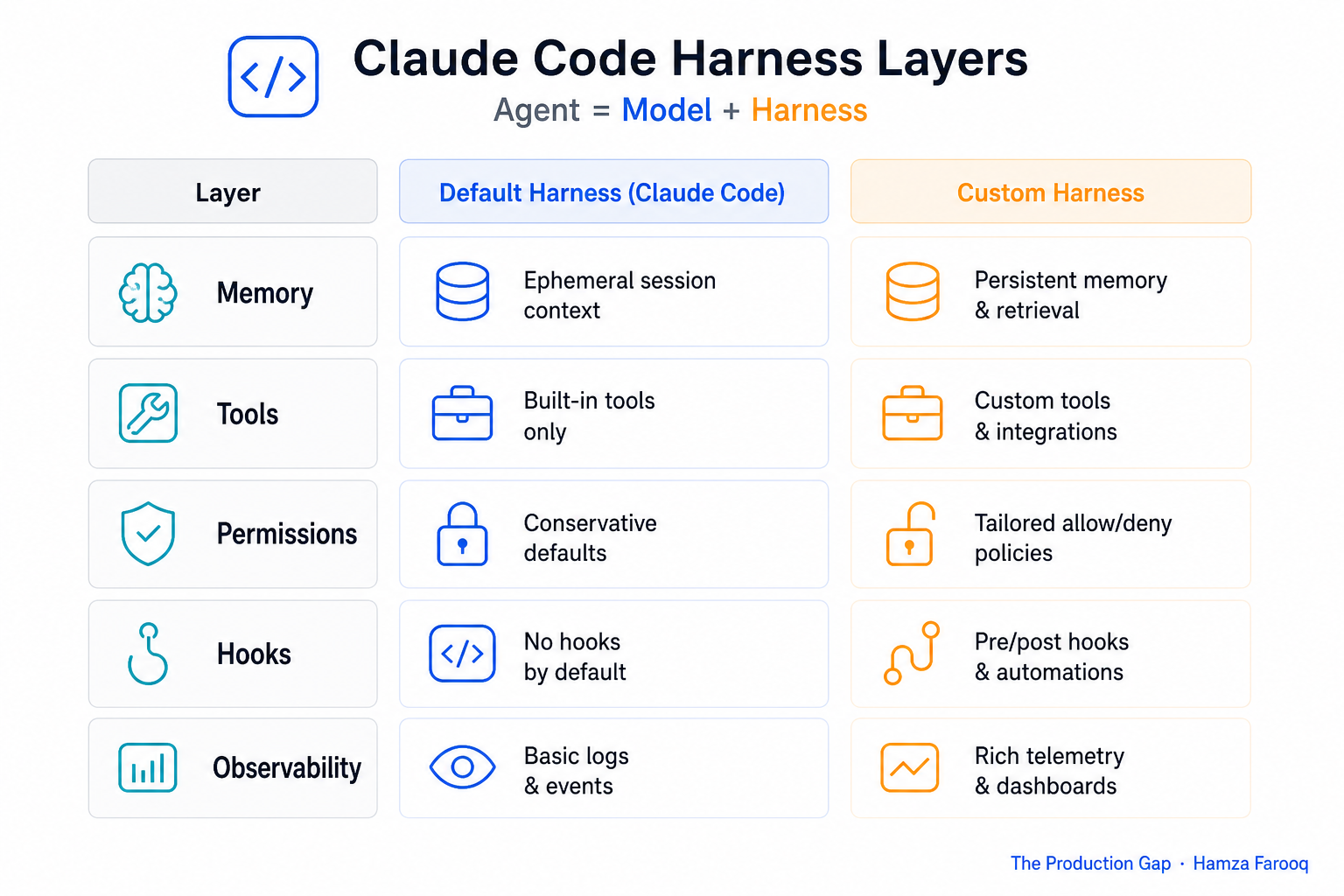
A Claude Code harness breaks into five distinct layers, neglect any one and you silently cap your agent's performance.
Memory maintains context across turns and sessions. Without deliberate design here, long-running sessions drift, the agent re-asks resolved questions and compounds errors.
Tools define available actions. Default Claude Code tools are broad by design; a custom harness narrows and extends the tool surface to match your domain. Every unneeded tool is noise the model has to filter.
Permissions are the access policy layer, what files, APIs, and system calls can the agent touch? Under-permissioned agents stall; over-permissioned ones create operational risk. Permissions and sandboxing belong to the same design conversation, not separate sprints.
Hooks are event-driven intercepts: pre-execution checks, post-execution validators, and error-handling branches that enforce constraints without bloating the model's context window.
Observability closes the loop. Without structured logging of tool calls and decision traces, you can't diagnose why an agent underperformed, so you keep blaming the model instead of the environment.
Each layer is a design decision. Skipping one doesn't eliminate it; it just means you're running an untested default.
Why does the same Claude model perform differently depending on the harness?
The harness controls what information the model sees, the actions it can take, and the feedback it receives, none of that is in the model's weights.
Osmani's TerminalBench 2.0 is the clearest public evidence: Claude Opus 4.6 running in Claude Code's default harness scores far lower than the identical model in a custom harness. A weak harness floods context with irrelevant state, withholds useful tool results, or fails to intercept mid-session errors. The model isn't underperforming, it's navigating a bad environment.
Software is a useful domain for this because code's binary feedback signal (it either compiles or it doesn't) makes harness quality measurable in a way that's genuinely rare. You can improve it and know whether it worked.
| Harness type | TerminalBench 2.0 context | Key variable |
|---|---|---|
| Claude Code default | Lower Opus 4.6 score | Broad tool surface, no custom hooks |
| Custom harness | Higher Opus 4.6 score | Tuned memory, scoped tools, observability |
| No harness (raw API) | Baseline | No environment scaffolding |
Instrument your harness before blaming the model. The environment is the more likely culprit, and the one you can actually change.
How do you start building a custom Claude Code harness instead of accepting defaults?
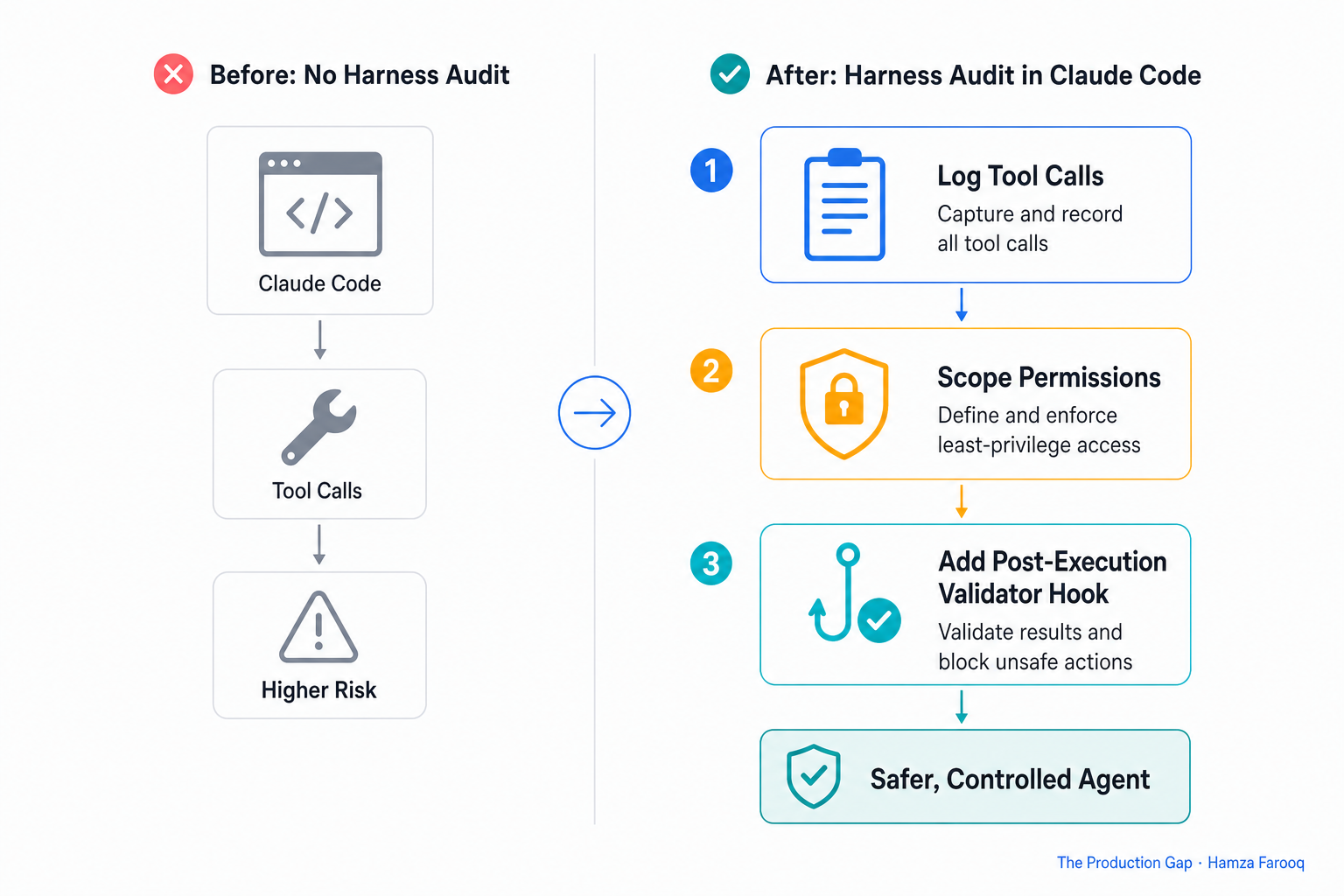
Audit what your current default harness decides for you, then replace each default with an explicit decision matched to your production use case.
Accepting Claude Code's out-of-the-box configuration is itself a harness design decision, just an unexamined one. Anthropic is direct about the tradeoff: using a harness takes more time and costs more upfront, but delivers significantly higher output quality.
Three concrete starting steps:
- Audit your defaults. Log every tool call and permission check across five representative sessions. You'll see which tools are never used (prune them) and which permissions are broader than needed (scope them).
- Design memory explicitly. Decide what context survives across turns and what resets. Drifting long-running sessions almost always have an unaddressed memory layer. Add one hook first. A post-execution validator that checks whether output compiles, passes lint, or matches a schema gives you a fast feedback loop on harness quality.
In my experience, one audit session and one hook will reveal more about your agent's actual behavior than repeated prompt rewrites.
FAQ
Q1: What is the difference between Claude Code's default harness and a custom harness, and when should I build my own?
The default harness is general-purpose; a custom harness replaces those defaults with explicit, domain-specific choices across all five layers. Build your own when you've hit a quality or reliability ceiling, TerminalBench 2.0 shows the same model performs measurably better in a purpose-built environment.
Q2: Why does Claude Opus 4.6 score differently on TerminalBench 2.0 depending on the harness?
Benchmark scores reflect the system, not just the model. The harness controls context, available tools, and mid-task feedback, a weaker harness means noisier input and no correction mechanisms, which degrades output regardless of model capability.
Q3: How do I implement the five layers, where should I start?
Start with observability. Instrument tool calls and decision traces first; that data will show you which of the remaining four layers is your weakest link.
Q4: How does harness engineering unify sandboxing, permissions, and guardrails into one design discipline?
All three answer the same question: what is the agent allowed to do? Treating them separately creates redundant controls and dangerous gaps. Harness engineering designs, versions, and audits them together as a single permissions layer.
Conclusion
Every Claude Code deployment runs inside a harness. The only question is whether yours was designed or inherited.
The evidence is consistent: Anthropic names harness design as the frontier variable for agentic coding performance, and Osmani's TerminalBench 2.0 puts real numbers behind that claim. The harness is auditable, instrumentable, and fixable, in a way model weights never are.
Your next step: Run Osmani's TerminalBench 2.0 evaluation against your current harness configuration before changing anything else. Measure first. Then build.
Learn from me
Claude Code in Practice, my Maven cohort. Master Claude Code from fundamentals to advanced orchestration: skills, subagents, hooks, MCP, and production automation. Join the next cohort →
Hire us
Traversaal.ai. We're a team of forward deployed engineers solving the toughest AI problems for Fortune 100 companies: document intelligence, agentic data platforms, and real-time web intelligence, deployed in production. Work with our team to deploy your next agentic ecosystem. Talk to Traversaal.ai →
Join us
Want to solve these problems with us? We're always looking for forward deployed engineers who want to ship production AI. jobs@traversaal.ai