Durable Execution for AI Agents: Why Long-Running Workflows Need State Persistence, Not Just Retry Logic
Durable execution for AI agents beats retry logic every time. Learn how state persistence and workflow history keep long-running agents on track after crashes.

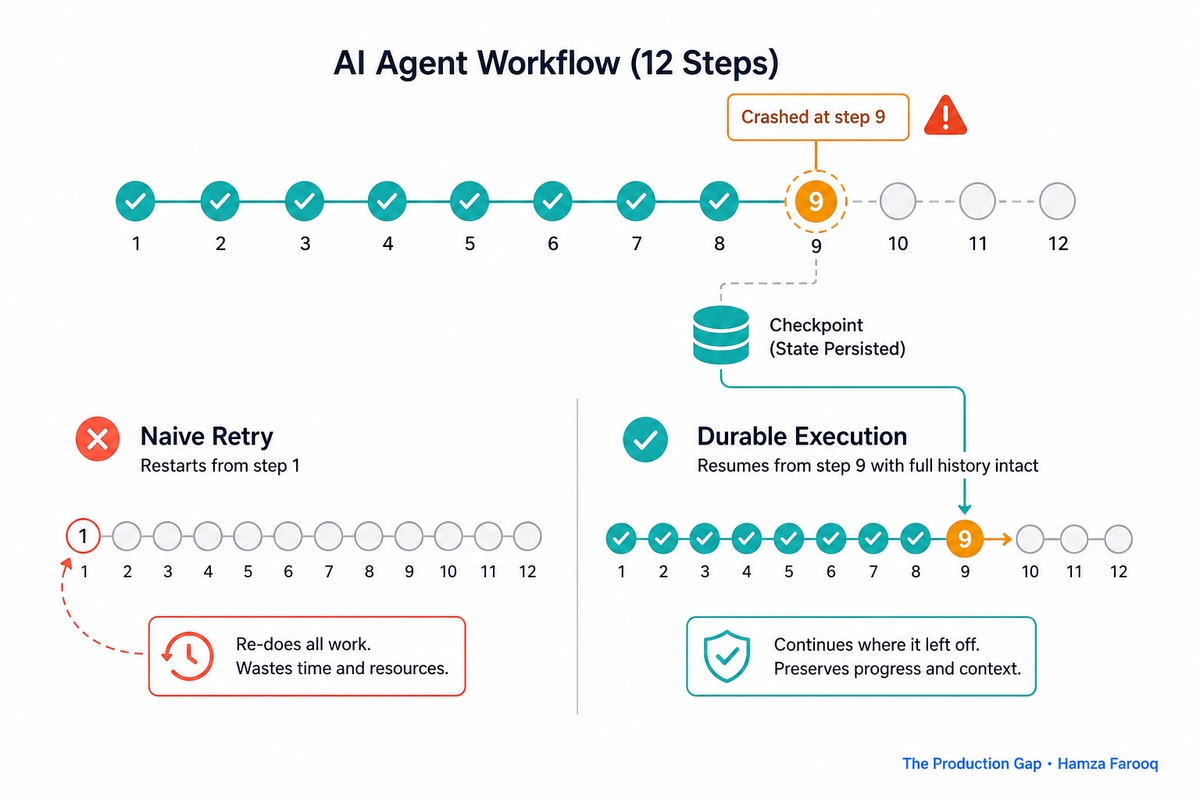
TL;DR: Durable execution for AI agents is the correct architectural primitive for long-running workflows because it persists exact tool-call history and replays execution state after crashes, something retry logic cannot do. Retries restart failed operations blindly, risking duplicate actions and lost context. Durable execution checkpoints every step, so agents resume precisely where they stopped without side-effect repetition. Durable execution for AI agents is the correct architectural primitive for long-running workflows because it persists exact tool-call history and replays execution state after crashes, something retry logic cannot do. Retries restart failed operations blindly, risking duplicate actions and lost context. Durable execution checkpoints every step, so agents resume precisely where they stopped without side-effect repetition.
Key Takeaways
- Retry logic is not enough: restarting a failed step throws away all work completed across a multi-hour workflow.
- State persistence is the real primitive: durable execution saves every step's result so a crashed agent picks up exactly where it stopped.
- Workflow history enables exact replay: a durable engine records each tool call and output so the agent reconstructs prior state without re-executing side effects.
- Human-in-the-loop gates require pause and resume: an agent waiting overnight for approval must hold state reliably, not keep an open thread.
- LLM tool calls are not naturally idempotent: calling a tool twice can book two flights or send two emails, and the execution layer must prevent that.
- Platform choice depends on trade-offs: Temporal, Restate, DBOS, Inngest, and Azure Durable Task handle agent workloads differently.
What is durable execution for AI agents and why does it matter?
Durable execution for AI agents is an architectural pattern that persists the full state of a running workflow to an event log after every step, enabling exact recovery after any failure without restarting from scratch or repeating side effects.
AI agents increasingly run multi-step workflows that span many minutes or hours, accumulate expensive tool-call results, and require human approval gates before proceeding. Standard retry logic was designed for short, stateless operations and cannot meet those requirements. The gap between what retry logic provides and what long-running agent workflows demand is a structural problem, not a configuration problem. Addressing it correctly requires a dedicated state-persistence layer built into the execution runtime from the start.
Why does retry logic fail for long-running AI agent workflows?
Retry logic restarts a failed step without knowing what the agent already did, wasting completed work, risking duplicate side effects, and destroying the causal history that makes decisions auditable.
Picture a 12-step financial analysis pipeline that completes steps 1 through 9, including three pay-per-use API calls, then crashes at step 10. Naive retry restarts from step 1: hours of compute gone, APIs billed twice. The deeper problem is correctness. LLM tool calls are not naturally idempotent. Calling book_flight() twice produces two bookings. As Quellix Labs frames it, this is an architectural decision, not a configuration tweak.
Retry logic asks one question: did this call succeed? For an agent accumulating a causal chain of decisions across hours, the right question is different: is the entire chain reproducible? Retry logic never asks that, and for long-running agent workflows, that gap is a structural flaw with real consequences.
How does durable execution actually work, and what does "exact replay" mean for agent tool calls?
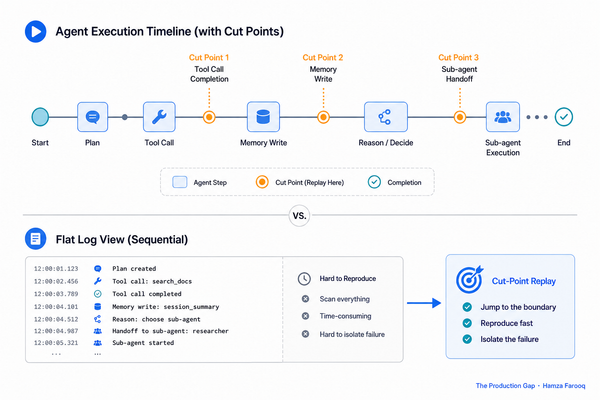
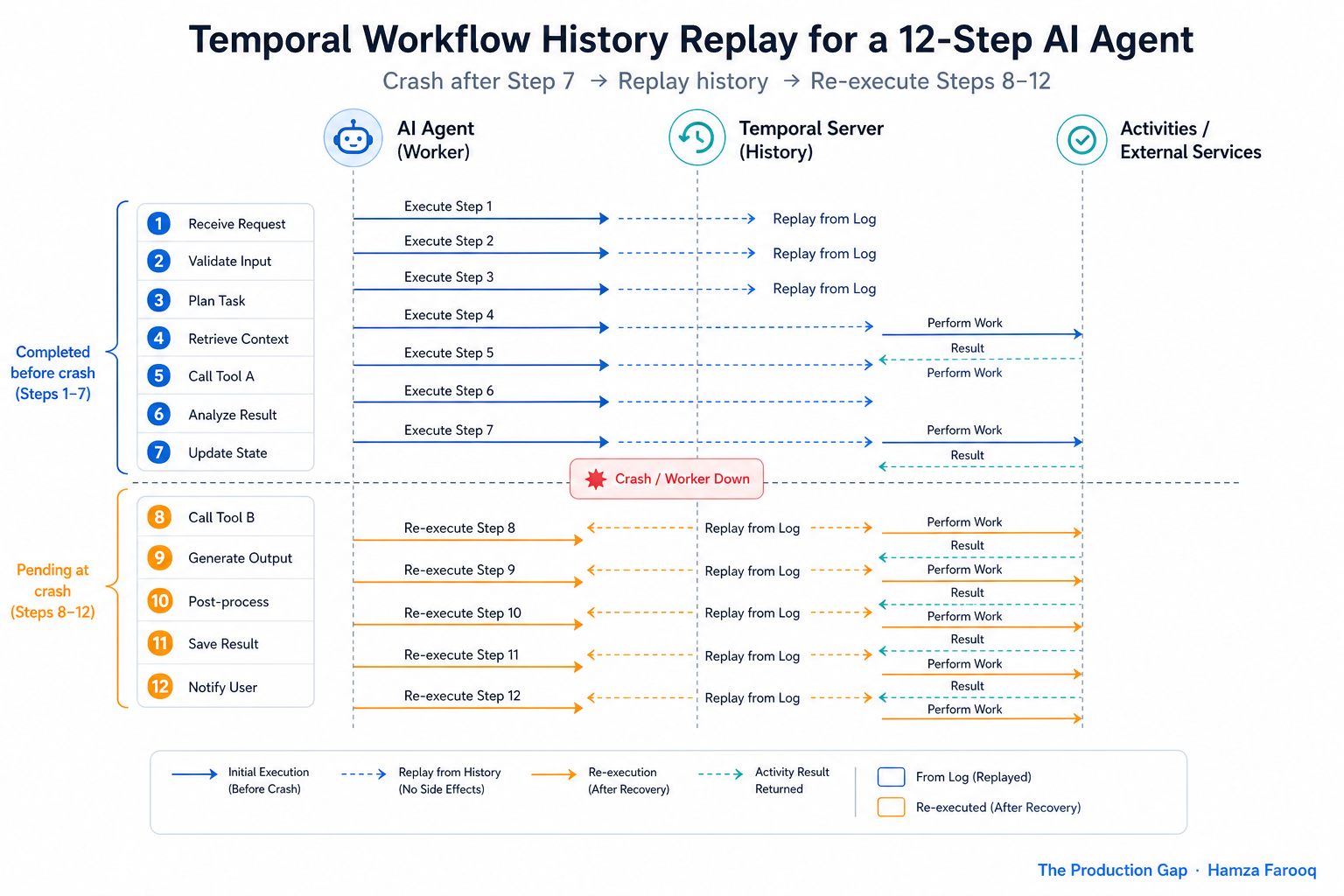
Durable execution persists every workflow step's result to an append-only event log so that when a process crashes, the engine replays completed steps from the log rather than re-executing them, restoring the agent's exact prior state.
Two core primitives make this work. Checkpointing writes each step's output before advancing. Event-sourced replay reconstructs in-memory state on restart by replaying the log without re-firing side effects. Zylos Research covers these mechanics in detail for agent-specific runtimes, and Quellix Labs addresses how state, retries, and pauses interact across long-running pipelines.
Replay matters beyond recovery speed. It ensures the agent resumes on the same causal chain the human approved. An agent reconstructing state from scratch might derive a different decision path: the human approved version A, but the restarted agent silently executes version B. In regulated industries, that divergence is already a hard audit requirement, and retry logic has no mechanism to detect it.
Exactly-once semantics close that gap. Durable execution engines assign each activity an idempotency key tied to its position in the workflow history. If the process restarts mid-step, any step already recorded is skipped rather than re-executed. Inference.sh's agent runtime guidance covers this deduplication pattern directly.
How do you implement a human-in-the-loop approval gate that survives overnight without losing agent state?
A human-in-the-loop gate suspends the agent at a named checkpoint, writes full state to the persistent log, releases the process thread entirely, and resumes only when the approval signal arrives, whether that is five minutes or five days later.
The naive alternative is keeping an async thread alive or polling in a loop. Both fail under process restarts. With durable execution, the agent reaches the approval checkpoint, the engine writes a signal subscription to the event log, and the process exits cleanly. When the human approves, the engine sends a signal and the workflow resumes from the exact checkpoint: no thread, no polling, no state loss.
This is a correctness primitive, not a UX convenience. In financial services, healthcare, and legal deployments, the approval must be tied to the exact decision tree the agent presented. A crash that produces different in-memory state means the human approved a decision they never actually reviewed. ZenML and Zylos Research both address this requirement directly. The same pattern handles rate-limiting pauses, multi-agent handoffs, and SLA windows.
Which durable-execution platform is best for AI agents: Temporal, Restate, DBOS, Inngest, or Azure Durable Task?
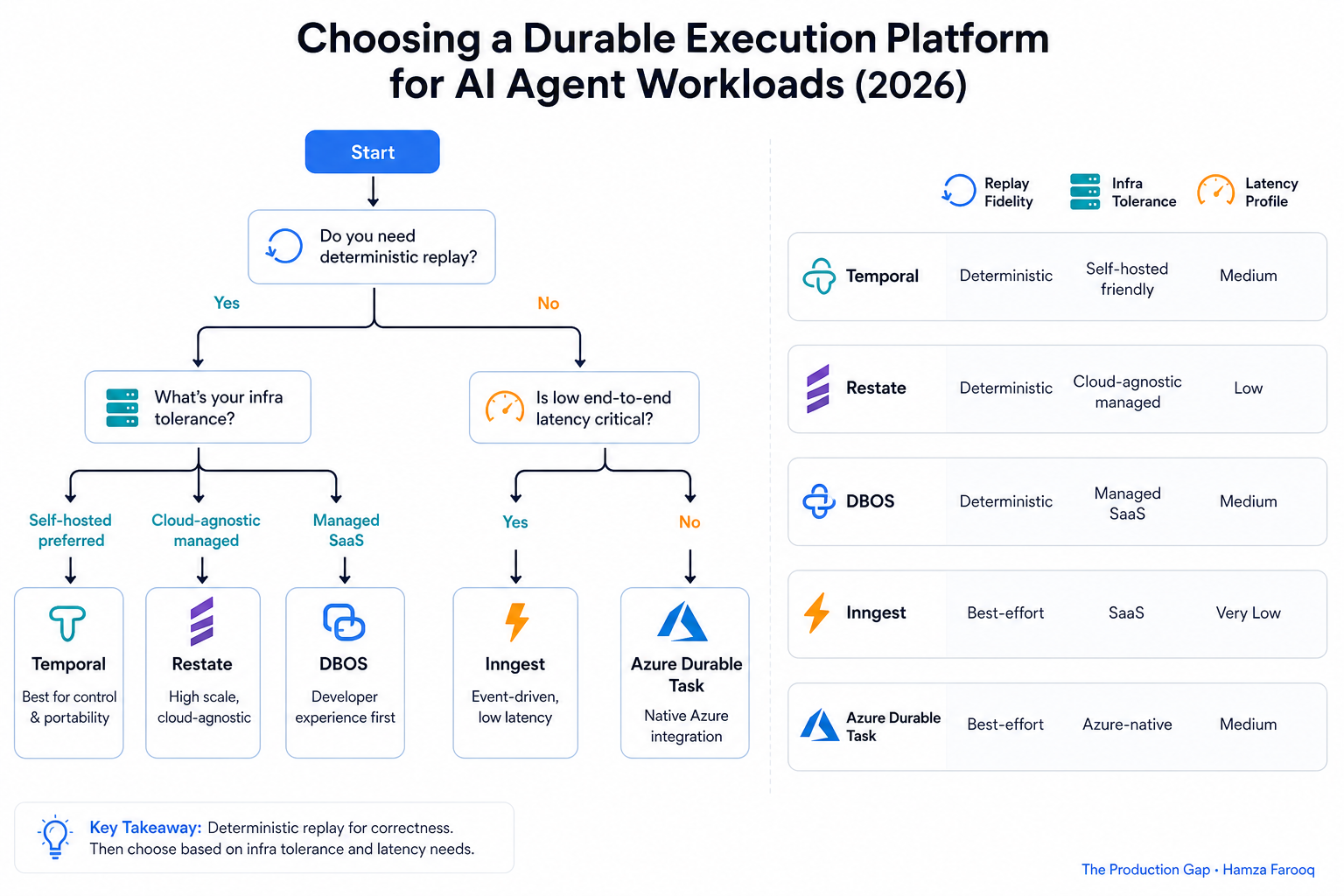
No single platform wins for every team. Each of the main contenders approaches agent workloads with different architectural trade-offs worth evaluating against your specific constraints.
The table below reflects published vendor and community documentation as of mid-2025. Platform capabilities change frequently; verify current feature status against each vendor's documentation before making a selection.
| Platform | Published agent guidance | Notes |
|---|---|---|
| DBOS | DBOS blog | Publishes dedicated crashproof agent guidance |
| Inngest | Inngest blog | Frames durable execution as key to production agents |
| Azure Durable Task | Microsoft Learn | Dedicated SDK documentation scoped to AI agents |
As a practical rule of thumb used in this guide, three questions should drive the evaluation. Do you need high-fidelity replay for audit purposes? That points toward platforms with explicit workflow history guarantees. Do you lack capacity to run a dedicated cluster? That favors managed or serverless-oriented options. Are you already inside a specific cloud ecosystem? Native integrations may reduce operational overhead more than any feature comparison would. Engineers are already working through these trade-offs in production, as the active discussion on Reddit r/node shows.
Frequently Asked Questions
What is the difference between durable execution and retry logic for AI agents? Retry logic restarts a failed operation from scratch without preserving prior state. Durable execution persists every completed step to an event log so a crashed agent resumes from its exact prior checkpoint, preventing duplicate side effects and preserving the causal decision history.
How does event-sourced replay enable exact recovery after a process crash? A durable engine appends every activity result to an immutable log. On restart, the engine replays that log deterministically, returning stored results instead of re-executing activities, so the workflow reaches the same in-memory state without re-firing any external tool calls.
How do you implement a human-approval pause in a durable-execution agent workflow? The workflow suspends at a named checkpoint, writes a signal subscription to the event log, and releases its thread. It resumes only when the approval event arrives. The specific API for sending that signal varies by platform; consult each platform's agent documentation for implementation details.
Why are LLM tool calls not idempotent, and how does durable execution handle this? Calling send_email() or book_flight() twice produces two real-world side effects. Durable execution assigns each activity an idempotency key tied to its position in the workflow history. On restart, the engine skips any step already recorded, guaranteeing exactly-once execution.
Conclusion
Run this test right now: kill your agent mid-workflow and see whether it resumes correctly or starts over. If it starts over, you have retry logic with a longer timeout. Review the platforms in the table above and prototype the pause-and-resume pattern against your actual workload this week.
Learn from me
Agent Engineering Bootcamp: Developers Edition, my Maven cohort. Advanced agentic RAG, multi-agent orchestration, memory, evals, and guardrails. Take agents from prototype to production. Join the next cohort →
Hire us
Traversaal.ai. We're a team of forward deployed engineers solving the toughest AI problems for Fortune 100 companies: document intelligence, agentic data platforms, and real-time web intelligence, deployed in production. Work with our team to deploy your next agentic ecosystem. Talk to Traversaal.ai →
Join us
Want to solve these problems with us? We're always looking for forward deployed engineers who want to ship production AI. jobs@traversaal.ai