EU AI Act Compliance for High-Risk AI Systems: Obligations, Audit Trails, and Human Oversight for Agentic Deployments
EU AI Act compliance gaps are costing deployers. Learn high-risk AI obligations, audit trail requirements, and human oversight rules for agentic systems.

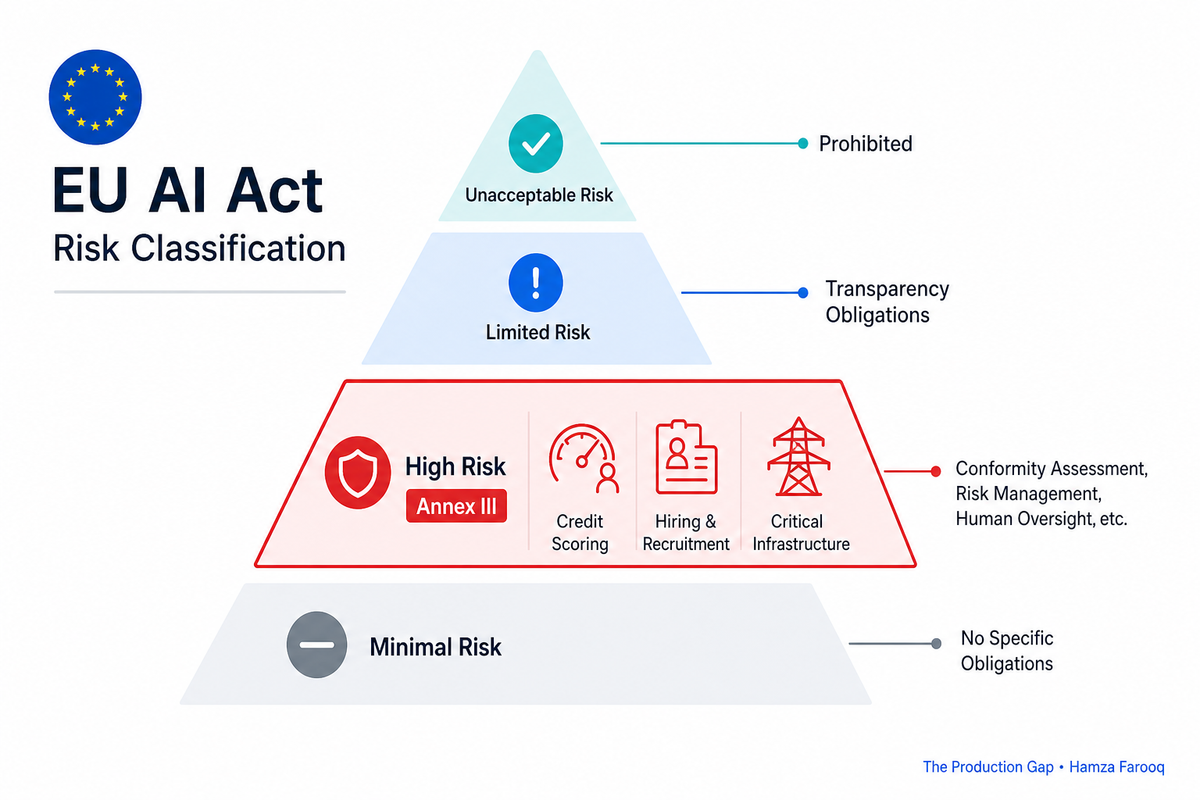
TL;DR: EU AI Act compliance for high-risk AI systems requires builders and deployers to implement mandatory risk classification, technical documentation, human oversight mechanisms, and auditable logs before placing agentic systems into regulated domains like credit, hiring, or critical infrastructure. Agentic deployments face heightened scrutiny because autonomous decision-making compresses the human review window the Act explicitly protects.
Your vendor sent a conformity certificate. Your legal team filed it and moved on. Here is what they almost certainly missed, and why the deployer gap is where most organizations are exposed.
Key Takeaways
- Annex III determines your risk tier: Credit scoring, hiring, and critical infrastructure almost certainly qualify as high-risk.
- Deployers carry independent obligations: Your vendor's paperwork does not cover you.
- Human oversight must be meaningful: Regulators require genuine ability to understand, challenge, and stop AI decisions.
- Audit trails are a legal requirement: Tamper-evident logs of inputs, outputs, and decisions are mandatory.
- Agentic architectures face extra scrutiny: Multi-step autonomous agents must have embedded human intervention points throughout the workflow.
Which AI systems qualify as high-risk, and how does Annex III determine your classification?
An AI system is high-risk if its primary use case falls within Annex III's eight enumerated category groups. Annex III is a named list, not a vague risk spectrum, and how a product is marketed does not change which category its function lands in.
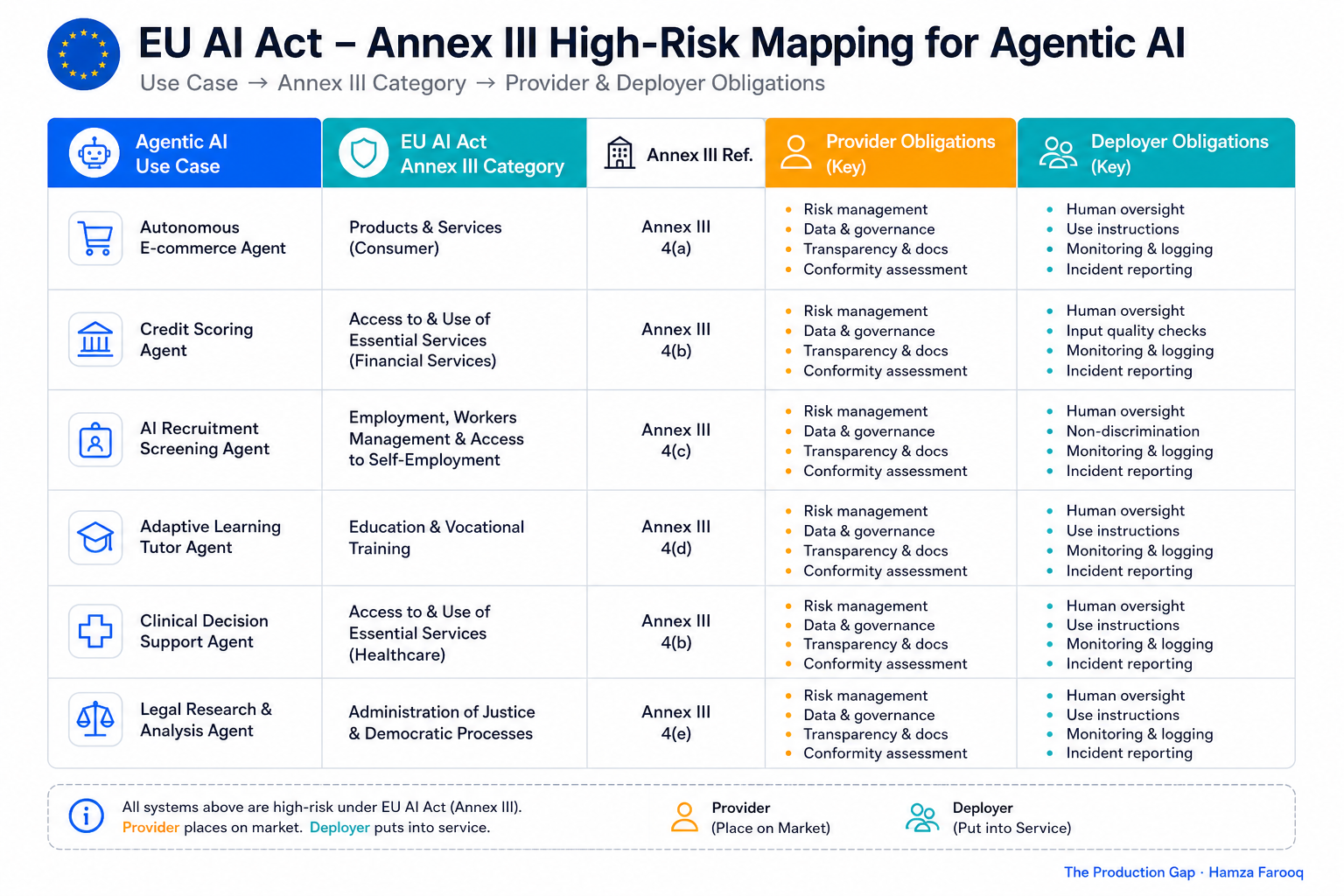
Three use cases are common in enterprise agentic deployments, and each maps to an Annex III category: credit decisioning agents (essential services, financial), CV-filtering and hiring agents (employment and workers management), and infrastructure management agents (critical infrastructure).
| Use Case | Annex III Category | High-Risk? | Provider Obligation | Deployer Obligation |
|---|---|---|---|---|
| Automated credit scoring agent | Essential services (financial) | Yes | Conformity assessment, technical docs | Usage logs, human oversight records |
| AI-powered CV screening tool | Employment and recruitment | Yes | Risk management system | Override logs, candidate notification |
| Autonomous grid management agent | Critical infrastructure | Yes | Robustness testing, logging | Incident reporting, intervention protocols |
| Internal HR chatbot (FAQ only) | General purpose / minimal risk | No (likely) | Transparency notice only | Minimal |
Use the official EU AI Act Compliance Checker as a structured self-assessment starting point, not a substitute for legal review. If your use case appears in the first three rows of the table above, you cannot self-exempt.
What are the technical documentation, audit trail, and human oversight obligations for high-risk deployments?
High-risk AI systems must maintain a continuously updated risk management system, tamper-evident logs of every decision, and a documented human oversight mechanism enabling real-time override, all three are independently enforceable under the EU AI Act.
Pillar 1: Risk management system
The risk management system is a living document that runs iteratively throughout the system's lifecycle, including after deployment. For agentic systems, document explicitly what the agent decides autonomously and when it must escalate to a human. The IAPP EU AI Act Compliance Matrix provides a useful structural reference for mapping key requirements.
Pillar 2: Tamper-evident audit logs
Tamper-evident logs of inputs, outputs, and decisions are a mandatory legal requirement, not a best practice. For agentic deployments, each step in a multi-decision chain must be individually logged so any single decision can be reconstructed by a regulator on demand. Consult the Act's implementing guidance and your legal counsel to confirm the specific retention periods applicable to your deployment context.
Pillar 3: Human oversight
A designated human must be able to understand what the system is doing, override it mid-process, and halt it entirely. A human who sees only the final shortlist from an autonomous hiring agent is ratifying a completed process, not exercising oversight. As a practical rule of thumb used in this guide: if your agent chains multiple decisions before any human sees output, your oversight architecture needs a structural redesign, not a policy addendum.
What obligations do deployers inherit when buying a third-party high-risk AI agent, and what must procurement contracts contain?
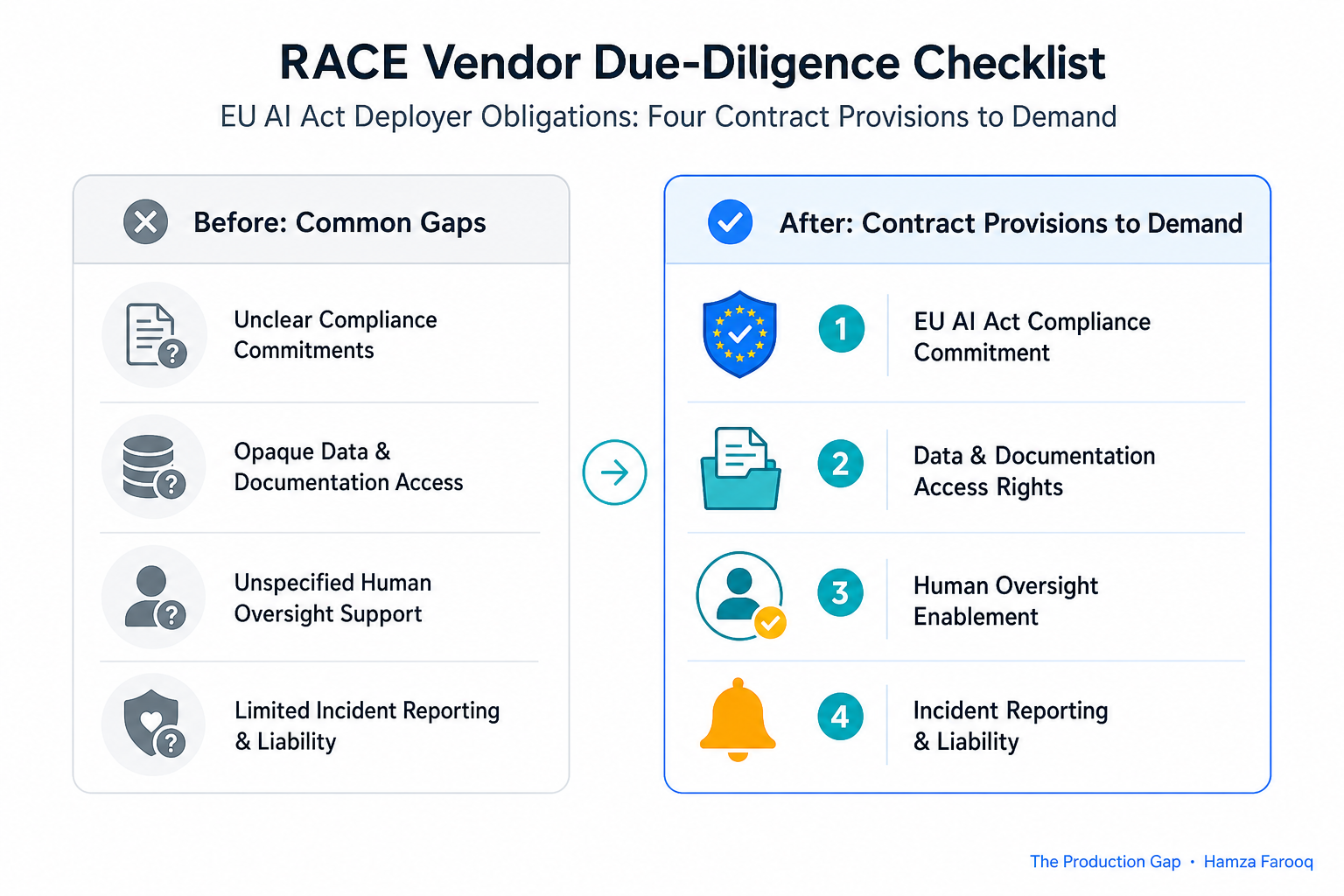
Deployers independently inherit obligations under the EU AI Act that no vendor contract eliminates, and the contracts written before the Act's obligations applied frequently contain none of the required provisions.
The RACE Vendor Due-Diligence Checklist
The RACE checklist below is a framework used in this guide, an author synthesis of the deployer obligations described above, structured as a practical procurement tool.
| Checklist Item | What to demand in the contract | Red flag if absent |
|---|---|---|
| R, Rights access | Right to access technical documentation on regulator demand | Vendor refuses audit access clauses |
| A, Audit log access | Contractual right to export your organization's usage logs | Logs held exclusively by vendor with no export SLA |
| C, Conformity evidence | Current, version-specific conformity assessment certificate | Certificate covers a different model version than deployed |
| E, Escalation protocol | Defined SLA for vendor to support your incident reporting obligation | No incident notification clause in the agreement |
When a regulator requests a deployer's oversight logs, the vendor's conformity certificate is a separate matter. The EU AI Act's extraterritorial scope means these obligations apply regardless of where the vendor is headquartered (artificialintelligenceact.eu). Procurement is now a compliance function.
Frequently Asked Questions
How do I determine if my AI agent qualifies as high-risk under the EU AI Act? Map your system's primary use case against Annex III's eight category groups, then use the official EU AI Act Compliance Checker as a starting point and obtain legal confirmation.
What human oversight requirements apply to autonomous agents making credit or hiring decisions? A human must be able to understand the agent's reasoning at each decision stage, override it mid-process, and halt it entirely. Reviewing only final outputs does not meet the standard.
What documentation must a deployer maintain when using a third-party AI vendor? Deployers must independently maintain usage logs, designate an oversight-responsible person, and retain records sufficient for regulators to audit any individual decision, regardless of what the vendor provides.
What are the penalties for non-compliance with high-risk obligations? Under Article 99 of the EU AI Act, penalties for violations involving high-risk systems can reach up to €35 million or 7% of total worldwide annual turnover for the preceding financial year, whichever is higher. The applicable tier depends on the nature of the violation and the organization's role as provider or deployer. Confirm how these tiers apply to your specific circumstances with legal counsel.
Conclusion
High-risk classification under Annex III is not discretionary, and its obligations fall on providers and deployers independently. The vendor's conformity certificate is necessary, and never sufficient.
Run every active high-risk AI vendor contract through the RACE checklist, then check your internal oversight architecture against the three pillars before your next agentic deployment goes live. The organizations that face the most exposure are not those who tried and fell short, they are the ones who assumed a vendor certificate was someone else's problem.
Learn from me
Agent Engineering Bootcamp: Developers Edition, my Maven cohort. Advanced agentic RAG, multi-agent orchestration, memory, evals, and guardrails. Take agents from prototype to production. Join the next cohort →
Hire us
Traversaal.ai. We're a team of forward deployed engineers solving the toughest AI problems for Fortune 100 companies: document intelligence, agentic data platforms, and real-time web intelligence, deployed in production. Work with our team to deploy your next agentic ecosystem. Talk to Traversaal.ai →
Join us
Want to solve these problems with us? We're always looking for forward deployed engineers who want to ship production AI. jobs@traversaal.ai