Embedded ML Engineering Teams: How the Databricks FDE Model Ships Production AI Inside Fortune 500 Data Organizations
Embedded ML engineering teams finally ship production AI. Learn how the Databricks FDE model uses access rights and sprint integration to make it stick.

TL;DR: Embedded ML engineering teams, as illustrated by the Databricks Field Data Engineer model, ship production AI inside Fortune 500 data organizations by positioning specialized engineers directly inside client environments with access to live pipelines, internal tooling, and cross-functional stakeholders. This model succeeds or fails based on three hard requirements: scoped system access, explicit workflow integration, and a defined organizational contract that separates the embedded team from generic professional services.
Key Takeaways
- FDE embedding is not consulting: Field Data Engineers sit inside customer sprint teams with shared pipeline ownership, not on the outside delivering recommendations.
- Access rights define the model: A true embedded FDE requires co-ownership of Unity Catalog permissions, MLflow experiments, and cluster policies. Without these, the engagement is traditional professional services.
- Workflow integration is the hard part: Shared sprint cadences and incident response inclusion separate embedded delivery from vendor support.
- Exit criteria prevent vendor lock-in: Defined knowledge transfer checkpoints must be built into the engagement before day one.
Introduction
Full Stack Deep Learning identified the pattern directly: ML teams with no control over data and no data engineering support rarely ship to production. The Databricks FDE embedding model addresses this by treating access rights and workflow integration as first-class requirements, not afterthoughts. The model works, and it carries consequences most vendor writeups skip entirely.
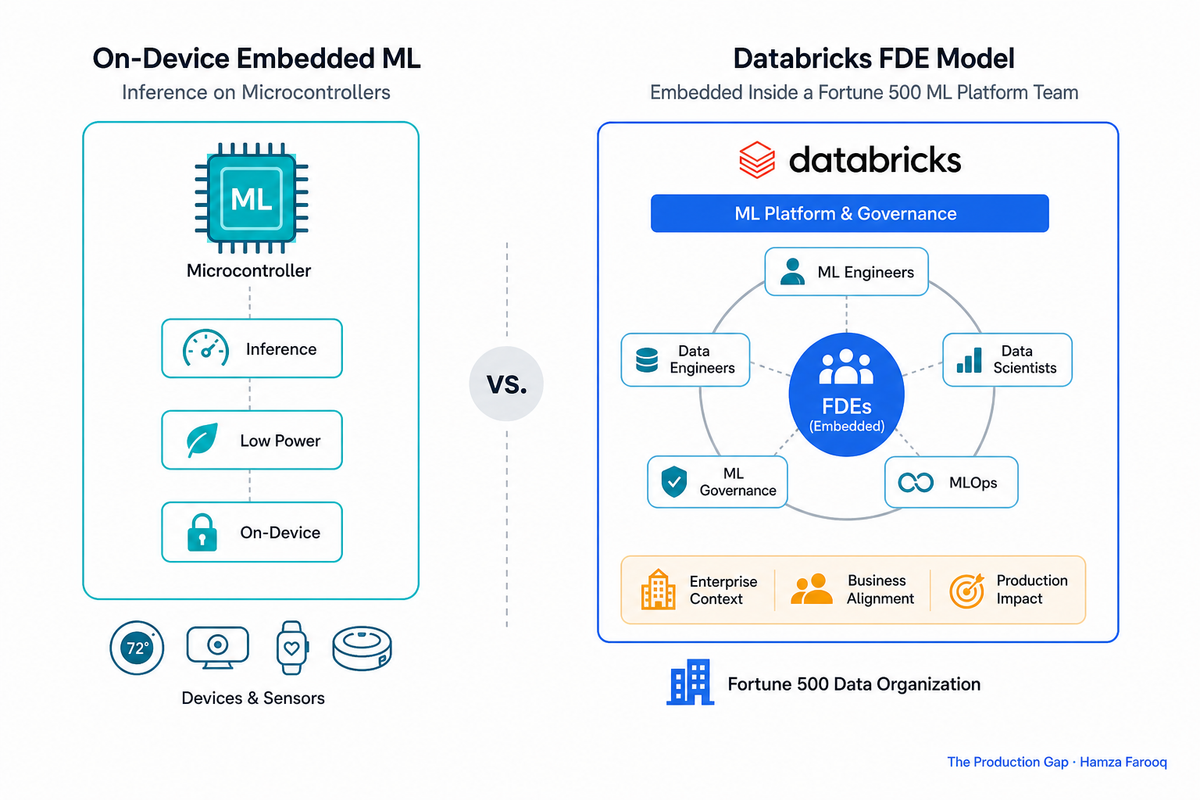
What does "embedded ML engineering" actually mean, and why are you reading about microcontrollers?
"Embedded ML engineering" names two completely different things: on-device inference for microcontrollers, and a human organizational pattern where a vendor engineer works inside a customer team. The Databricks FDE model is the latter.
This naming collision is professionally costly. When ML platform leads search for org-design patterns to solve a pipeline bottleneck, results are dominated by edge-device content. Edge Impulse defines embedded ML as "on-device inference for connected products" (correct for that domain, categorically irrelevant to enterprise org design. Embedded ML engineer roles on Indeed command $142,300 to $263,300 (based on Indeed listings at time of research) and require microcontroller expertise) nothing to do with lakehouse delivery.
What specific technical access does a Databricks FDE need to function as a true embedded engineer, not an external consultant?
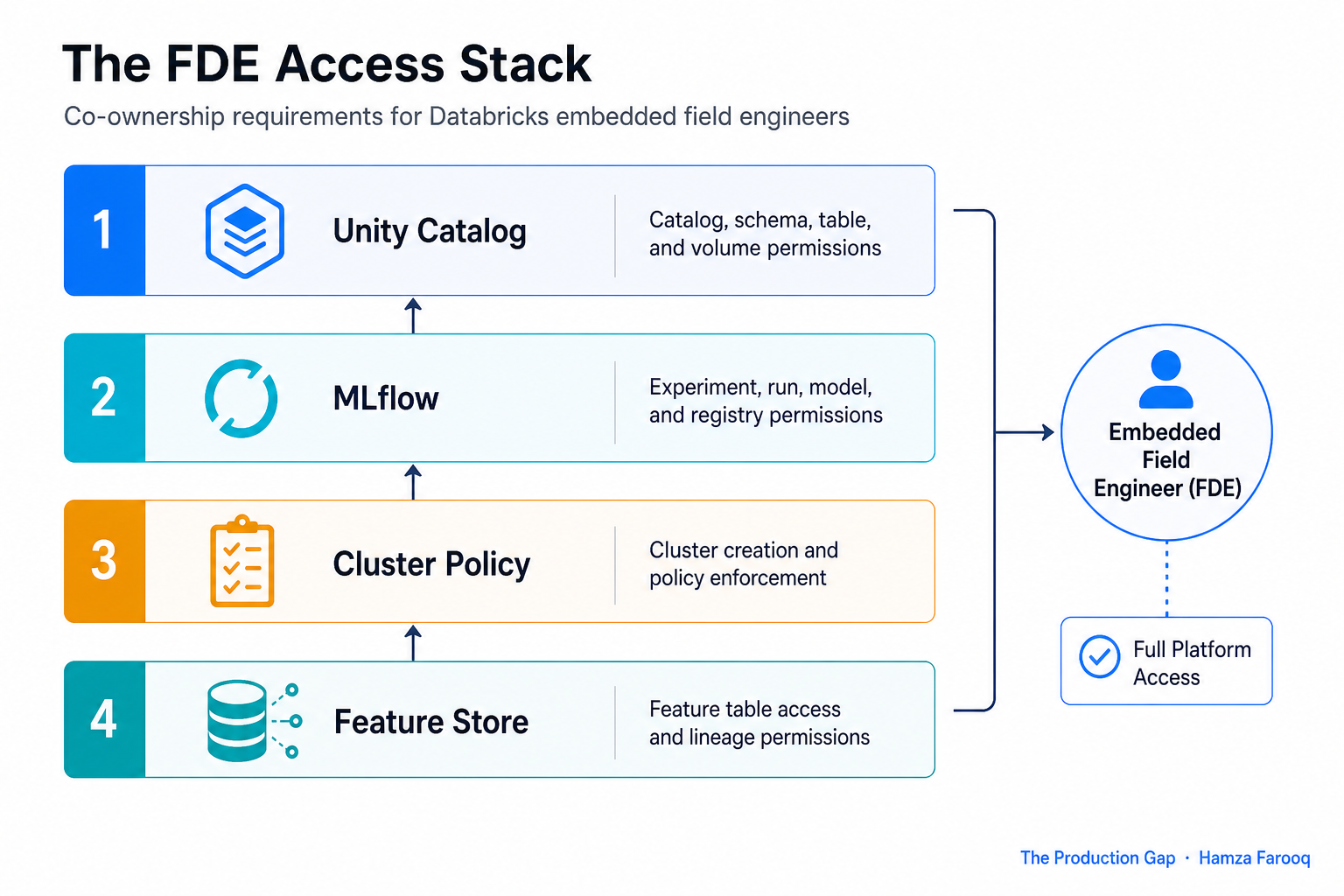
An embedded FDE requires co-ownership of Unity Catalog permissions, MLflow experiment namespaces, cluster policies, and feature store write access. Without all four, the engagement is professional services regardless of how the contract reads.
The FDE Access Stack has four non-negotiable layers:
- Unity Catalog permissions: Data-steward-level access to relevant catalogs and schemas. Column-level security and row-level filters scope the FDE precisely, the compliance case for granting external engineers production access in regulated environments.
- MLflow experiment co-ownership: The FDE must log runs, register models, and promote versions inside the customer's production MLflow tracking server, not a sandboxed demo namespace. This closes the artifact-handoff gap where a vendor delivers a notebook but the model lives nowhere the customer owns.
- Cluster policy co-ownership: The FDE needs to modify or create compute configurations. Read-only access creates a bottleneck every time infrastructure tuning is required, which is constant in production.
- Feature store write access: Without write access, the FDE can advise on feature engineering but cannot ship it. Advice is not delivery.
Table 1: FDE Embedded vs. Traditional PS vs. SI Engagement, Access and Workflow Dimensions
| Dimension | FDE Embedded | Traditional PS | SI Engagement |
|---|---|---|---|
| Unity Catalog access | Co-owner (data steward) | Read-only or sandbox | Usually sandbox |
| MLflow experiment ownership | Shared production namespace | Deliverable handoff | Deliverable handoff |
| Cluster policy rights | Co-owner | None | None |
| Feature store access | Write (production) | None | None |
| Sprint participation | Full member | Milestone check-ins | Milestone check-ins |
| Incident response inclusion | Yes | No | Rarely |
| Knowledge transfer mechanism | Defined exit criteria | Documentation | Documentation |
If any of the four access layers is missing, the engagement defaults to the SI column regardless of what the contract calls it.
How does the FDE model integrate into sprint and incident workflows, and what does it reveal about Databricks's actual incentives?
The FDE model's operational edge over traditional professional services is inclusion in shared sprint cadences and incident response, which forces the vendor engineer to co-own production failure, not just delivery.
A true embedded FDE carries assigned user stories in the customer's project tracking system, participates in sprint planning and retrospectives, and operates under the same definition of done as the internal team. Incident response inclusion is the practical test: if the FDE is not paged when a production ML pipeline fails, the embedding is performative.
Vendor writeups also skip the bidirectional knowledge flow. The customer gains delivery velocity; Databricks gains real-time observability into enterprise pipeline failure modes and feature engineering patterns. Understand what each party receives before signing.
The practical distinction: an FDE who is a named assignee on the champion-challenger model promotion ticket and included in the incident response channel, versus an FDE who delivers a notebook and attends a monthly steering committee.
What are the exit criteria that prevent FDE embedding from becoming permanent vendor dependency?
An FDE engagement without defined exit criteria is vendor dependency with modern org-design vocabulary. The exit plan must be written before the access stack is provisioned.
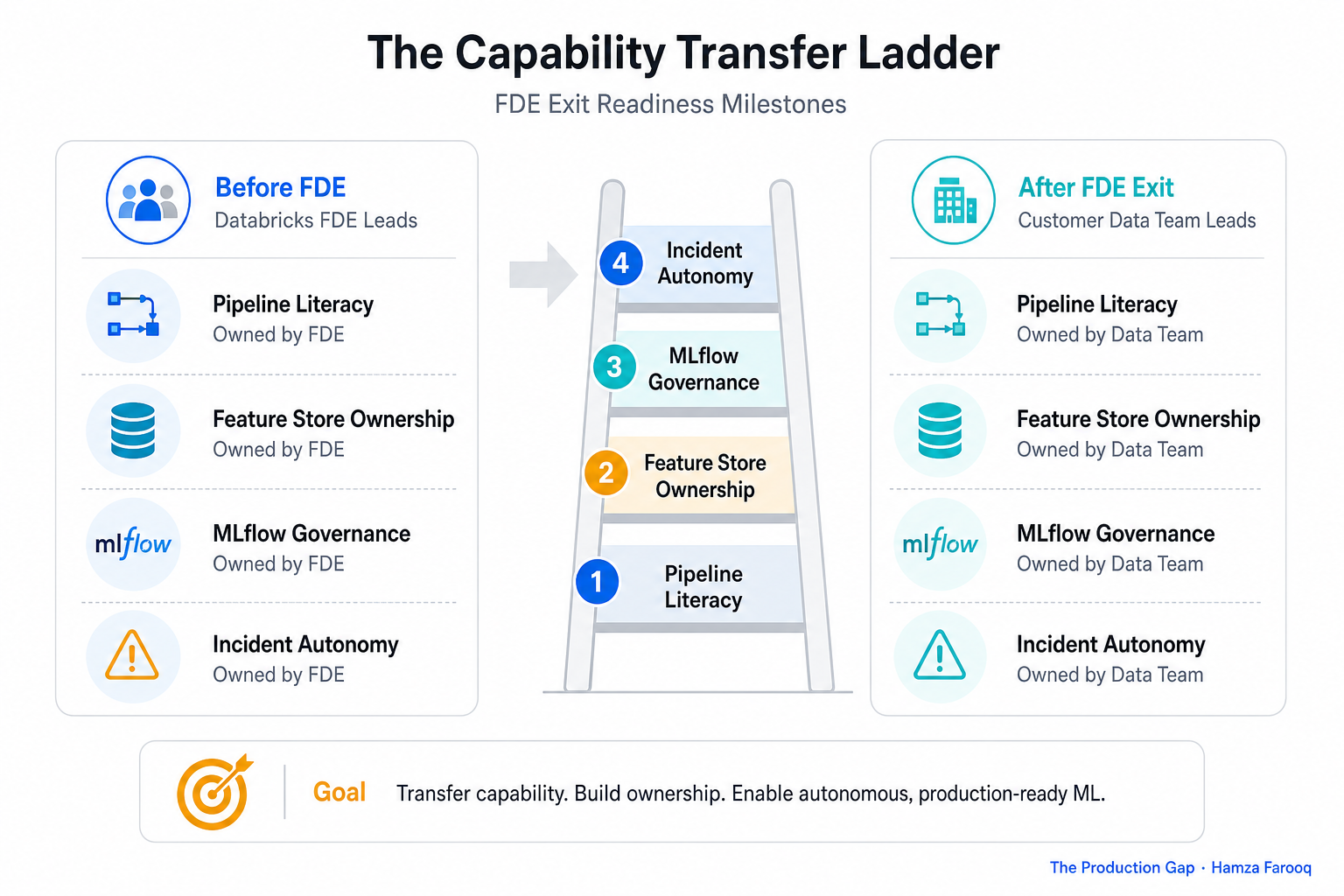
The Capability Transfer Ladder measures exit readiness through four sequential rungs:
- Pipeline literacy: At least two internal engineers can explain every production pipeline component without referencing the FDE.
- Feature store ownership: Internal engineers have authored and promoted at least one feature set end-to-end without FDE involvement.
- MLflow experiment governance: The internal team owns the model registry promotion workflow and has run at least one champion-challenger cycle independently.
- Incident autonomy: The internal team has resolved at least one production ML incident without FDE involvement, documented in the runbook.
Exit criteria must specify measurable outputs, not subjective readiness assessments. Criteria written in terms of documentation delivered rather than capability demonstrated are how this step most commonly fails.
Frequently Asked Questions
What is a Databricks FDE and how is it different from a regular consultant? A Databricks FDE works inside a customer's ML platform team as a co-owner of production pipelines, sharing sprint workflows, Unity Catalog permissions, and incident response, not delivering recommendations from the outside.
How does Unity Catalog allow an external engineer to work inside a regulated Fortune 500 environment without violating data governance? Column-level security, row-level filters, and fine-grained privilege grants scope the FDE to exactly the relevant catalogs and schemas. Readers should consult current Databricks Unity Catalog documentation to verify specific access control capabilities for their environment.
How do you structure sprint ownership when an embedded vendor engineer shares a production ML pipeline with an internal team? The FDE should be a named assignee on tickets for pipeline components they co-own, with sign-off from both parties on model promotion; sprint retrospectives should include knowledge transfer agenda items tied to the Capability Transfer Ladder.
What is the difference between the Databricks FDE model and hiring a system integrator? An SI works against milestone deliverables with sandbox or read-only access; an FDE operates with production-level co-ownership inside daily team workflows. SI dependency is scoped to a project; FDE dependency becomes structural if exit criteria are not defined upfront.
Conclusion
Two facts determine whether this model delivers. The FDE Access Stack is binary: co-ownership across Unity Catalog, MLflow, cluster policies, and the feature store, or the engagement defaults to professional services. Sprint membership and incident response inclusion are the operational tests that separate genuine embedding from a rebranded vendor relationship.
Full Stack Deep Learning's diagnosis still applies: ML teams without data engineering support rarely ship to production. The FDE model closes that gap, but the customer's job is to make the FDE unnecessary as quickly as possible.
Before the next engagement kickoff, write all four rungs of the Capability Transfer Ladder into the SOW as measurable exit criteria, and ask Databricks to name the internal owner for each rung at engagement end. If that question cannot be answered at the start, the engagement is structured for continuation, not transfer.
Learn from me
Forward Deployed Engineering Bootcamp for Full-Stack Developers, my Maven cohort. Build and ship complete AI products end to end, from React and Node.js frontends to deployed models with caching and observability. Join the next cohort →
Hire us
Traversaal.ai. We're a team of forward deployed engineers solving the toughest AI problems for Fortune 100 companies: document intelligence, agentic data platforms, and real-time web intelligence, deployed in production. Work with our team to deploy your next agentic ecosystem. Talk to Traversaal.ai →
Join us
Want to solve these problems with us? We're always looking for forward deployed engineers who want to ship production AI. jobs@traversaal.ai