Ephemeral Credentials Per Request: How Per-Tool-Call Credential Issuance Replaces Rotation Schedules for Long-Running Agent Sessions
Ephemeral credentials per request fix broken rotation schedules for agent sessions. Learn how per-tool-call issuance via forward proxies keeps workload IAM secure.

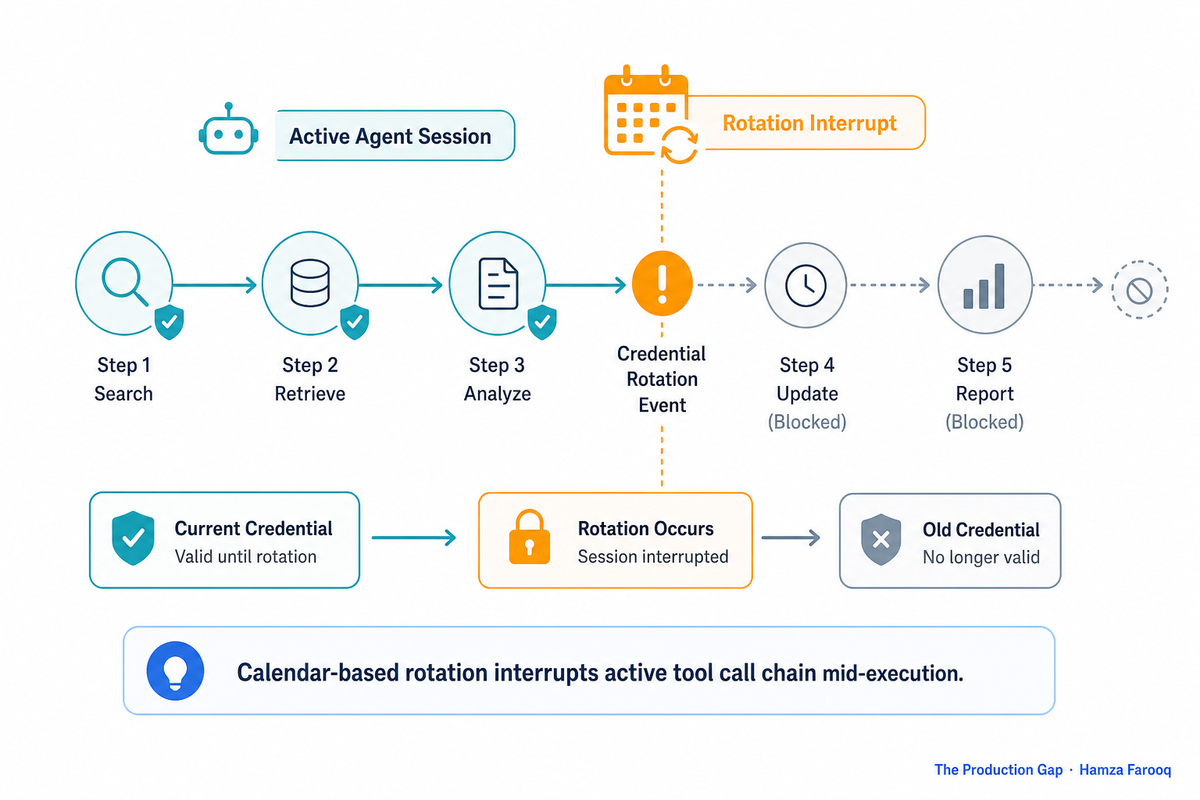
TL;DR: Ephemeral credentials per request replace rotation schedules for long-running agent sessions by issuing a fresh, scoped credential for every individual tool call through a forward proxy, then expiring it immediately after that call completes. Calendar-based rotation is structurally incompatible with agentic workloads because a session can outlive any fixed interval, leaving a single credential exposed across thousands of actions. Per-call issuance closes that gap by making credential lifetime match action lifetime, not clock time.
Key Takeaways
- Calendar rotation breaks live sessions: A scheduled refresh that fires mid-task invalidates the token an agent is actively using.
- Per-tool-call issuance replaces rotation schedules: A fresh short-lived token is minted and discarded per invocation, with no stale credential to rotate out.
- Forward proxies handle the credential plumbing: The proxy intercepts each outbound call, injects a freshly issued token, and tears it down after the response.
- Scope is bound to a single tool call: A compromised token from one step cannot be reused for any other operation.
- Workload identity is the prerequisite: Agents must hold a verifiable machine identity before a proxy can safely issue per-call tokens.
- Scoping and rotation mechanics are separate problems: Conflating least-privilege IAM policy with credential lifecycle leaves the rotation layer unaddressed.
Introduction
Long-running agent sessions require per-request credential issuance because any fixed rotation schedule can fire mid-task, revoke the active token, and crash the session with no clean recovery path. This is a structural incompatibility, not a tuning problem. Credential lifecycle management is already moving from 24-hour tokens toward ephemeral credentials measured in seconds, and as of August 2026, the Identity Defined Security Alliance identifies dynamic ephemeral credentials as the gold standard of modern workload IAM. The fix is a forward proxy that issues a fresh credential per tool call, removing rotation schedules entirely. This is not a new IAM policy; it is a shift in where rotation responsibility lives.
Why does calendar-based credential rotation break long-running agent sessions?
Rotation fires, the vault issues a new credential, and the current token is gone. Any in-flight tool call returns a 401, and no retry recovers cleanly. The agent's session state, including partial results, open connections, and queued calls, was built on the now-dead token. That is a state-coherence problem, not a retry problem. The move to ephemeral credentials reflects a structural change in how workload authentication must be designed for agentic systems. The issue is not the rotation interval; it is that rotation fires with no knowledge of what the session is doing.
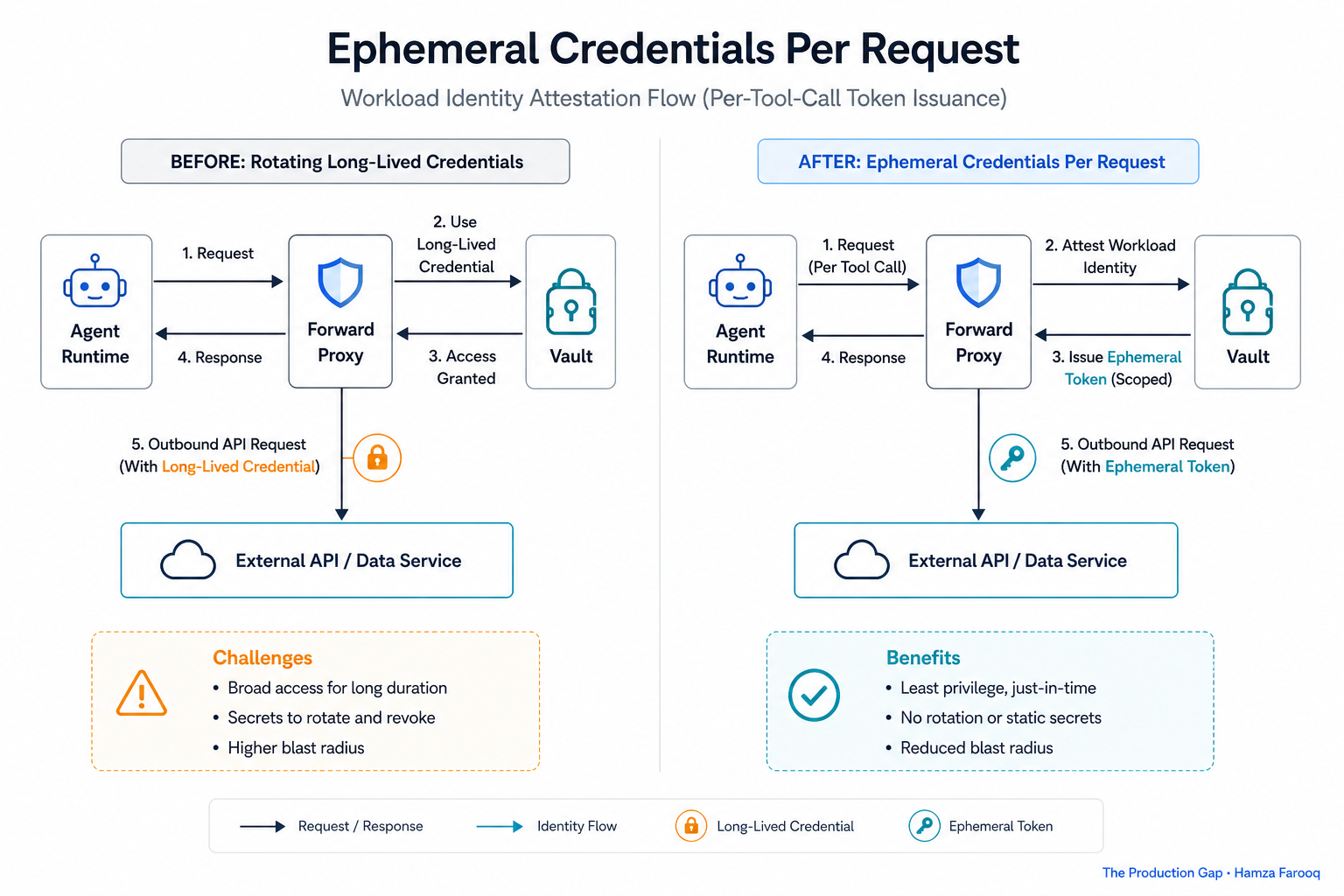
How does a forward proxy issue ephemeral credentials per tool call without the agent implementing refresh logic?
The lifecycle runs in four steps: (1) the agent signals a tool call; (2) the proxy intercepts the outbound request; (3) the proxy calls the vault with the agent's workload identity to mint a task-scoped token with TTLs measured in seconds; (4) the proxy injects the token, forwards the request, receives the response, and tears the token down. The agent sees only a successful API call. The Ephemeral Agent Credentialing v1.4 specification formalizes this proxy-interception model. Open-source credential proxy tooling for agent workloads is now available, and OAuth with per-call scope binding is the token protocol underlying this flow.
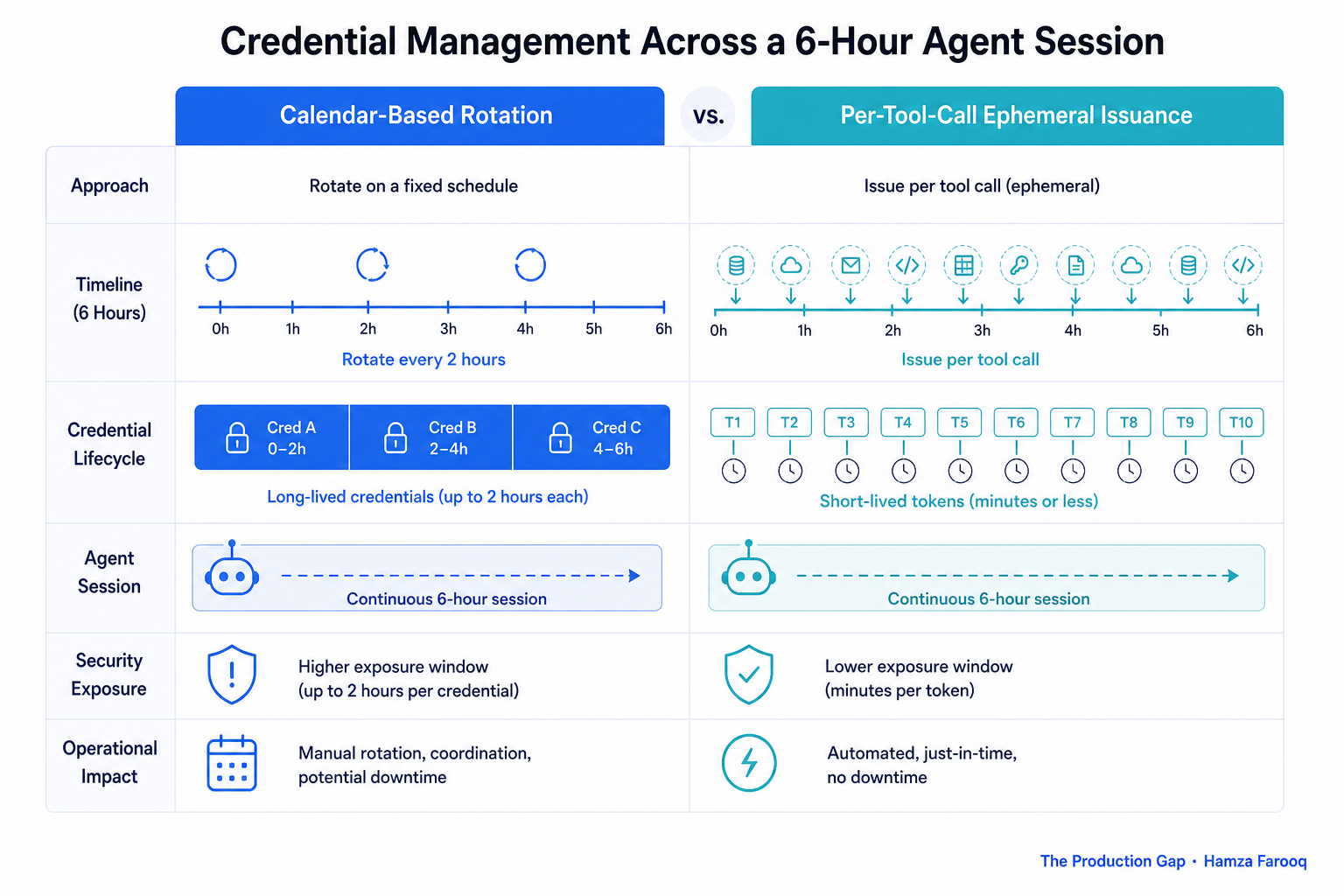
Table 1: Calendar-Based Rotation vs. Per-Tool-Call Ephemeral Issuance
| Dimension | Calendar-based rotation | Per-tool-call ephemeral issuance |
|---|---|---|
| Rotation trigger | Fixed clock schedule | Each individual tool invocation |
| Token TTL | Hours | Seconds |
| Session awareness | None | Fully bounded to one call |
| Agent refresh logic required | Yes (or crash on expiry) | No, proxy handles entirely |
| Blast radius of compromise | Full session scope | Single tool call scope |
| Rotation boundary risk | High (fires mid-task) | Eliminated |
How is scope determined for a per-tool-call ephemeral credential, and why does this differ from least-privilege IAM scoping?
Least-privilege IAM answers: what is this agent allowed to do across its entire lifetime? That is a policy problem. Per-tool-call credential mechanics answers: what is this token authorized to do for the next few seconds? That is a lifecycle problem. Conflating them leaves the rotation layer unaddressed. IAM policy implementations typically assume a scheduler manages credential rotation, and that assumption is what produces the 401-mid-task failure.
When the proxy intercepts write_file(path="/reports/q3.csv"), the minted token covers only that path. A simultaneous read_database() call gets entirely separate permissions and a separate TTL. Zero-trust framing for AI agents treats per-call scoping as a foundational requirement, and as of August 2026, Zylos Research identifies per-call credential lifecycle management as the active frontier problem in multi-agent deployments. Scoping is the policy layer; per-tool-call issuance is the mechanics layer. Each is required, and neither substitutes for the other.
What is the workload identity prerequisite that makes per-request credential issuance possible?
Per-request ephemeral credential issuance requires an agent runtime to hold a cryptographically attested workload identity, a machine identity the proxy can verify before minting any per-call token.
Without that verified identity, any process on the network could impersonate the agent and trigger token issuance. The trust chain works as a practical rule of thumb in this guide: the agent is provisioned with a workload identity at deployment, the proxy presents this identity to the vault per tool call, the vault validates and mints the scoped token, and the proxy injects and discards it. The agent's long-term identity is never exposed to external APIs.
Frequently Asked Questions
What happens to an agent session when a calendar-based credential rotation fires mid-task?
The active token is revoked immediately, the in-flight call returns a 401, and session state including partial results, queued calls, and open connections is lost with no clean recovery. Retry logic can reissue a single call; it cannot reconstruct deterministic state built on the now-dead token.
How does the forward proxy authenticate to the vault without itself becoming a long-lived credential risk?
The proxy authenticates using the agent's workload identity assertion, a short-lived, automatically rotated cryptographic identity managed by the workload identity infrastructure, never a static secret. This mechanism keeps the proxy from reintroducing the long-lived credential problem it is designed to eliminate.
Which tools implement credential proxy patterns for AI agent workloads?
The Ephemeral Agent Credentialing v1.4 specification and open-source credential proxy tooling are the primary implementations practitioners reference today. The specification provides the formalized pattern; the open-source tooling provides a working proxy and vault integration built against it.
Is OAuth sufficient, or does per-tool-call issuance require a custom protocol?
OAuth with short TTLs and per-call scope binding is sufficient; no custom protocol is needed. The engineering work is concentrated in the proxy and vault integration, not in replacing the token protocol itself.
Conclusion
Least-privilege IAM tells a credential what it can do. Per-tool-call ephemeral issuance governs when and how that credential exists. These are separate problems that require separate solutions, and addressing only the policy layer leaves the lifecycle layer exposed.
The architecture is documented: workload identity as the cryptographic trust anchor, a forward proxy as the interception and issuance layer, and task-scoped ephemeral tokens with second-range TTLs as the operational credential. The v1.4 specification and open-source tooling make this buildable today.
Two diagnostics worth running, framed here as a practical rule of thumb: whether your agent holds any credential with a TTL longer than its longest expected tool call, and whether your rotation schedule has any awareness of session state. Either gap points to the forward proxy pattern as the next engineering problem to scope.
Learn from me
Forward Deployed Engineering Bootcamp for Full-Stack Developers, my Maven cohort. Build and ship complete AI products end to end, from React and Node.js frontends to deployed models with caching and observability. Join the next cohort →
Hire us
Traversaal.ai. We're a team of forward deployed engineers solving the toughest AI problems for Fortune 100 companies: document intelligence, agentic data platforms, and real-time web intelligence, deployed in production. Work with our team to deploy your next agentic ecosystem. Talk to Traversaal.ai →
Join us
Want to solve these problems with us? We're always looking for forward deployed engineers who want to ship production AI. jobs@traversaal.ai