Forward Deployed Engineer Explained: 10 Things You Need to Know About the FDE Role
Forward deployed engineer explained: what the FDE role is, how it differs from solutions engineering, and why it's the AI era's most in-demand technical job.

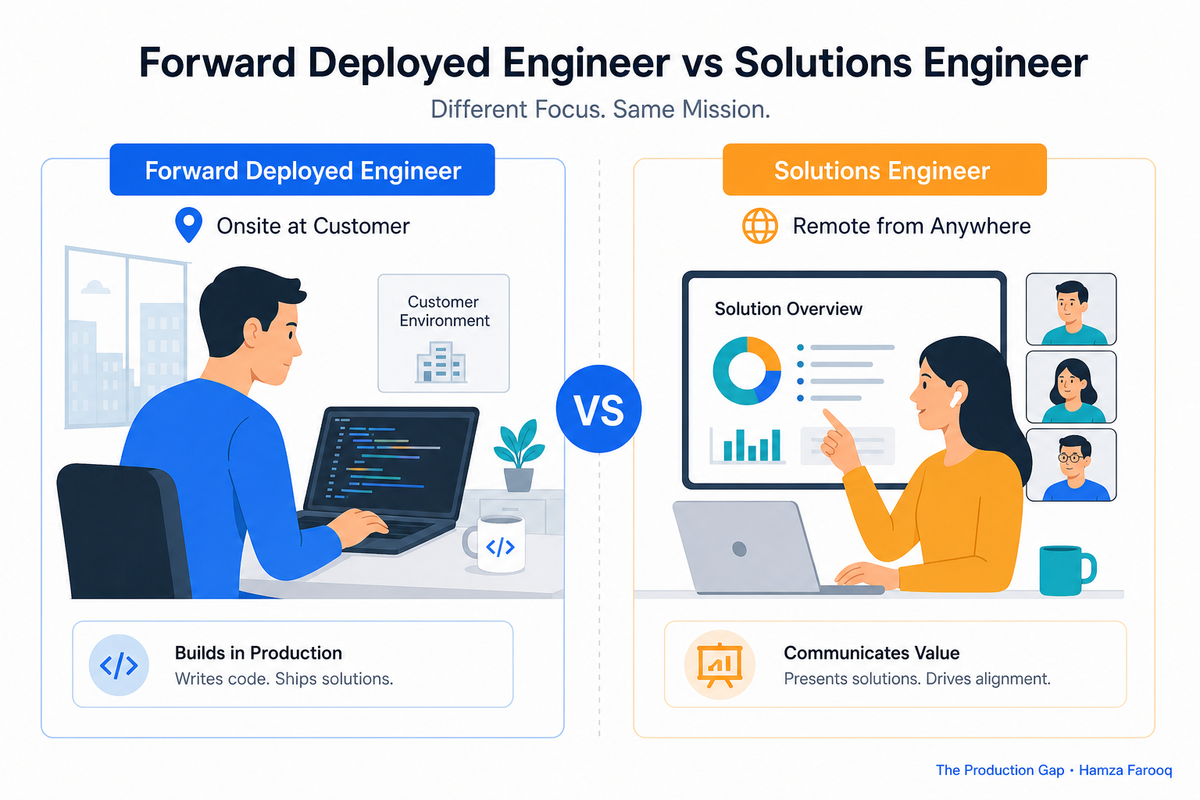
TL;DR: A forward deployed engineer (FDE) is a software engineer who embeds directly inside a customer's environment to solve complex technical problems, customize enterprise software, and ensure successful adoption, blending solutions architecture and hands-on coding into one role. They work at the intersection of product and customer, acting as both technical translator and builder to drive real-world outcomes in production, not in a sandbox.
Key Takeaways
- Palantir pioneered the FDE model: engineers embedded directly inside customer environments to ship working software on-site, in environments too complex for remote support.
- FDEs are not solutions engineers: forward deployed engineers write production code inside the customer's environment and own the deployment outcome end to end.
- AI adoption made this role urgent: as enterprises moved from pilots to full-scale deployments, a last-mile gap opened that consulting and sales engineering could not close.
- The job is equal parts coding and translating: FDEs turn messy operational problems into working software, not specs or slides.
- Field work feeds the product roadmap: FDE learnings flow directly back to core engineering, making the role a critical source of real-world product signal.
- Adaptability outranks specialization: strong FDE candidates combine solid fundamentals with fast context-switching, clear communication, and composure under pressure.
Enterprise AI deployments run inside hospitals, logistics networks, and financial institutions with zero tolerance for demo-day behavior. Most stall at the last mile because no one can make a working model function inside messy, legacy-riddled operations. That is the gap the forward deployed engineer (FDE) closes, and it is the fastest-growing engineering role of the AI era.
1. A forward deployed engineer builds inside the customer's environment
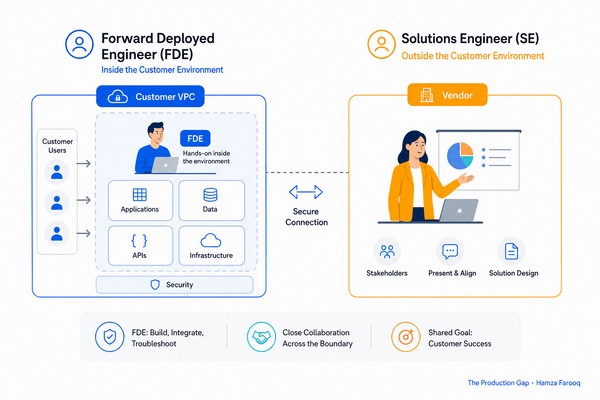
A forward deployed engineer embeds directly inside a customer's environment, writes production code on-site, and owns the deployment outcome, not from a distance, but from within the operation itself.
The sharpest working definition: an FDE is "what happens when you mix a software engineer with a consultant and drop them straight into a customer's environment." In practice, that means a software engineer whose desk is inside a hospital's IT operations center, not visiting, not advising, but building.
2. Palantir created the role
Palantir Technologies pioneered the role as Forward Deployed Software Engineer (FDSE) because government and enterprise clients required working systems built inside their environments rather than products handed off remotely.
3. It is not a solutions engineer, consultant or product engineer
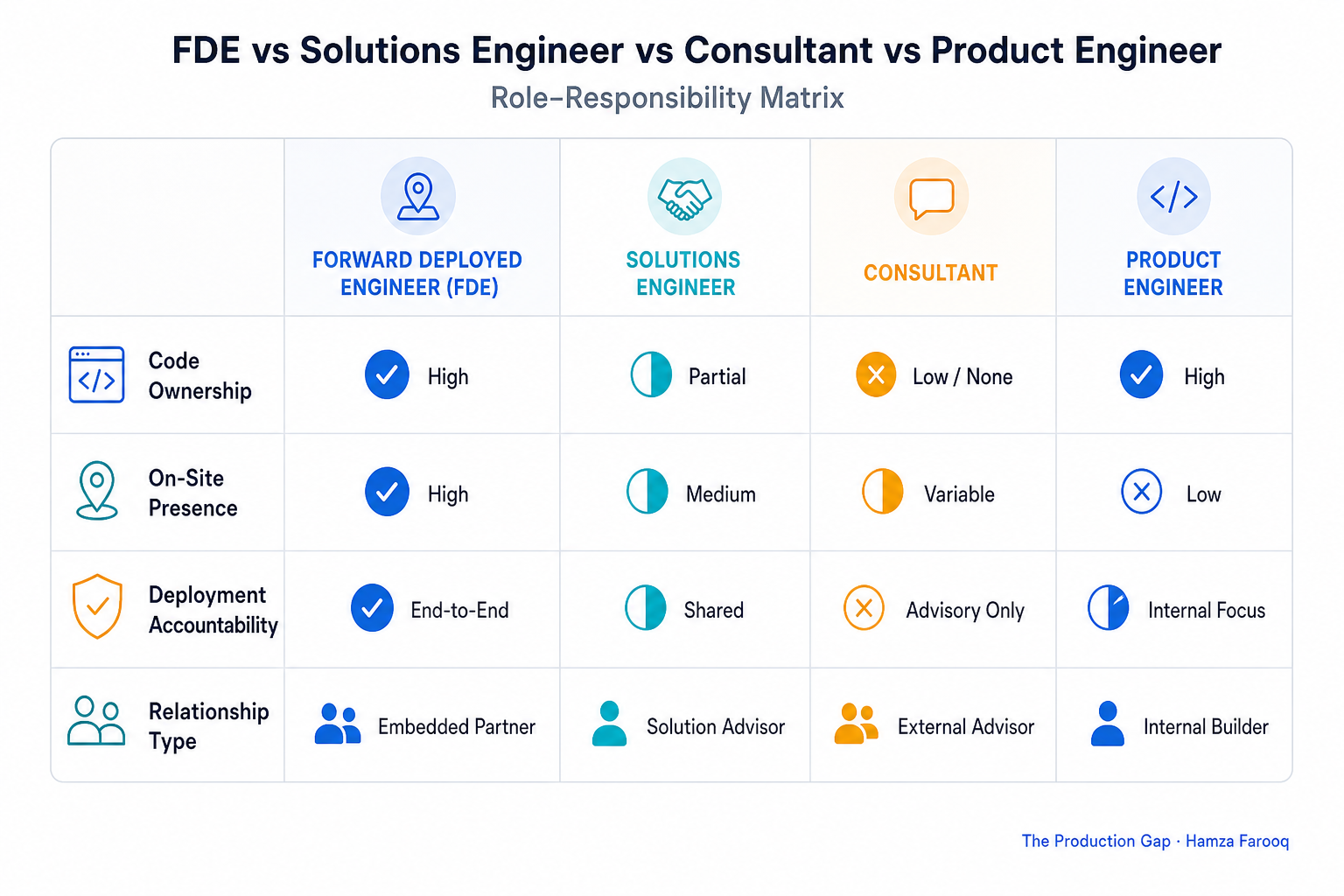
A forward deployed engineer ships production code inside the customer's system; a solutions engineer demos the product and advises from the outside, and that single distinction separates two roles that are otherwise easy to confuse.
The core difference comes down to ownership and code. An FDE owns the deployment outcome and writes real code in the customer's environment, while a solutions engineer owns pre-sales technical fit, a management consultant owns a recommendation deck, and a product engineer owns a feature in the vendor's internal codebase. As educative.io notes, the FDE role "spans the path from problem definition to production", and that full-stack ownership is the clearest differentiator from every adjacent role.
Table 1: FDE vs. Adjacent Engineering Roles
| Role | Writes Prod Code? | On-site? | Owns Outcome? | Primary Relationship |
|---|---|---|---|---|
| Forward Deployed Engineer | Yes | Yes | Yes | Customer ops team |
| Solutions Engineer | No | Occasionally | No | Buyer/evaluator |
| Management Consultant | Rarely | Sometimes | No | Executive sponsor |
| Product Engineer | Yes | No | Partial | Internal product team |
| Implementation Consultant | Sometimes | Sometimes | Partial | Project sponsor |
If you are not shipping code inside the customer's environment, you are not doing FDE work, regardless of the title.
4. The day mixes debugging, interviews and code
On any given day, a forward deployed engineer is debugging a data pipeline, interviewing an operations manager about a broken workflow, and writing the code that replaces it with something that works.
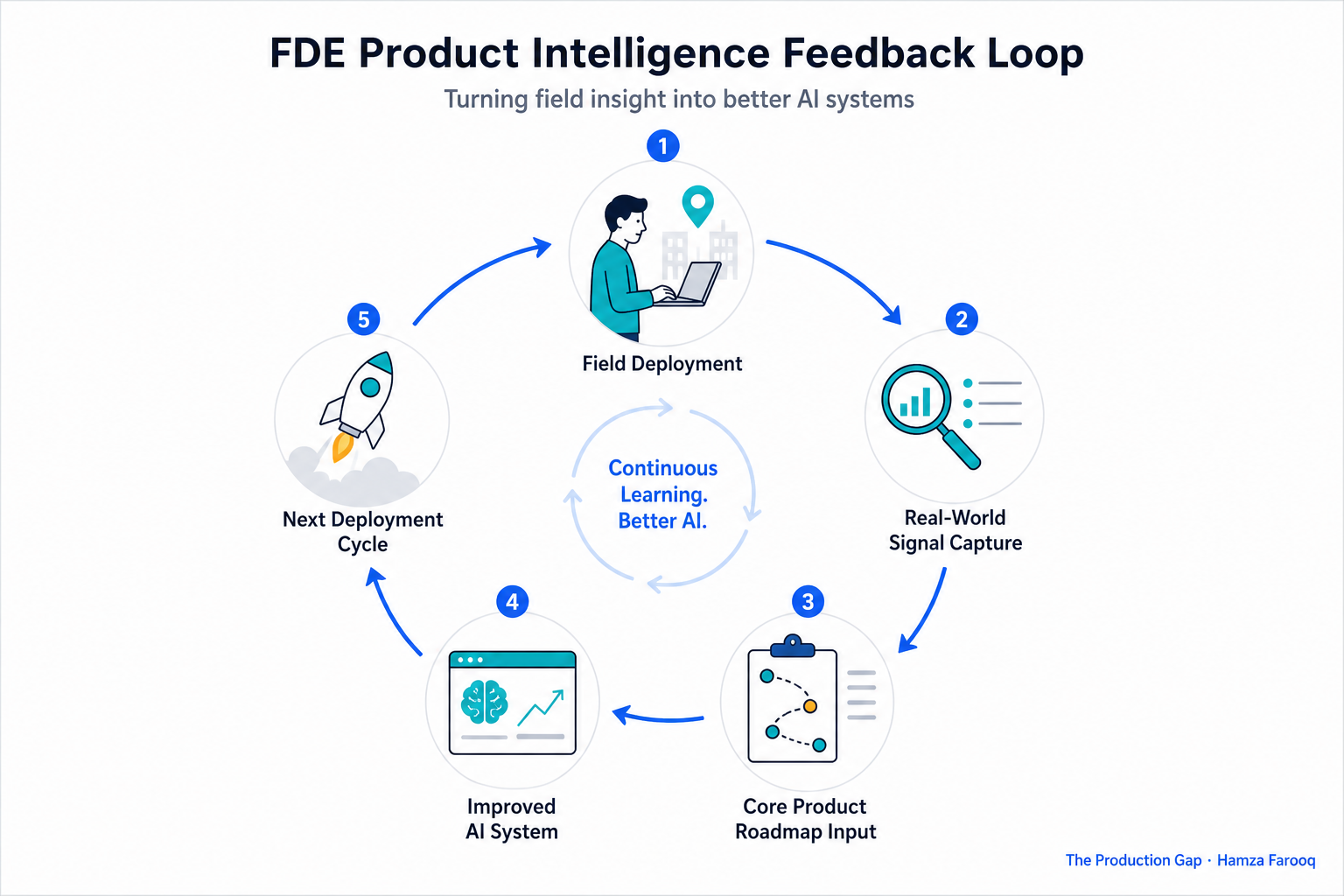
5. The work runs on a discover, translate, build and feed back loop
The daily loop follows four steps, a framework used in this guide as author synthesis of the role's core pattern:
The FDE Discovery-to-Feedback Loop
- Discover. Work alongside domain experts; real problems and documented problems rarely match the statement of work.
- Translate. Convert a messy human workflow ("we have 14 spreadsheets that tell us if a shipment is late") into a technical problem solvable with code.
- Build. Write and ship production code in the customer's environment. Not a prototype. Not a demo.
- Feed back. Document what the product cannot yet handle and route that intelligence to core engineering.
This loop repeats across every engagement and is what separates sustained FDE value from a one-time deployment handoff.
6. Five skills matter more than any one specialty
Strong software fundamentals are the floor, but the five capabilities below determine whether an engineer thrives or stalls in the field, a practical rule of thumb drawn from the role's core demands:
The FDE Five-Skill Profile
- Full-stack software fundamentals: ship code under pressure in unfamiliar environments.
- Systems thinking: diagnose a broken operation, not just a broken API.
- Non-technical communication: explain a data model to a plant manager in one sentence.
- Tolerance for ambiguity: requirements change daily; stay productive anyway.
- Speed over perfection: working code that ships beats elegant code that does not.
Candidates who can only do one half of this profile will find themselves limited in the field. The role demands rigorous engineering and operational translation in equal measure.
7. AI deployments fail at the last mile, not the model
The failure point in AI deployments is almost never the model. It is data quality, legacy integration, workflow misalignment, and organizational resistance, and the FDE model addresses the gap between AI's promise and organizational reality.
8. FDEs own long-term value, not a one-time handoff
The forward deployed engineer is also responsible for ensuring that the platform provides long-term value to the client, which requires sustained presence inside the customer's environment rather than a one-time handoff.
9. What FDEs learn in the field should shape the product
When field learnings are not routed back to core engineering in structured form, signal that could sharpen the roadmap goes to waste. Treating the FDE function as a product intelligence system rather than only a delivery mechanism is the strategic advantage most teams are leaving on the table.
10. Hiring is broad, and most of it is in the US
Traversaal's FDE job board tracks 1,249 forward deployed roles from 707 companies (as of 19 October 2026; updates weekly). About 60% are in the US, 19% in Europe and 6% in India, and the biggest hirers on the board are Google, Databricks and Salesforce. Among US listings that publish pay, the median midpoint is about $174k for mid-level roles and $210k for senior ones.
Frequently Asked Questions
What is a forward deployed engineer in simple terms? A software engineer who works inside a customer's environment to build and ship what that customer needs, writing real production code, owning the deployment outcome, and bridging the gap between what a product can do and what an operation actually requires.
Is the FDE role the same as a solutions engineer? No. A solutions engineer demos and advises on technical fit before the sale; a forward deployed engineer writes production code inside the customer's environment after the sale and owns whether the deployment succeeds.
Which company invented the forward deployed engineer model? Palantir Technologies pioneered the role as Forward Deployed Software Engineer (FDSE) because government and enterprise clients required working systems built inside their environments, not products handed off remotely.
What skills do I need to become a forward deployed engineer? Strong software fundamentals are non-negotiable. What separates strong candidates is systems thinking, clear communication with non-engineers, comfort with fast-changing requirements, and the discipline to ship under pressure.
Conclusion
From the outside, the FDE role looks like a deployment function. Look closer and it is also a direct test of whether a product holds up against real operations, real users, and real consequences.
For engineers weighing the move: the FDE path offers ownership, variety, and proximity to real problems that most roles cannot match. The tradeoff is ambiguity and pace. For team builders: treating the FDE function as a product intelligence system from day one, not just a delivery mechanism, is worth taking seriously. If field learnings are not reaching core engineering in structured form, signal that could sharpen the roadmap is going to waste.
The role exists to solve the last-mile problem that stalls most AI deployments. Whether you are building the team or joining one, that is the job, and it is harder than it looks on paper.
Your next step: Assess your skills against the five skills above, then start Traversaal's free FDE courses and browse open roles on the FDE job board
Learn from me
Forward Deployed Engineering Bootcamp for Full-Stack Developers, my Maven cohort. Build and ship complete AI products end to end, from React and Node.js frontends to deployed models with caching and observability. Join the next cohort →
Hire us
Traversaal.ai. We're a team of forward deployed engineers solving the toughest AI problems for Fortune 100 companies: document intelligence, agentic data platforms, and real-time web intelligence, deployed in production. Work with our team to deploy your next agentic ecosystem. Talk to Traversaal.ai →
Join us
Want to solve these problems with us? We're always looking for forward deployed engineers who want to ship production AI. jobs@traversaal.ai