Holistic Agent Benchmark Evaluation: How HAL's Multi-Benchmark Harness Beats Single-Benchmark Testing
Holistic agent benchmark evaluation exposes AI agent gaps single benchmarks miss. See how HAL's multi-benchmark harness stops score gaming cold.

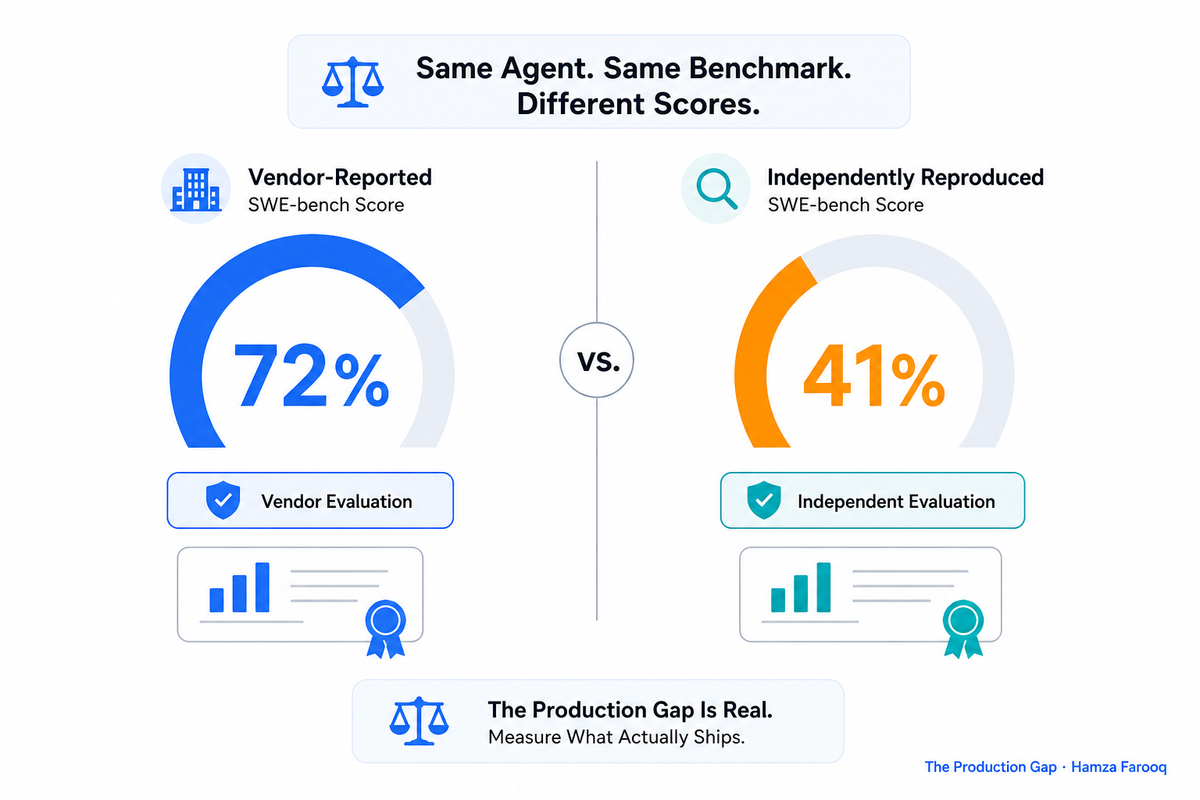
TL;DR: Holistic agent benchmark evaluation through HAL's multi-benchmark harness produces more trustworthy performance data because it surfaces how agents generalize across diverse tasks rather than overfit to a single test. Built-in cost tracking ensures comparisons reflect real-world deployment tradeoffs. No single benchmark can expose both capability gaps and economic viability simultaneously the way a standardized, multi-benchmark approach does.
Key takeaways
- Single benchmarks invite gaming: Vendors tune systems to one popular test, making scores unreliable for real-world decisions.
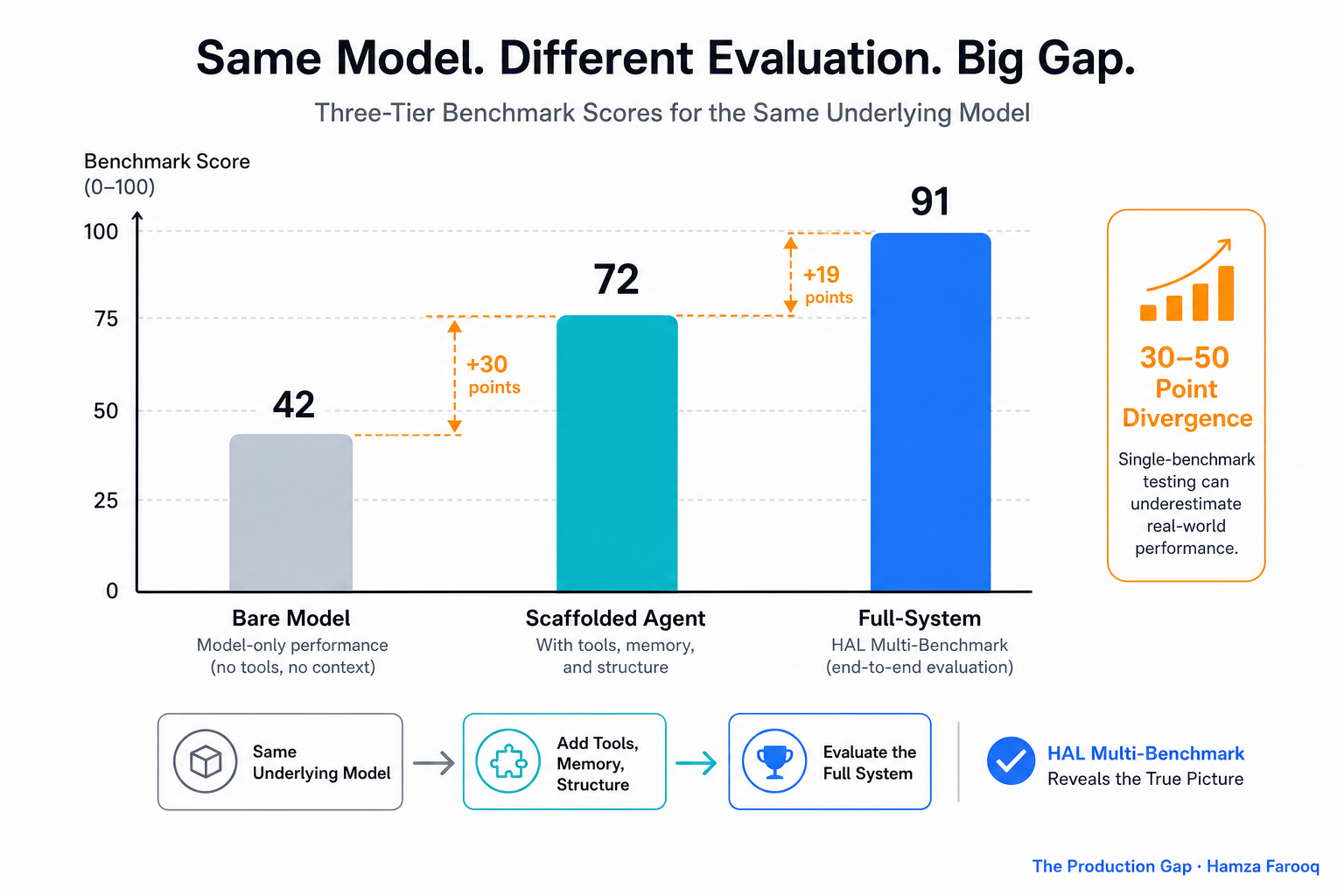
- Bare model vs. full system scores diverge wildly: Scaffolding alone can shift scores 30–50 points on the same benchmark.
- Multi-benchmark testing exposes hidden weaknesses: A single high score masks gaps that only appear across diverse tasks.
- Parallel VM orchestration enables simultaneous evaluation: HAL runs benchmarks across hundreds of VMs at once rather than sequentially.
- Third-party independence is non-negotiable: Trustworthy leaderboards must live outside the organizations whose products they test.
Why do single benchmarks fail AI agent evaluation?
The SWE-bench monoculture problem
Because everyone reports SWE-bench, everyone optimizes for it. Prompt engineering tuned to SWE-bench task formats, custom scaffolding, and cherry-picked inference settings shift scores dramatically without touching a single model weight. The result measures how well a vendor tuned for that benchmark, not how well their agent performs on a real codebase. This is benchmark gaming in its most commercially damaging form: widespread, largely undetected, and happening at scale.
The three-tier divergence problem
A bare model is the raw LLM with no orchestration. A scaffolded agent wraps it in tool calls, memory, and orchestration logic. A full system adds retrieval layers, production infrastructure, and custom prompting stacks. Princeton's HAL research documents these three configurations of the same model diverging by 30–50 points on the same benchmark. When vendors report a score without disclosing which configuration produced it, the number is technically accurate and practically meaningless.
What is HAL and how does its multi-benchmark harness work?
HAL (the Holistic Agent Leaderboard from Princeton) is a standardized, cost-aware, third-party evaluation harness that runs an agent across 9 benchmark types using parallel VM orchestration, returning results that are comparable across organizations and configurations. The framework was introduced in the October 2025 paper "The Missing Infrastructure for AI Agent Evaluation" (arXiv:2510.11977).
HAL's three core contributions
The paper identifies three contributions. First, a standardized harness across 9 models and 9 benchmark types, with every agent tested under identical conditions. Second, cost-aware benchmarking: every run records token usage and compute spend alongside task performance. Third, third-party independence: Princeton maintains the leaderboard entirely outside commercial vendor control.
The infrastructure nobody is talking about
HAL spins up hundreds of isolated virtual machines simultaneously, each executing a separate benchmark task in parallel, as documented by Semantic Scholar. That parallel architecture makes comprehensive evaluation economically viable outside research institutions in a way that sequential approaches do not. Most practitioners still assume HAL is just a website to read scores from.
The hal-harness repository on GitHub is a runnable harness that teams can point at their own agents, not just a public scoreboard. That distinction matters for any organization that wants Princeton-grade evaluation infrastructure without building a custom pipeline from scratch.
How does HAL compare to single-benchmark evaluation?
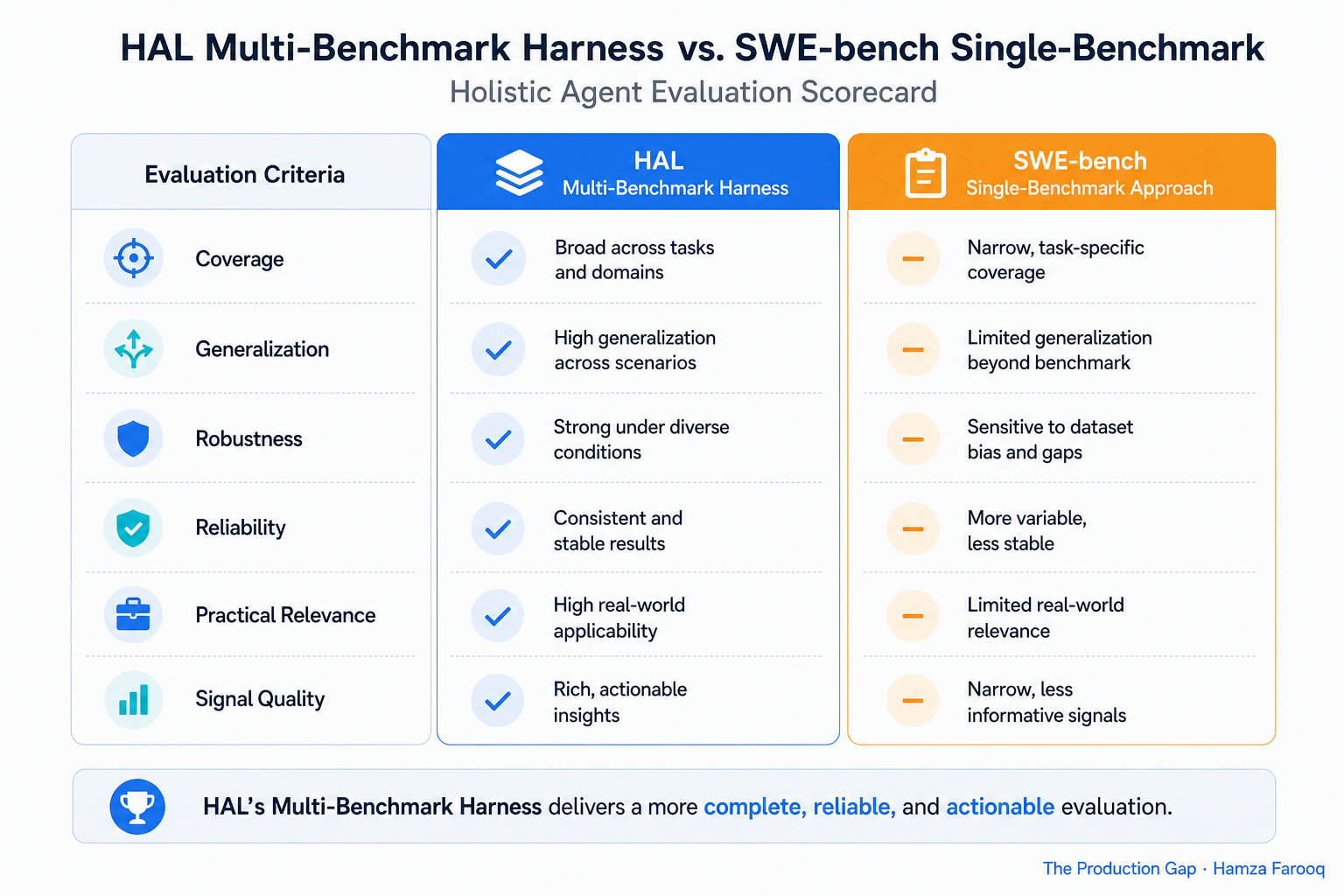
| Evaluation dimension | Single-benchmark (e.g., SWE-bench only) | HAL multi-benchmark harness |
|---|---|---|
| Gaming resistance | Low: vendors can overfit scaffolding to one test | High: overfitting 9 standardized benchmarks simultaneously is impractical |
| Score transparency | Reports final score only | Tracks token spend and compute cost per run |
| Setup comparability | Bare model vs. full system often conflated | Explicitly distinguishes all three configuration tiers |
| Evaluation speed | Sequential runs across benchmarks | Parallel VM orchestration across hundreds of VMs |
| Third-party independence | Typically vendor-reported | Maintained by Princeton outside commercial control |
| Capability coverage | Single domain | 9 benchmark types expose hidden weaknesses |
Two rows drive procurement decisions most. Gaming resistance matters because overfitting one benchmark is trivially achievable; overfitting nine under standardized conditions is not. Cost transparency matters because the highest-scoring agent on a single benchmark is rarely the most token-efficient one in production, and that difference compounds across large-scale agent deployments.
How should a team decide to adopt the HAL harness?
A team should consider adopting HAL when their current evaluation produces a score they cannot fully explain by the model alone, specifically when scaffold configuration, prompt wording, or inference settings could plausibly account for a meaningful portion of the reported result.
A practical three-signal test
As a practical rule of thumb used in this guide, it is worth running HAL multi-benchmark evaluation if any one of the following signals applies:
- Reproducibility gap: You cannot reproduce a competitor's published score using their stated setup.
- Cost blindness: Your evaluation records performance but not token or compute spend per task.
- Single-domain reliance: Your go/no-go deployment decision rests on scores from one benchmark only.
If any signal applies, your evaluation infrastructure may be a procurement liability. The princeton-pli/hal-harness repository is open-source and designed for custom agents, with no custom eval pipeline required.
Frequently asked questions
What is the Holistic Agent Leaderboard (HAL) in plain terms? HAL is a standardized, cost-aware, third-party leaderboard built by Princeton to evaluate AI agents across multiple benchmarks simultaneously, tracking task performance, token usage, and compute cost per run. The system is described in the October 2025 paper "The Missing Infrastructure for AI Agent Evaluation" (arXiv:2510.11977), which makes the case that existing single-benchmark infrastructure is insufficient for reliable agent comparison.
Why can't I just use SWE-bench scores to compare agents? Princeton's HAL research shows 30–50 point divergence across bare model, scaffolded, and full-system setups for the same underlying model. Vendors typically report their best-case configuration without disclosing setup details, making scores non-comparable across organizations.
How does HAL run evaluations across multiple benchmarks? HAL uses parallel VM orchestration, spinning up hundreds of isolated virtual machines simultaneously so benchmark tasks execute in parallel rather than in sequence. That architecture makes holistic evaluation feasible at a scale that purely sequential approaches cannot match.
Can I run the HAL harness against my own proprietary agent, or is it only for leaderboard submissions? The open-source hal-harness repository is designed to run against custom agents, not only official leaderboard submissions, giving any organization Princeton-grade evaluation infrastructure without building a custom pipeline.
Conclusion
Single benchmarks were adequate when agents were a research curiosity. They now underpin significant enterprise commitments, and the 30–50 point configuration divergence documented in Princeton's October 2025 research is a known systematic bias that teams are absorbing into high-stakes decisions.
The parallel VM infrastructure that makes holistic evaluation feasible is already open-source at princeton-pli/hal-harness. The gap between vendor claims and real-world agent performance is not a data problem. It is an infrastructure problem, and the infrastructure is already built.
Clone the hal-harness repository, run your current best agent through it, and compare the multi-benchmark profile against the single-benchmark score you have been relying on. The result will either confirm your confidence or surface something worth knowing before a costly commitment.
Learn from me
Agent Engineering Bootcamp: Developers Edition, my Maven cohort. Advanced agentic RAG, multi-agent orchestration, memory, evals, and guardrails. Take agents from prototype to production. Join the next cohort →
Hire us
Traversaal.ai. We're a team of forward deployed engineers solving the toughest AI problems for Fortune 100 companies: document intelligence, agentic data platforms, and real-time web intelligence, deployed in production. Work with our team to deploy your next agentic ecosystem. Talk to Traversaal.ai →
Join us
Want to solve these problems with us? We're always looking for forward deployed engineers who want to ship production AI. jobs@traversaal.ai