LLM Caching Strategies Explained: KV, Prefix, Prompt, and Semantic, and Why Most Teams Only Use One
LLM caching strategies decoded: KV, prefix, prompt, and semantic layers each cut different costs. Learn how combining all four slashes latency and spend.

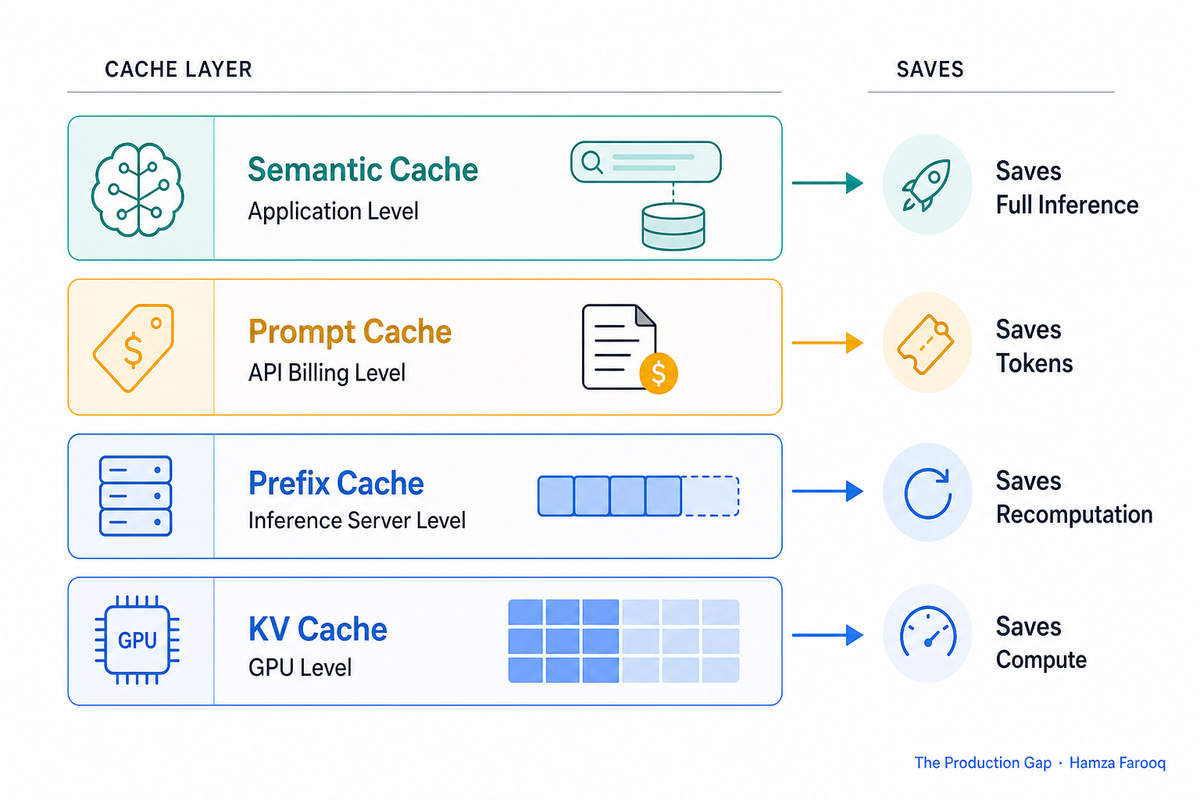
TL;DR: LLM caching strategies fall into four distinct layers (KV cache, prefix cache, prompt cache, and semantic cache) each saving a different resource: GPU compute, attention recomputation, input token billing costs, and full inference calls respectively. Most teams only activate the one their vendor enables by default. Combining all four compounds the savings across latency, throughput, and cost simultaneously.
Key Takeaways
- KV cache is the speed lever: stores attention calculations in GPU memory during a single inference run, cuts compute, not your bill.
- Prefix caching multiplies shared-prompt savings: reuses pre-computed work across requests sharing a system prompt or context prefix.
- Prompt caching is a billing discount, not a complete solution: real savings on input tokens, but only one of four layers.
- Semantic caching catches paraphrased repeats: vector similarity matches intent, returning stored answers without running inference at all.
- Defaulting to vendor caching alone leaves money on the table: each layer saves something different, and skipping any one means paying for work already done.
- The Effective Cost Per Query metric is the only number that shows which layer still has headroom.
Introduction
Most production AI teams have enabled some caching and then hit a wall. Major providers offer prompt caching as an opt-in feature, which creates a false sense of completeness. There are actually four distinct caching layers, each operating at a different stack position and saving a fundamentally different resource. Turning one on is a starting point, not a strategy.
Developers have reported cutting LLM costs by 80% through systematic multi-layer caching. Teams relying on a single vendor-default layer are unlikely to reach that ceiling.
What do the four LLM caching layers actually do, and what does each one save?
The four layers are KV cache, prefix cache, prompt cache, and semantic cache. Each operates at a different stack position and saves a different resource: GPU compute, repeated attention recomputation, input token billing costs, and full inference calls respectively.
What does KV cache save, and where does it operate?
KV cache stores key-value attention matrices in GPU VRAM during a single forward pass, so the transformer does not recompute them for every generated token. It is intra-request only: it speeds up generation within a single call but never reduces your API bill. As context windows grow, memory footprint scales directly with context length, making KV cache allocation a first-order infrastructure concern.
What does prefix cache save, and where does it operate?
One distinction practitioners consistently miss: prefix caching lives at the inference server and saves GPU work; prompt caching lives at the API billing boundary and saves token charges. Conflating them is a common source of coverage gaps in production.
How do prompt caching and semantic caching save money differently, and why do teams confuse them?
Prompt caching reduces tokens billed at the API boundary; semantic caching skips the API call entirely. They target different cost drivers and work together, not against each other.
What does prompt cache save, and where does it operate?
Prompt caching is a vendor-provided feature that applies a discount to input tokens when a request prefix matches a cached server-side representation. The key point: it reduces token billing costs without requiring any custom infrastructure on your side. Whether a provider bills at a reduced rate or waives charges entirely depends on current pricing, verify directly with each vendor.
What does semantic cache save, and where does it operate?
Semantic caching stores full model responses and retrieves them when a new query is semantically equivalent to a past one, even if the wording differs entirely. It uses vector embeddings and similarity search to match intent. "What's your return policy?" and "Can I return something I bought last week?" may pull the same cached response: no tokens billed, no GPU consumed.
The confusion between these two layers stems from setup cost asymmetry. Semantic caching requires infrastructure your team builds and maintains; prompt caching requires nothing because the vendor enables it. That gap pushes teams toward the lower-ceiling option even when semantic caching would deliver greater savings.
What does the multi-layer caching stack look like in production, and where does each layer fail alone?
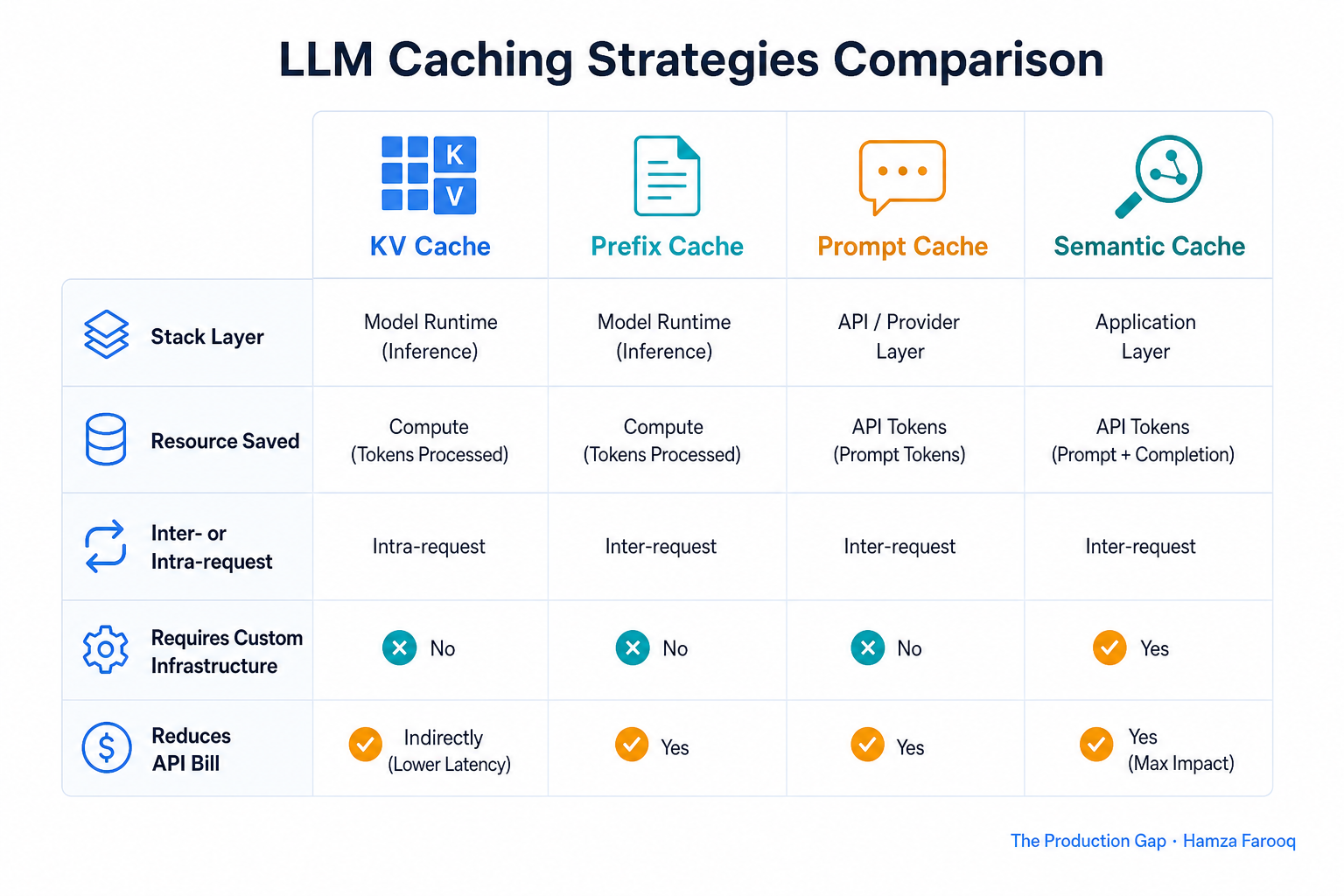
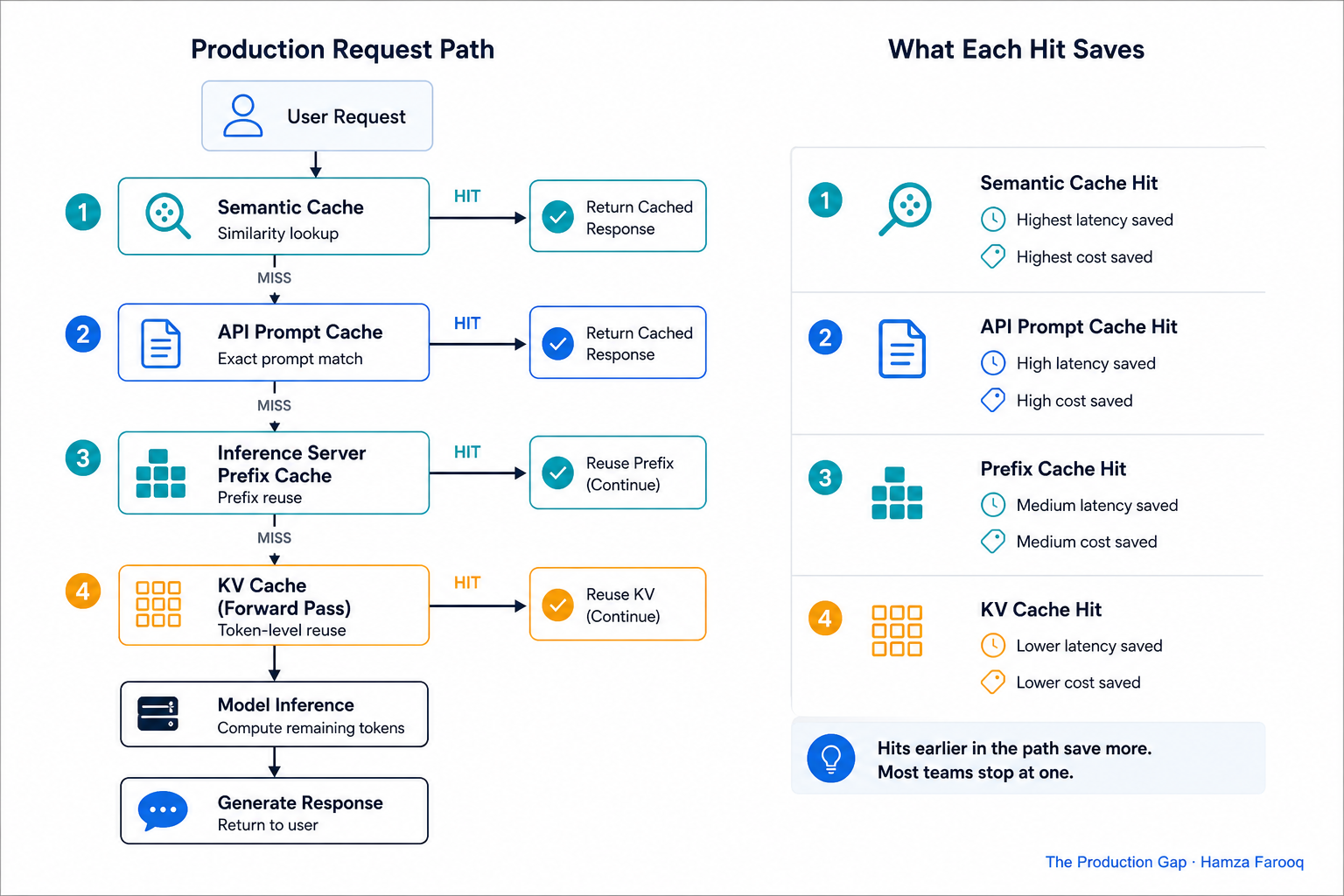
A production multi-layer stack sequences semantic cache first at the application edge, prompt cache second at the API boundary, prefix cache third at the inference server, and KV cache fourth inside the forward pass. Each layer catches what the one above it misses. Table: LLM Caching Layers Compared, scope, savings, and infrastructure requirements
| Layer | Stack Position | Resource Saved | Scope | Reduces API Bill | Requires Custom Infra |
|---|---|---|---|---|---|
| KV cache | GPU / inference engine | Attention recomputation | Single request | No | No (built-in) |
| Prefix cache | Inference server | Cross-request KV reuse | Cross-request | No | No (server config) |
| Prompt cache | API billing boundary | Input token charges | Cross-request | Yes | No (vendor-provided) |
| Semantic cache | Application layer | Full inference call | Cross-request | Yes | Yes (vector store) |
Requests hit semantic cache first. A similarity match above threshold returns the stored response immediately: zero tokens, zero inference. Misses fall through to the API, where prompt caching discounts input tokens on repeated prefixes. At the inference server, prefix caching skips shared-context recomputation. Inside the forward pass, KV caching handles efficient token generation.
A team relying only on vendor prompt caching still pays full token prices for input variation, full latency on every request, and full GPU cost for semantically duplicate queries phrased differently. The most common semantic cache failure is stale responses on time-sensitive or personalized queries; the fix is calibrated similarity thresholds, hard exclusion rules for dynamic categories, and appropriate TTLs
How do you measure whether your caching stack is actually working?
The Effective Cost Per Query framework is the metric that shows which layer still has headroom. Track each layer independently and aggregate.
For semantic cache: multiply semantic hit rate by average inference cost. For prompt cache: compare billed input tokens against gross input tokens. For prefix cache: track the KV cache hit ratio reported by your inference server. Summing these gives a true Effective Cost Per Query, the only number that reveals whether a given layer is saturated or improvable.
Without this breakdown, a high aggregate cache hit rate can mask a single underperforming layer quietly absorbing the majority of your spend.
FAQ
Q1: What is the difference between KV cache and prefix cache in LLMs? KV cache stores attention matrices within a single inference pass (intra-request); prefix cache reuses those representations across multiple requests sharing a common input prefix (cross-request). Both save GPU compute rather than API token costs.
Q2: Does enabling prompt caching on a major provider API replace the need for semantic caching? No. Prompt caching discounts matched input prefixes; semantic caching eliminates the API call entirely on semantically equivalent queries. They target different cost drivers and compound when used together.
Q3: When does semantic caching break down or return incorrect responses? When the similarity threshold is too low, or on personalized, stateful, or time-sensitive queries. The fix is a calibrated threshold, hard exclusions for dynamic query categories, and appropriate TTLs.
Q4: How do you measure cache hit rate and cost savings across multiple layers? Use the Effective Cost Per Query framework: semantic hit rate × average inference cost; billed versus gross input tokens for prompt cache; KV cache hit ratio at the inference server for prefix cache. Aggregating these reveals which layer still has optimization headroom.
Conclusion
Each caching layer does distinct, non-overlapping work, and each is blind to what the others catch. Treating caching as a single vendor-enabled switch means paying repeatedly for work already done.
Audit your stack against the four-layer table above. If semantic caching is absent, you pay full inference cost on every semantically duplicate query. If prompt caching is active but prefix caching is unconfigured, you are still recomputing shared context at the GPU layer on every request. Find the first missing layer, instrument its hit rate baseline using the Effective Cost Per Query framework, and address layers sequentially.
Learn from me

Forward Deployed Engineering Bootcamp for Full-Stack Developers, my Maven cohort. Build and ship complete AI products end to end, from React and Node.js frontends to deployed models with caching and observability. Join the next cohort →
Hire us
Traversaal.ai. We're a team of forward deployed engineers solving the toughest AI problems for Fortune 100 companies: document intelligence, agentic data platforms, and real-time web intelligence, deployed in production. Work with our team to deploy your next agentic ecosystem. Talk to Traversaal.ai →
Join us
Want to solve these problems with us? We're always looking for forward deployed engineers who want to ship production AI. jobs@traversaal.ai