Local vs Cloud Coding AI: A Benchmark-Grounded Framework for Quantifying the Capability Gap and Deciding When Privacy Justifies It
Local vs cloud coding AI: quantify the benchmark gap, weigh privacy needs, and use our RDCT framework to choose the right deployment before committing.


TL;DR: Local 70B-class coding models trail frontier hosted models on SWE-bench Verified, and that gap compounds across multi-step agent loops. Whether the privacy benefit justifies lower capability depends on four auditable factors: regulatory classification, data sensitivity, agent task complexity, and total cost of ownership. Most teams land in hybrid territory, and the RDCT framework provides a structured rubric for making that call before committing to infrastructure.
Key takeaways
- The benchmark gap compounds: local models trail frontier models such as Claude Sonnet 4, and that gap multiplies across every step in a multi-stage agent workflow.
- Air-gap mandates are frequently legal obligations, not cultural preferences: finance, defense, and healthcare teams under FedRAMP High, CMMC, or HIPAA often face hard requirements to keep code off external APIs.
- Hybrid routing closes most of the gap: route sensitive context to a local model such as Qwen2.5-72B-Instruct and non-sensitive tasks to a frontier API, satisfying compliance without surrendering full capability.
- On-premises TCO surprises most teams: once hardware, power, maintenance, and staffing are amortized, local inference often costs more than cloud API.
- "Runnable" and "production-grade for a coding agent" are different claims that require hands-on validation against your specific loop depth and latency targets.
- Score regulatory classification, data sensitivity, agent task complexity, and total cost before committing to a deployment path.
Introduction
Regulated industries face genuine legal pressure to keep source code off external APIs. Frontier hosted models continue to lead on agentic coding benchmarks. Hardware can now run 70B-class models on-premises, but conflating "runnable" with "production-grade for a coding agent" is an expensive mistake.
Most benchmark comparisons measure single-turn completions, not multi-step agent loops, a distinction that systematically understates the real capability gap. Local AI at enterprise scale may simply cost more than SaaS when full infrastructure costs are factored in. The decision rubric and compounding-gap analysis below address what standard evaluation data almost certainly misses.
What does the benchmark gap between local and frontier coding models actually look like?
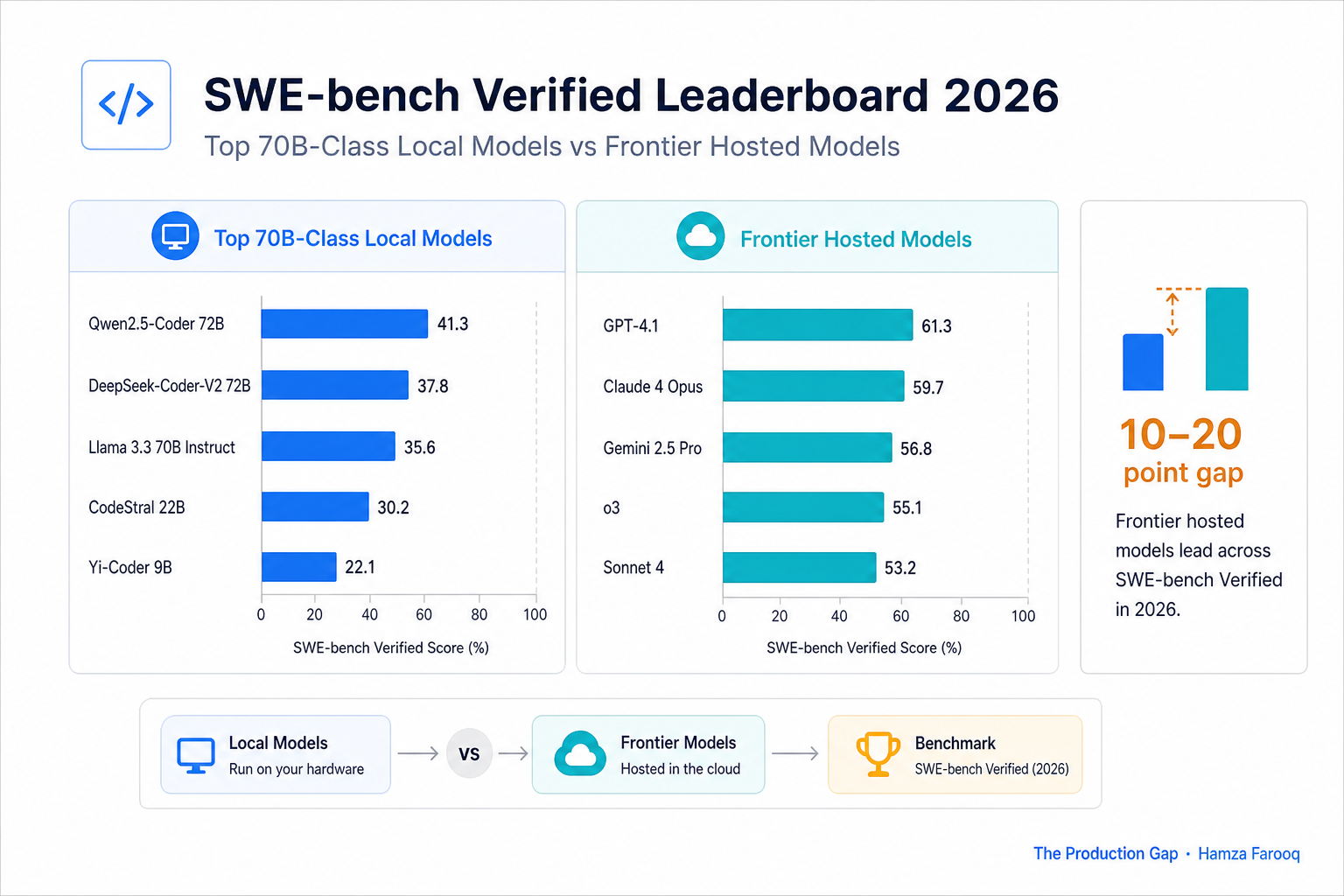
SWE-bench Verified is the primary benchmark referenced here because it measures end-to-end resolution of real GitHub issues, not toy completions. HumanEval measures single-function completion and consistently produces scores that do not reflect performance inside a real agent harness, making single-turn scores a floor for the real-world gap, not a ceiling. Even a modest score difference can translate to materially worse outcomes when steps are chained.
Comparing Qwen2.5-72B-Instruct locally against Claude Sonnet 4 via API gives procurement teams a concrete, auditable reference point. Check the live SWE-bench leaderboard before specifying hardware; rankings shift with each model release.
How does the capability gap compound inside a multi-step coding-agent loop?
In a 15–30 step agent loop, even a modest SWE-bench deficit does not produce proportionally worse outcomes, it compounds into errors that degrade end-task success rates far more than the raw score difference suggests.
If each step has success probability p and n steps are chained, overall task success approximates p^n. The table below is an author synthesis illustrating the compounding mechanism using hypothetical per-step probabilities.
Important: the figures below are illustrative probability estimates showing the compounding mechanism. They are not empirical SWE-bench measurements and should not be cited as benchmark data.
| Steps in agent loop | Frontier model (P=0.90 per step) | Local model (P=0.80 per step) | Compound delta |
|---|---|---|---|
| 5 steps | 59% | 33% | -26 pts |
| 10 steps | 35% | 11% | -24 pts |
| 20 steps | 12% | 1.2% | -10.8 pts |
| 30 steps | 4% | 0.1% | -3.9 pts |
Most procurement frameworks miss this by benchmarking single-turn completions. Run the arithmetic against your specific loop depth before accepting any "small" benchmark gap. Cloud dependency carries its own compounding risks (rate limits, price hikes, policy changes) but those are discontinuous shocks rather than gradual drift, and both belong in a complete risk assessment.
When does a data-residency requirement legally mandate local inference, and when is it organizational preference?
A requirement is a legal mandate when regulations such as FedRAMP High, HIPAA, or data sovereignty laws prohibit transmitting code to third-party servers. Many perceived mandates are organizational preference, and those two cases require completely different infrastructure responses.
Category 1, Hard legal or regulatory mandate: FedRAMP High, CMMC Level 2+, HIPAA without a viable BAA pathway, EU AI Act data localization, classified program contractual clauses. Non-negotiable. Full local or sovereign cloud only.
Category 2, Contractual obligation: Client contracts or IP agreements prohibiting source code transmission to third-party processors. Requires legal review; some contracts include carve-outs for anonymized or non-proprietary context.
Category 3, Organizational preference: Legitimate but negotiable, and where hybrid architectures become available options.
Local AI inference means running a model entirely on hardware you control, with no data sent to external servers, the exact definition compliance auditors use. Get written legal classification from counsel before specifying infrastructure. "We think we need air-gap" and "our lawyers confirmed we need air-gap" lead to very different architectures and cost structures.
What deployment architecture should you choose, and how do you score the decision?
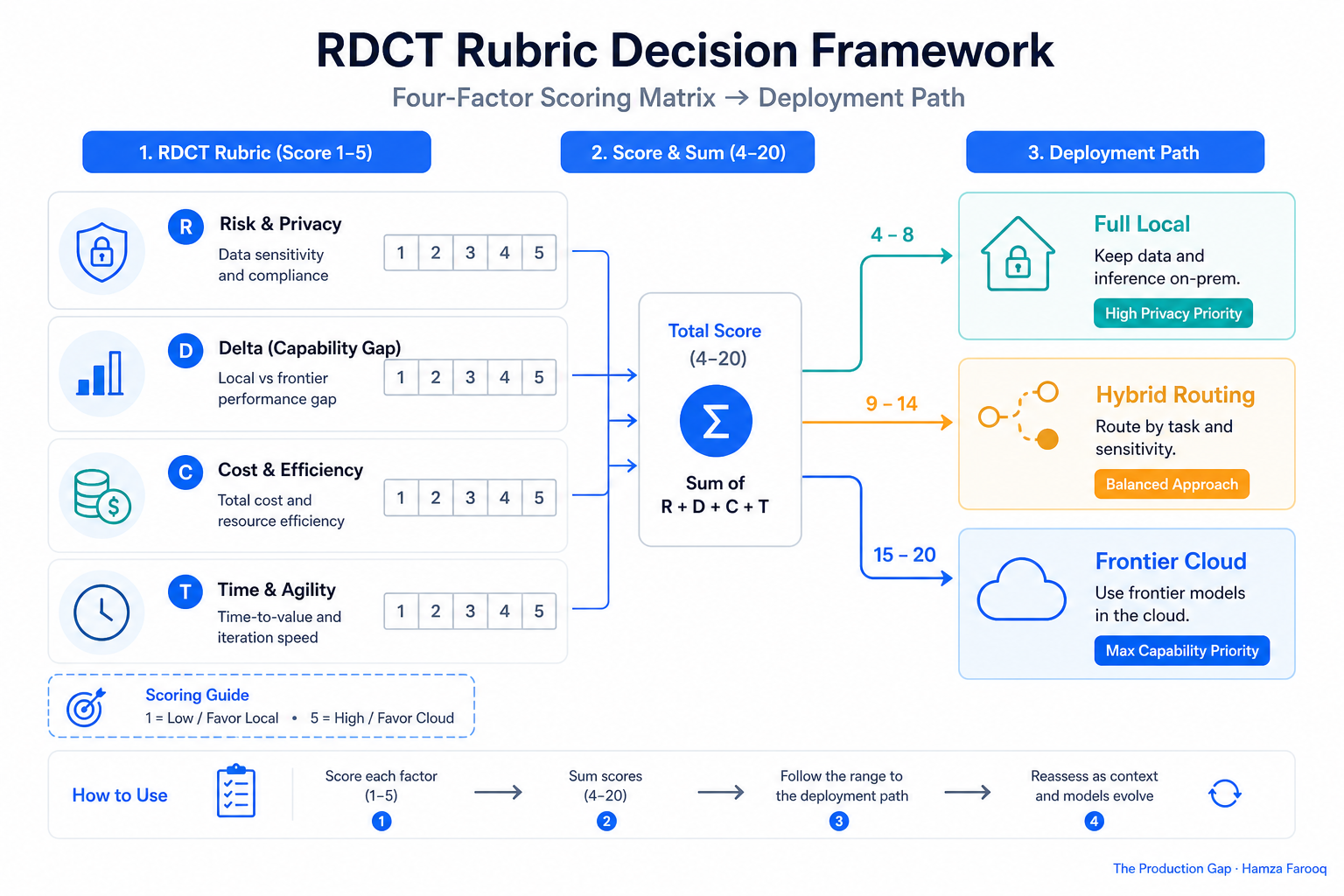
The RDCT framework scores four auditable factors before procurement: Regulatory class, Data sensitivity, Complexity of agent task, and Total cost of ownership.
The RDCT Decision Framework (author synthesis)
| RDCT Factor | Key question | Decision output |
|---|---|---|
| R, Regulatory class | Hard legal mandate (Cat. 1) or contractual obligation (Cat. 2)? | Cat. 1: local or sovereign cloud only. Cat. 2: legal review required. Cat. 3: hybrid eligible. |
| D, Data sensitivity | Does the context window contain proprietary IP, PII, or classified logic? | Sensitive context routes local. Non-sensitive tasks may route to frontier. |
| C, Complexity and loop depth | Does the agent task exceed 10 interdependent steps? | Deep loops amplify the capability gap; shallow tasks tolerate local limitations more readily. |
| T, Total cost of ownership | When hardware, power, maintenance, and MLOps staffing are fully amortized, does local cost less? | Local AI at scale may cost more than SaaS. Run full TCO before assuming local saves money. |
Teams that over-invest in on-premises infrastructure almost always skipped D and T, or misclassified R. Hybrid routing (local model for sensitive context, frontier model for the rest) satisfies Categories 2 and 3 while preserving most of the frontier capability advantage.
Frequently asked questions
What hardware do I need to run a 70B-parameter coding model locally at production latency?
Most desktop PCs lack sufficient acceleration to run frontier-class models effectively; dedicated accelerator hardware with substantial VRAM is required. Benchmark latency inside your actual agent loop rather than extrapolating from single-turn tests, it compounds across deep loops in ways that are easy to underestimate.
Is a hybrid architecture compliant if part of my workflow touches a cloud model?
Compliance depends on what data crosses the network boundary, not whether a cloud connection exists. If proprietary code, PII, or classified logic never enters the frontier model's context window, the architecture may satisfy Category 2 and 3 requirements, but legal counsel must confirm the boundary definition in writing before production.
Yes. A smaller local context forces more chunking, increases loop depth, and compounds the capability gap further. Measure this against your actual codebase size rather than estimating.
When does going fully local actually make financial sense?
When three conditions align: a hard Category 1 regulatory mandate, accelerator hardware already owned and depreciated, and agent loop depth shallow enough that the capability gap is tolerable. At enterprise scale, local infrastructure often costs more than SaaS when TCO is fully amortized, so deep agentic workflows frequently favor frontier or sovereign cloud.
Conclusion
Score RDCT before specifying infrastructure. Confirm the regulatory classification in writing, audit what data enters the context window, measure your loop depth against the compounding-gap table, and run full TCO before assuming local is cheaper. Most teams land in hybrid territory, and hybrid routing satisfies most compliance requirements while recovering the majority of frontier capability. Naming specific models (Qwen2.5-72B-Instruct locally against Claude Sonnet 4 via API) produces a decision that holds up under procurement review and compliance audit.
Learn from me
Forward Deployed Engineering Bootcamp for Full-Stack Developers, my Maven cohort. Build and ship complete AI products end to end, from React and Node.js frontends to deployed models with caching and observability. Join the next cohort →
Hire us
Traversaal.ai. We're a team of forward deployed engineers solving the toughest AI problems for Fortune 100 companies: document intelligence, agentic data platforms, and real-time web intelligence, deployed in production. Work with our team to deploy your next agentic ecosystem. Talk to Traversaal.ai →
Join us
Want to solve these problems with us? We're always looking for forward deployed engineers who want to ship production AI. jobs@traversaal.ai