Multi-Cloud AI Agents: The Three-Layer Architecture for Build, Deploy, and Governance
Multi-cloud AI agents done right use a 3-layer architecture for build, deploy, and governance. Learn how MCP and A2A protocols connect it all.

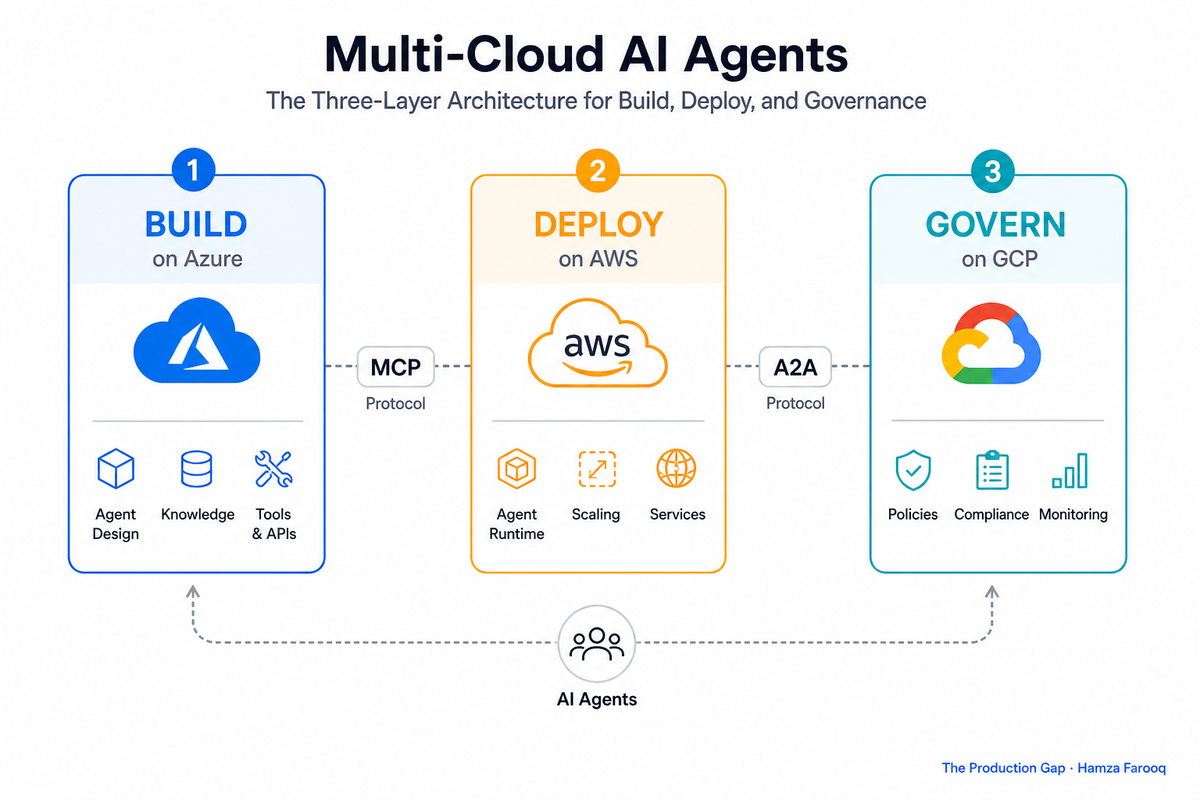
TL;DR: Multi-cloud AI agents work best through a three-layer architecture where you build on one cloud's strengths, deploy on another's infrastructure, and govern through a dedicated control plane. That flexibility comes at the cost of integration complexity that a single-vendor stack eliminates. The right choice depends on whether your workload's performance and compliance requirements outweigh the overhead of stitching together MCP and A2A interoperability primitives across providers.
Key Takeaways
- Is a three-layer multi-cloud AI agent stack now buildable without custom middleware? As of mid-2025, AWS, Azure, and GCP each expose agent tooling that supports MCP and A2A, though authentication integration varies by provider. Validate native support against your specific setup before assuming full parity.
- What role do MCP and A2A play? MCP exposes tools and context; A2A handles task delegation between autonomous agents. Together they are the load-bearing protocols for cross-cloud agent communication.
- When should you choose a single-vendor stack? Single-vendor stacks cost less, deploy faster, and carry lower latency, but cannot provide a vendor-neutral audit trail for risk functions that require independence from the system operator.
- What breaks naive multi-cloud designs? Cross-region data movement undermines performance assumptions, and cross-cloud identity federation has no unified OIDC standard for agent-to-agent auth, requiring per-hop token exchange.
- What is the most overlooked driver of three-layer splits? Org politics. Identify whether a client's push for multi-cloud reflects a genuine compliance or ownership requirement before endorsing the complexity.
What exactly are the three layers, and what does each one own?
In a three-layer multi-cloud AI agent stack, the Build layer handles model training and agent definition, the Deploy layer runs inference and orchestration, and the Govern layer maintains vendor-neutral audit logs, policy enforcement, and explainability pipelines.
Build layer owns fine-tuning, agent persona definition, tool-schema registration, and evaluation harnesses, typically on Azure ML or Vertex AI. A financial services firm fine-tuning a document-extraction agent on Azure AI Foundry registers tool schemas via MCP endpoints. That agent can later be invoked by a Deploy-layer runtime it has never directly called, because MCP standardizes the handshake. Whoever controls fine-tuning controls the agent's behavior ceiling.
Deploy layer owns runtime orchestration, agent-to-agent routing, latency SLAs, and scaling, typically on AWS Bedrock Agents or GCP Vertex AI Agent Builder. An AWS Bedrock runtime receives an A2A handoff from an Azure-built agent and routes sub-tasks to specialized agents across regions. This is where latency problems from cross-cloud data movement surface first.
Govern layer owns the vendor-neutral audit trail, policy guardrails, explainability pipeline, and identity federation logs, typically a neutral third cloud or dedicated governance platform such as GCP with Chronicle. Enterprise risk functions that require a vendor-independent audit record cannot rely on the same provider operating the AI system. The three layers map to three budget owners: ML platform (Build), cloud ops (Deploy), risk/compliance (Govern). The architecture is an org chart drawn in infrastructure.
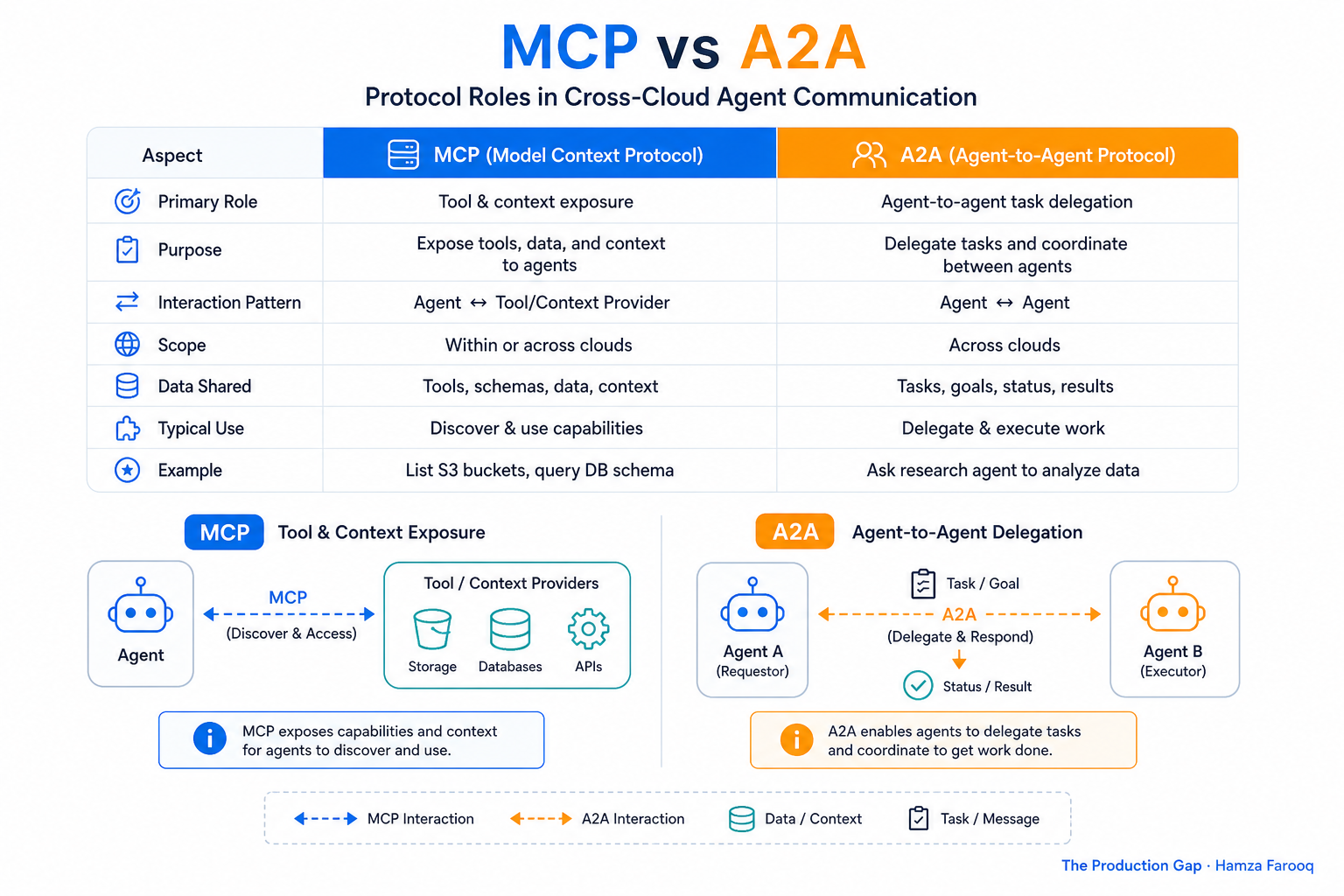
How do MCP and A2A actually wire the three layers together, and where do the gaps still live?
MCP exposes tools and context across cloud boundaries; A2A handles task delegation between autonomous agents. Together they eliminate the need for custom middleware at the protocol level, though gaps remain that technical buyers should understand before committing.
MCP standardizes how an agent discovers and calls tools regardless of which cloud hosts them. Schema registration happens at the Build layer; client calls happen at the Deploy layer at runtime. Authentication integration varies across providers, validate IAM-to-MCP auth behavior against your specific configuration before assuming parity.
A2A handles task delegation: a Deploy-layer orchestrator on AWS Bedrock issues an A2A task to a compliance-checking agent on GCP, and that agent returns a structured result that feeds directly into the Govern layer audit log. This shift from human-initiated to agent-initiated workflows is already observable in production.
Remaining gaps as of mid-2025:
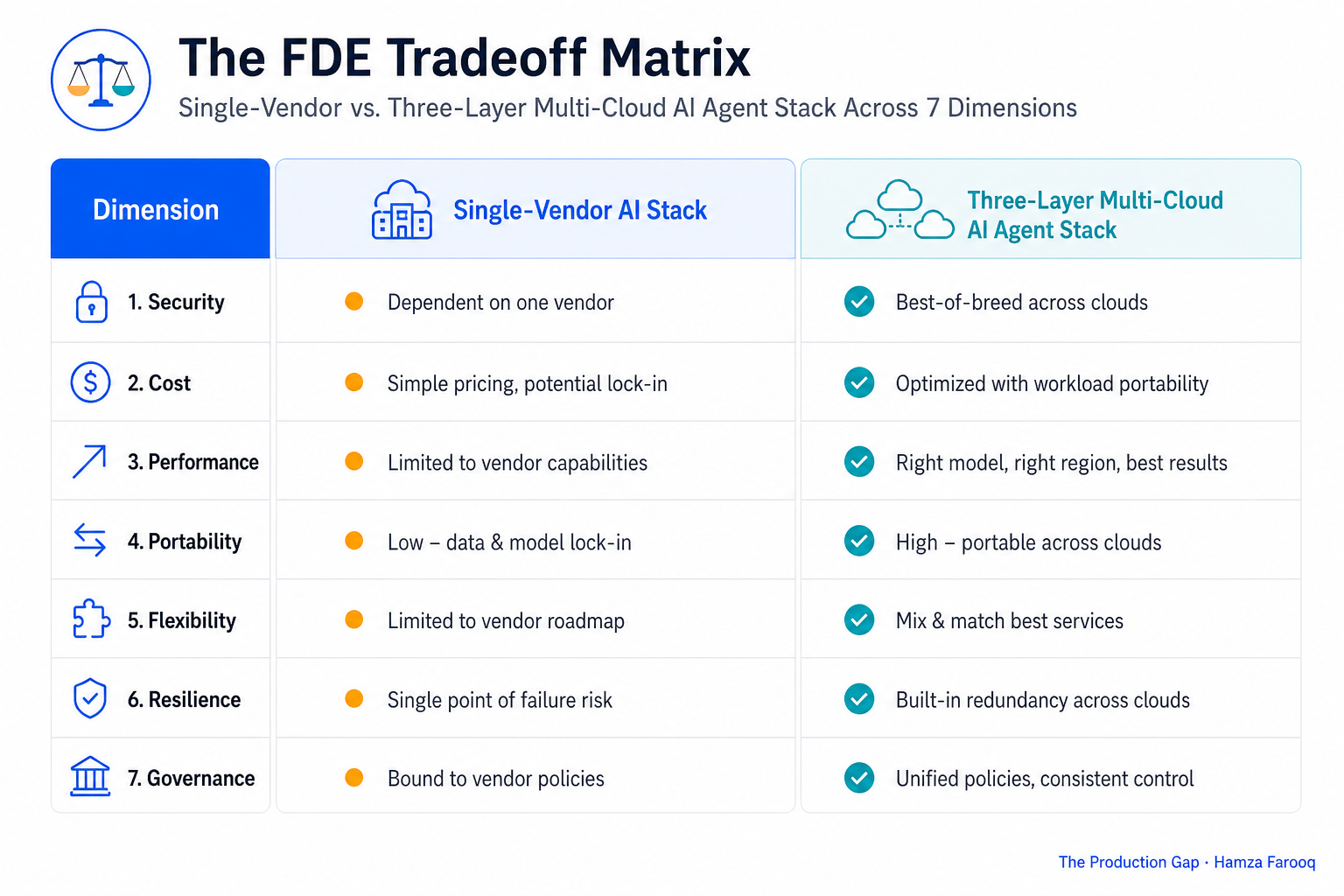
Three-layer stack versus single-vendor full-stack: how do they compare across seven dimensions?
A single-vendor stack costs less and deploys faster but cannot satisfy vendor-neutral audit requirements. The three-layer split trades operational overhead for compliance cleanness and org-political viability.
| Dimension | Single-vendor stack | Three-layer multi-cloud stack |
|---|---|---|
| Latency per agent hop | Low (intra-cloud) | Higher (cross-cloud per A2A hop) |
| Identity management | Native IAM, single control plane | Federated; workload identity per cloud boundary |
| Vendor-neutral audit capability | Limited (provider audits own platform) | Achievable via independent Govern layer |
| Operational overhead | Low (one cloud's ops model) | High (three clouds, three incident response playbooks) |
| Data residency control | Dependent on single vendor's regions | Build, Deploy, and Govern can be region-pinned independently |
| Org-political viability | Requires one team to cede control | Maps to existing team ownership boundaries |
| Time to first production agent | Fast (weeks) | Slow (months; protocol integration, IAM federation, audit pipeline) |
The overhead is real: every A2A hop adds latency, every cloud boundary adds an identity federation problem, and every incident has three vendor support queues. For a regulated enterprise where the risk function demands a vendor-neutral AI audit trail and ML platform and cloud ops won't share a control plane, the single-vendor stack may not survive compliance review.
Why is the real decision-maker for a three-layer split almost never the architect in the room?
The three-layer split is driven by org politics and compliance mandates more than engineering preference, FDEs who pitch it purely on technical merit will stall because the actual decision-maker is usually the risk function, not the platform team.
Build, Deploy, and Govern map onto org fault lines that predate AI agents: ML platform won't hand model artifacts to cloud ops; cloud ops won't give ML platform admin access to production; the risk function wants a governance record independent of the system operator. That combination of ownership disputes is what makes the three-layer split a mandate rather than a preference in regulated enterprise engagements.
The Build-Deploy-Govern Ownership Diagnostic, three questions to run before recommending the three-layer stack:
- Who owns the fine-tuned model artifacts? If separate from production infrastructure owners, the Build/Deploy split already exists in org structure.
- Who signs the AI compliance attestation? If a risk function reporting outside the CTO org, the Govern layer separation is likely required by mandate.
- Is the multi-cloud push a technical requirement or a vendor-preference policy? If the latter, the three-layer stack may add complexity without adding compliance value.
Get the risk and compliance stakeholder into the architecture review before the vendor shortlist closes. They can end a single-vendor recommendation at legal review and are rarely in the room when the technical architecture is first chosen.
Frequently asked questions
What protocols enable cross-cloud AI agent communication?
MCP handles tool and context exposure; A2A handles task delegation between autonomous agents. All three major hyperscalers support both protocols as of mid-2025, though authentication integration varies, validate against your specific setup before assuming parity.
Can a single cloud provider satisfy enterprise audit requirements for AI agents?
Where policy requires the audit record not be controlled by the system operator, a vendor-neutral governance layer is necessary, a single-vendor stack cannot provide that separation by design.
What are the latency costs of splitting AI agent build and deploy across different clouds?
Each cross-cloud A2A call adds meaningful round-trip latency versus intra-cloud calls; Equinix interconnects reduce overhead, but data residency constraints can force suboptimal routing and compound the cost.
How should an FDE decide between a single-vendor agent stack and a three-layer multi-cloud approach?
Run the Build-Deploy-Govern Ownership Diagnostic: if model artifacts and compliance attestation have separate organizational owners, the three-layer split is likely mandated. If the multi-cloud push is vendor-preference policy, the operational overhead won't deliver corresponding value.
Conclusion
The three-layer multi-cloud AI agent stack is technically viable, and MCP and A2A availability across major hyperscalers removes the main engineering objection. What most architecture guidance underweights: the three-layer split is not primarily a cost or performance optimization, it is a power-sharing agreement between three organizational functions that do not trust each other, and MCP and A2A make that agreement technically expressible.
Run the Build-Deploy-Govern Ownership Diagnostic before you open the whiteboard, and get the risk and compliance stakeholder in the room before the vendor shortlist closes.
Learn from me
Forward Deployed Engineering Bootcamp for Full-Stack Developers, my Maven cohort. Build and ship complete AI products end to end, from React and Node.js frontends to deployed models with caching and observability. Join the next cohort →
Hire us
Traversaal.ai. We're a team of forward deployed engineers solving the toughest AI problems for Fortune 100 companies: document intelligence, agentic data platforms, and real-time web intelligence, deployed in production. Work with our team to deploy your next agentic ecosystem. Talk to Traversaal.ai →
Join us
Want to solve these problems with us? We're always looking for forward deployed engineers who want to ship production AI. jobs@traversaal.ai