Notion AI Agent Longevity: How Queue-Backed Workers, Stall Detection, and a Review Model Extended Task Duration from 5 Minutes to 24+ Hours
Notion AI agent longevity explained: learn how queue-backed workers, stall detection, and a review model push task duration past 24 hours.

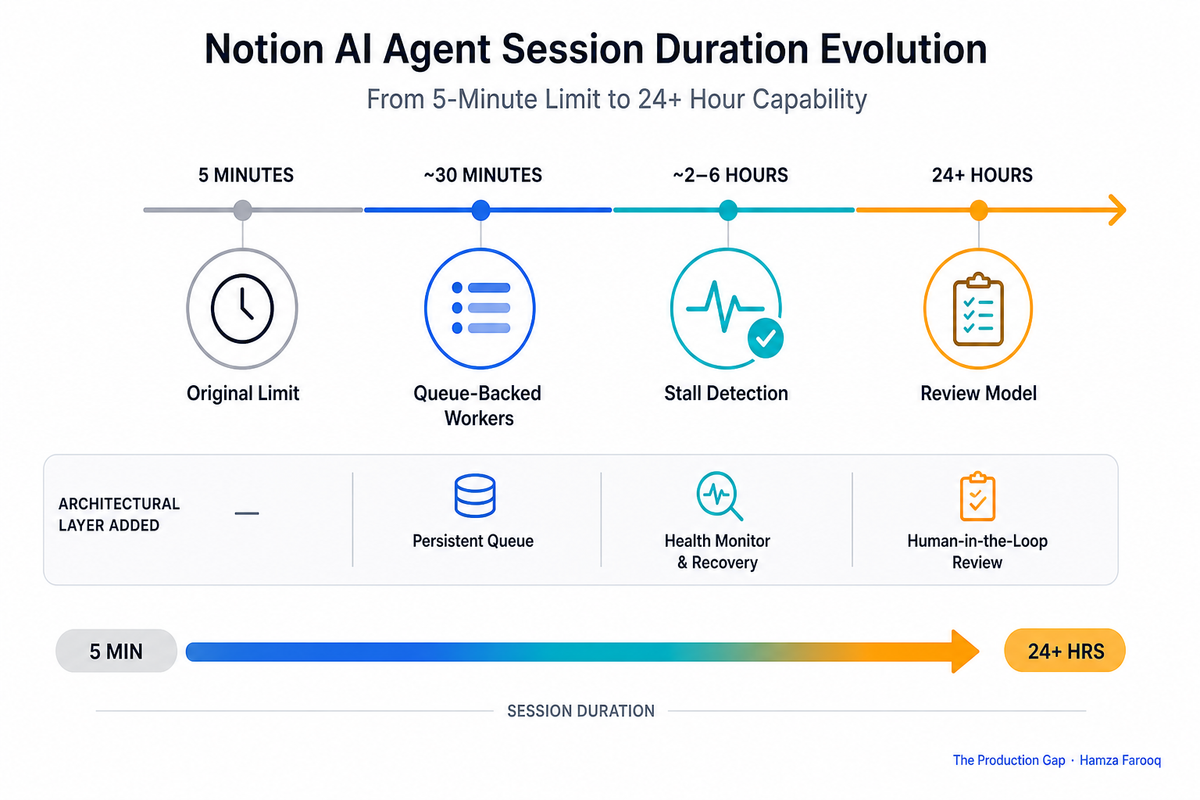
TL;DR: Notion AI agent longevity scaled from 5 minutes to 24-plus hours by combining queue-backed workers that survive connection drops, stall detection that restarts frozen tasks automatically, and a human-in-the-loop review model that prevents runaway execution. These three mechanisms work together to decouple task runtime from session limits while keeping costs bounded and errors recoverable.
Key Takeaways
- Extended task duration is the headline change: Notion agents now run for 24+ hours on a single task, up from five minutes.
- Context management is cited as a prerequisite: Long-running tasks require handling accumulated tool results and conversation history.
- Stall detection and model rerouting are built in: When a task stops advancing, the system switches models rather than spinning indefinitely.
- A review model checks high-stakes actions: A separate model independently checks consequential actions before execution.
- November 2, 2026 is a hard pricing deadline: All existing Notion AI customers migrate to credit-based billing; audit usage now.
- Vendor claims need independent validation: Real-world results depend heavily on workflow structure and data.
Introduction
Notion published "Agents, rebuilt to do more for less", announcing that agents now run for 24+ hours on a single task, up from a five-minute ceiling. On November 2, 2026, Notion migrates all existing AI customers to a credit-based billing system, which means architectural decisions and pricing commitments land at exactly the same moment. Teams that misread what changed will either over-invest in tooling that does not fit or walk into a credit system they have not instrumented.
How does Notion extend agent task duration to 24+ hours?
Notion's agents now run for more than 24 hours on a single task, up from five minutes, a change Notion attributes to rebuilding how agents persist and resume work.
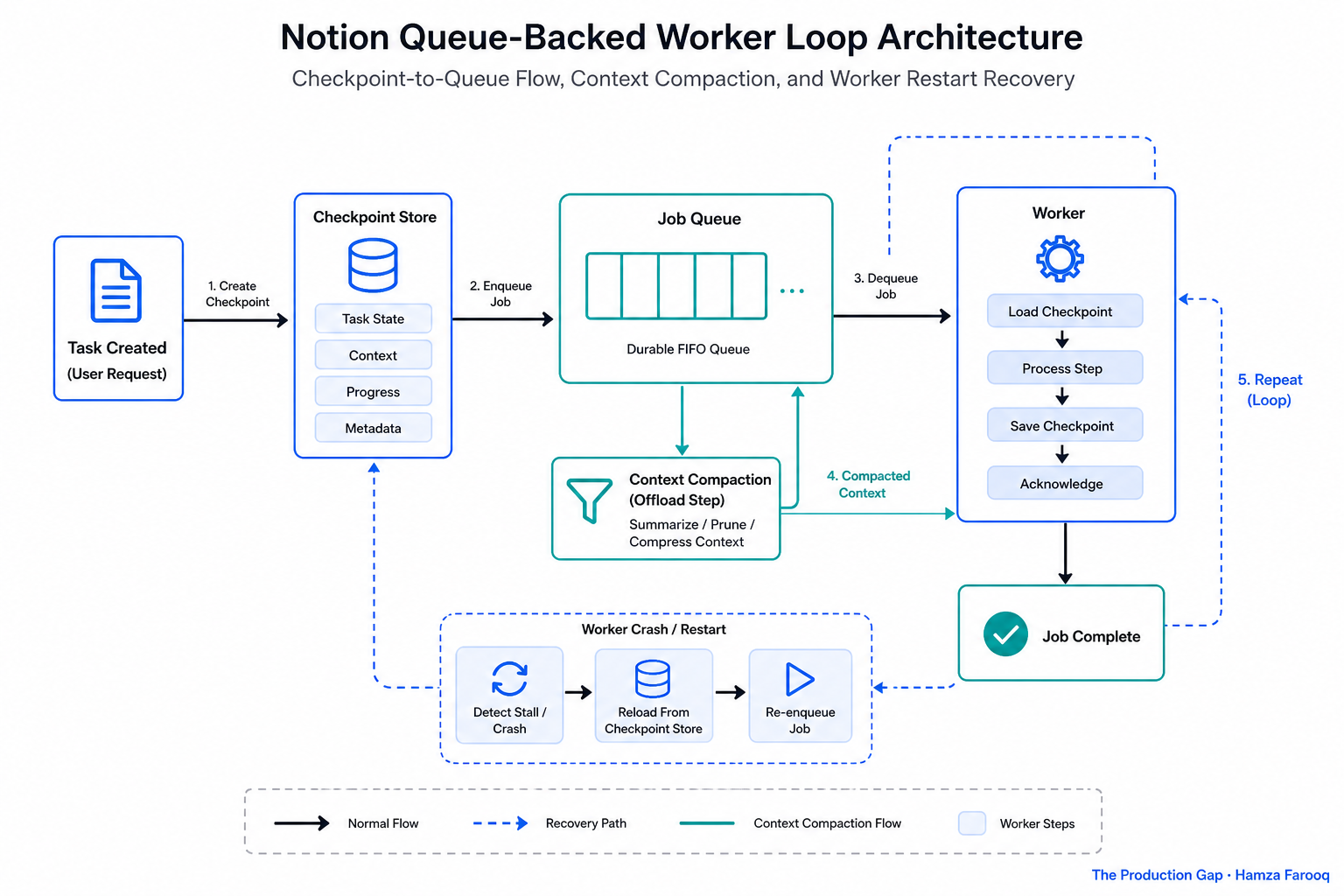
The five-minute limit was an architectural ceiling, not an AI capability ceiling. According to Notion, the fix involves externalizing execution state so an agent can resume after an interruption rather than starting over. The specific internal mechanisms, including how checkpoints are stored and what triggers a resume, are not publicly documented in detail. The architecture described in Notion's announcement should therefore be treated as vendor disclosure pending independent verification.
What triggers model rerouting?
The system detects when a task has stopped advancing and automatically switches to a different underlying model, rather than looping indefinitely.
This is an explicit acknowledgment that no single model is reliable enough for long-horizon autonomous work. The design treats model-level unreliability as a constant to be managed, not an edge case to be avoided. Specific stall-detection thresholds are not publicly documented as of the announcement, which is worth flagging as a transparency gap in any vendor evaluation.
How does the Review model intervene before high-stakes actions?
The Review model runs an independent check before any consequential, hard-to-reverse action executes, providing a safeguard that is structurally separate from the primary agent's reasoning chain.
Whether this is a structurally different model family or the same model running with an independent context is not publicly confirmed. The value is independence from the primary agent's reasoning chain, not necessarily superior intelligence. The Review model addresses a different failure mode than stall detection: it catches destructive action errors rather than circular or stalled execution.
Table 1: Notion Agent Reliability Layers
| Layer | Failure mode addressed | Mechanism | Human equivalent |
|---|---|---|---|
| Extended task duration | Session drop or timeout | Persistent state and resume | Save-and-resume |
| Context management | Context window overload | Tool result handling | Archiving old files mid-project |
| Model rerouting | Model stall or circular output | Automatic model switch on stall | Escalating to a different team member |
| Review model | Destructive action error | Independent second-model check | Second-signature authorization |
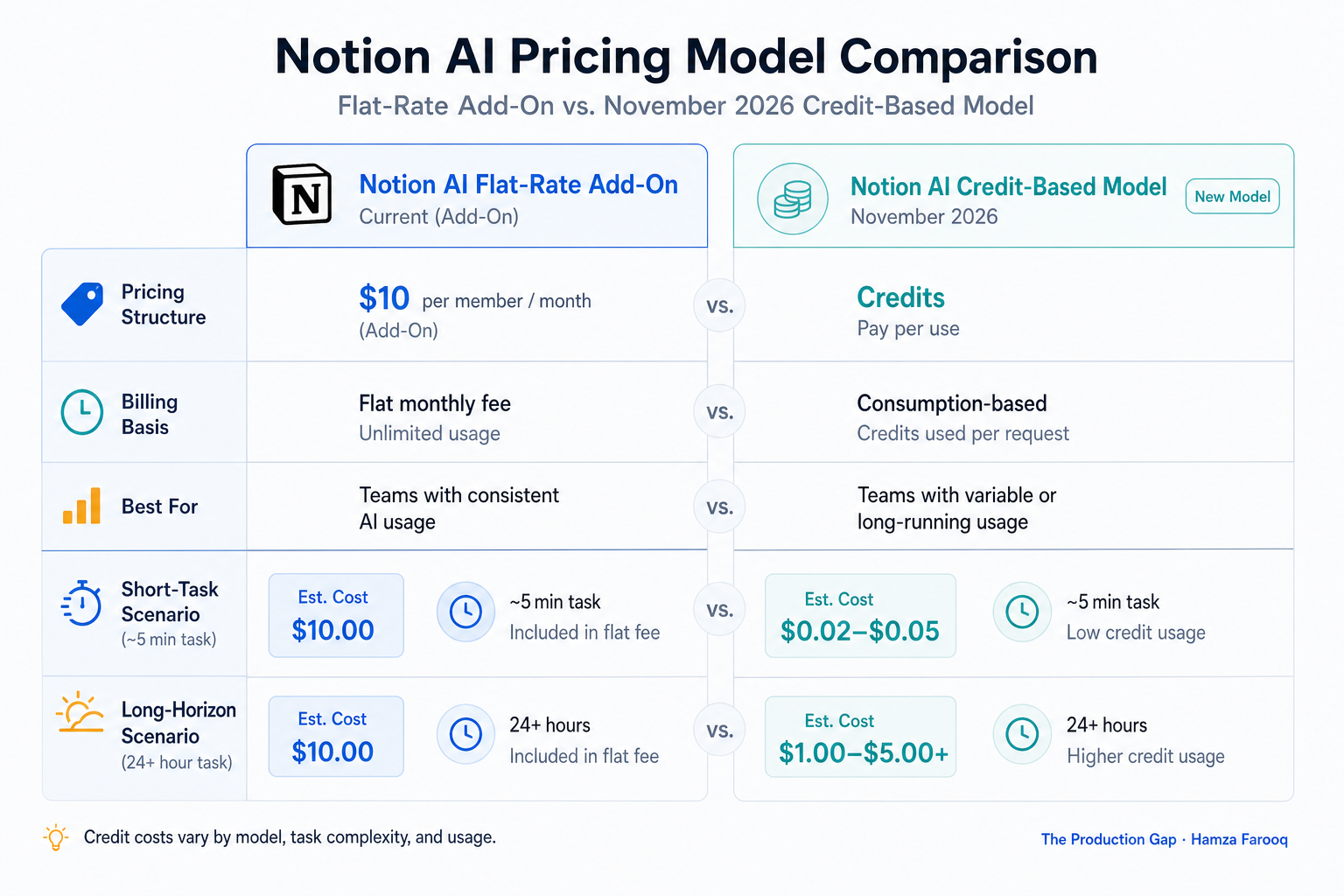
What does the November 2, 2026 credit migration mean for teams, and are the vendor's cost claims credible?
Notion's published pricing does not clarify how credits map to multi-step task chains, integration calls, or model reroutes. A long-running agent task is not the same cost as a five-minute summarization, but the per-action credit math is not yet spelled out publicly. The following four-step audit is author synthesis, offered as a practical rule of thumb rather than a vendor-endorsed process:
- Log current AI feature usage by workflow type for the past 30 days.
- Identify long-horizon tasks, which are likely higher credit burn, versus short-form tasks.
- Set a monthly credit cap before the migration date.
On vendor credibility: the "more for less" framing comes from Notion. The cjwray.com review describes a genuine reversal of opinion after the update, a practitioner who found real value once agents could work across five years of accumulated workspace data. Community discussion on Reddit captures users reporting zero value from the same tooling. Both responses are credible and reflect workflow-fit variation, not product quality in isolation.
FAQ
Q1: How do Notion agents now run for 24+ hours without losing progress?
Notion states that agents persist execution state so work survives interruptions and resumes from where it stopped, rather than restarting from scratch. The specific internal mechanism is not publicly detailed.
Q2: What triggers the system to switch models mid-task?
The system switches models when the agent fails to advance task state. Specific detection thresholds are not yet publicly documented, which is a transparency gap worth tracking when evaluating the platform.
Q3: When does the Review model intervene, and is it always a different model?
The Review model intervenes before consequential, hard-to-reverse actions execute. Whether it is a structurally different model family or the same model running with an independent context is not publicly confirmed as of the announcement.
Q4: Should a team build fault-tolerant agent infrastructure in-house or adopt Notion's?
The right call depends on whether your workflows already live in Notion and whether Notion's integration set covers your tools. If you are running tasks on proprietary pipelines with strict compliance requirements around external tool-call logging, Notion's platform may not fit. If Notion is already your primary workspace, the built-in agent infrastructure removes overhead you would otherwise own indefinitely. This is author synthesis based on the framework used in this guide, not a vendor recommendation.
Conclusion
The jump from five minutes to 24-plus hours is a significant capability claim, and one Notion attributes to how agents now persist and resume work, handle growing context, and reroute around model failures. The internal architecture is not fully public, so the mechanisms described here reflect Notion's own disclosure. The Review model adds an independent check before consequential actions, which is a sound design principle regardless of implementation details.
On November 2, 2026, Notion migrates all existing AI customers to credit-based billing, and that deadline is the practical reason this is worth understanding now rather than later. Run one long-horizon agent task in a controlled workflow before that date. Instrument it. Then decide.
Learn from me
Forward Deployed Engineering Bootcamp for Full-Stack Developers, my Maven cohort. Build and ship complete AI products end to end, from React and Node.js frontends to deployed models with caching and observability. Join the next cohort →
Hire us
Traversaal.ai. We're a team of forward deployed engineers solving the toughest AI problems for Fortune 100 companies: document intelligence, agentic data platforms, and real-time web intelligence, deployed in production. Work with our team to deploy your next agentic ecosystem. Talk to Traversaal.ai →
Join us
Want to solve these problems with us? We're always looking for forward deployed engineers who want to ship production AI. jobs@traversaal.ai