Retail AI Catalog Enrichment Is Where Agentic ROI Actually Lands First — Here's the Pilot Data That Proves It
Retail AI catalog enrichment delivers measurable agentic ROI at the SKU level. See pilot data, NVIDIA's blueprint, and why product data quality wins.

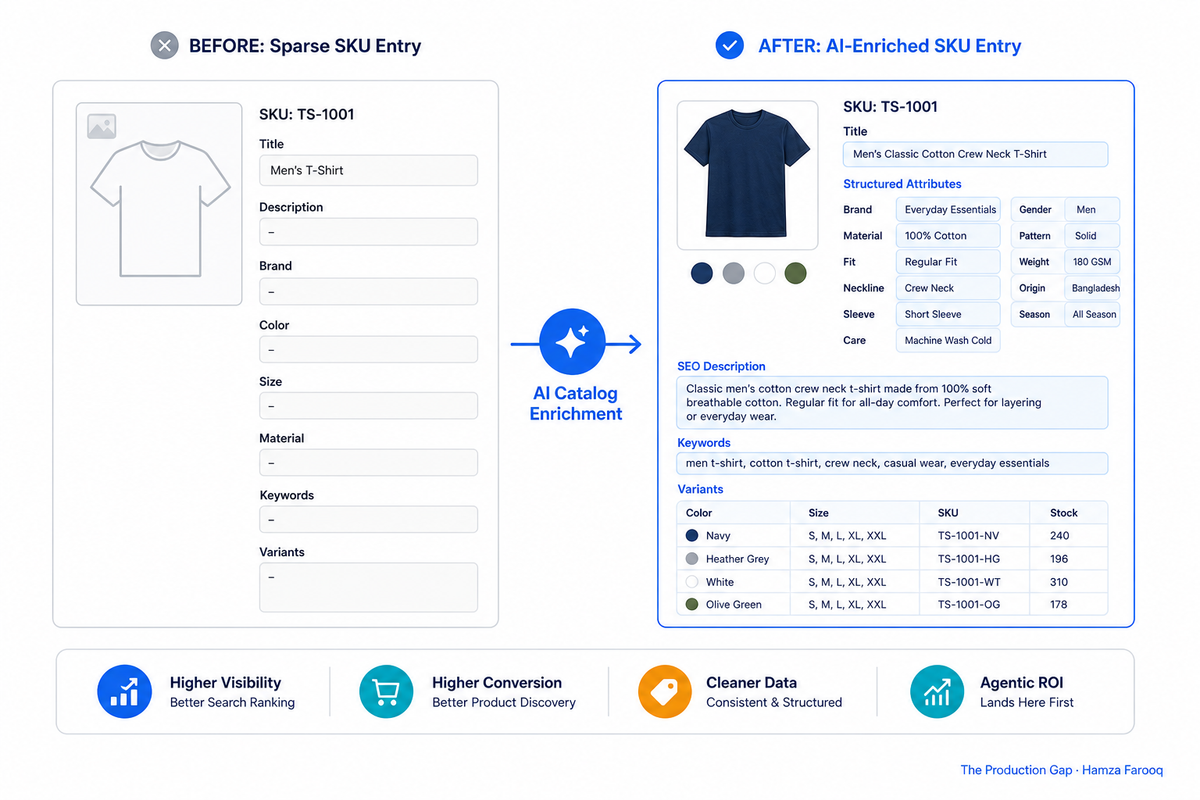
TL;DR: As of mid-2026, retail AI catalog enrichment is producing the clearest agentic ROI in retail technology, not customer-service chatbots. Because outputs are verifiable at the SKU level, finance teams can measure attribute completeness, search rank delta, and conversion impact without attribution guesswork. NVIDIA's Nemotron-based reference architecture lowers the deployment barrier for mid-market retailers, and catalog data quality compounds returns across every downstream AI system already running.
Key Takeaways
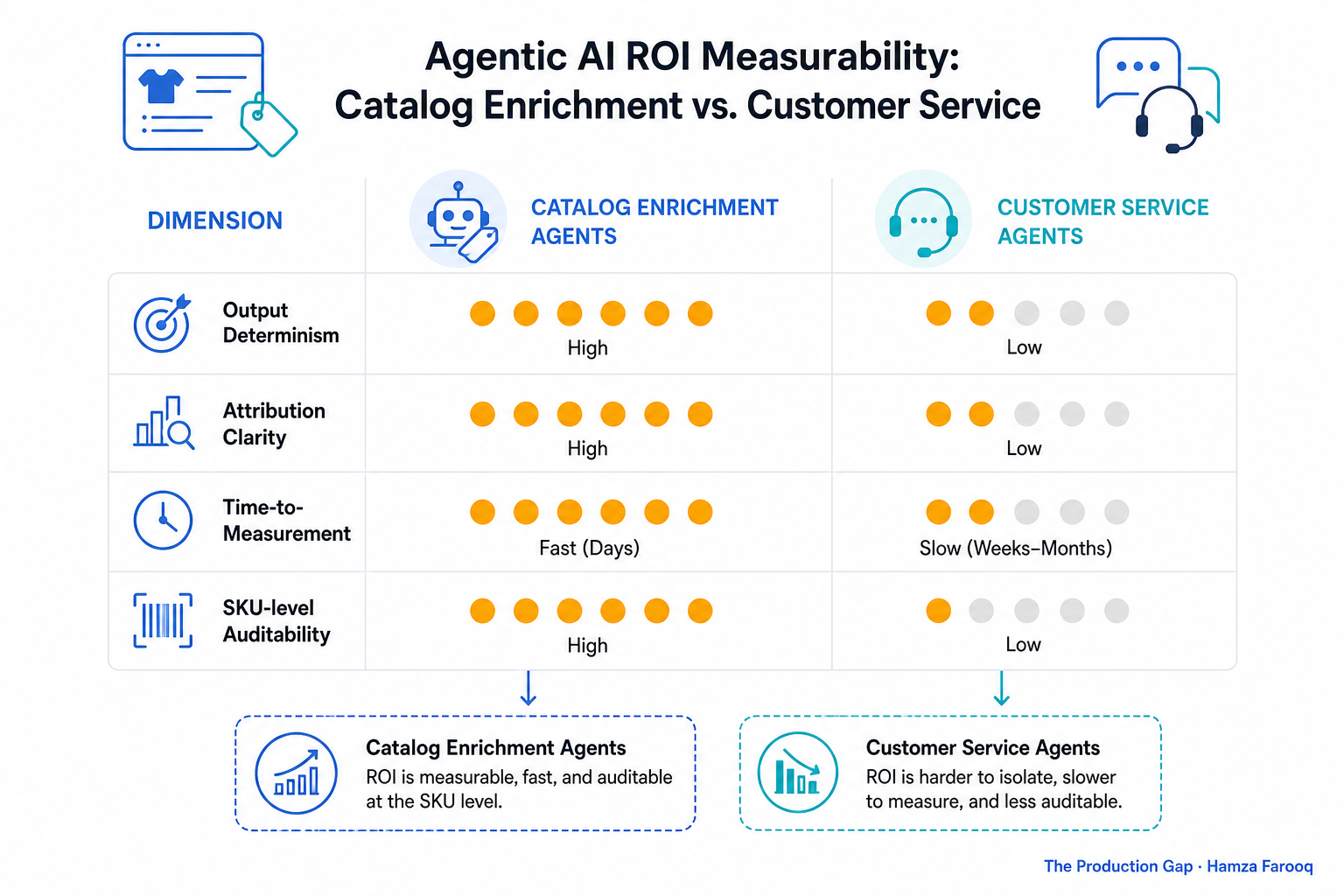
- Catalog agents beat service agents on ROI measurability: Customer-facing chatbots grabbed early pilot budgets, but catalog enrichment delivers returns that are auditable at the SKU level, not estimated at the session level.
- Verifiable outputs are the structural advantage: Catalog enrichment produces a countable fact, an attribute is either present and accurate or it is not, which makes ROI legible to finance in a way chatbot attribution never has been.
- NVIDIA's Nemotron blueprint lowers the entry bar: The open-source reference architecture gives mid-market retailers a deployable starting point without an open-ended ML engineering build.
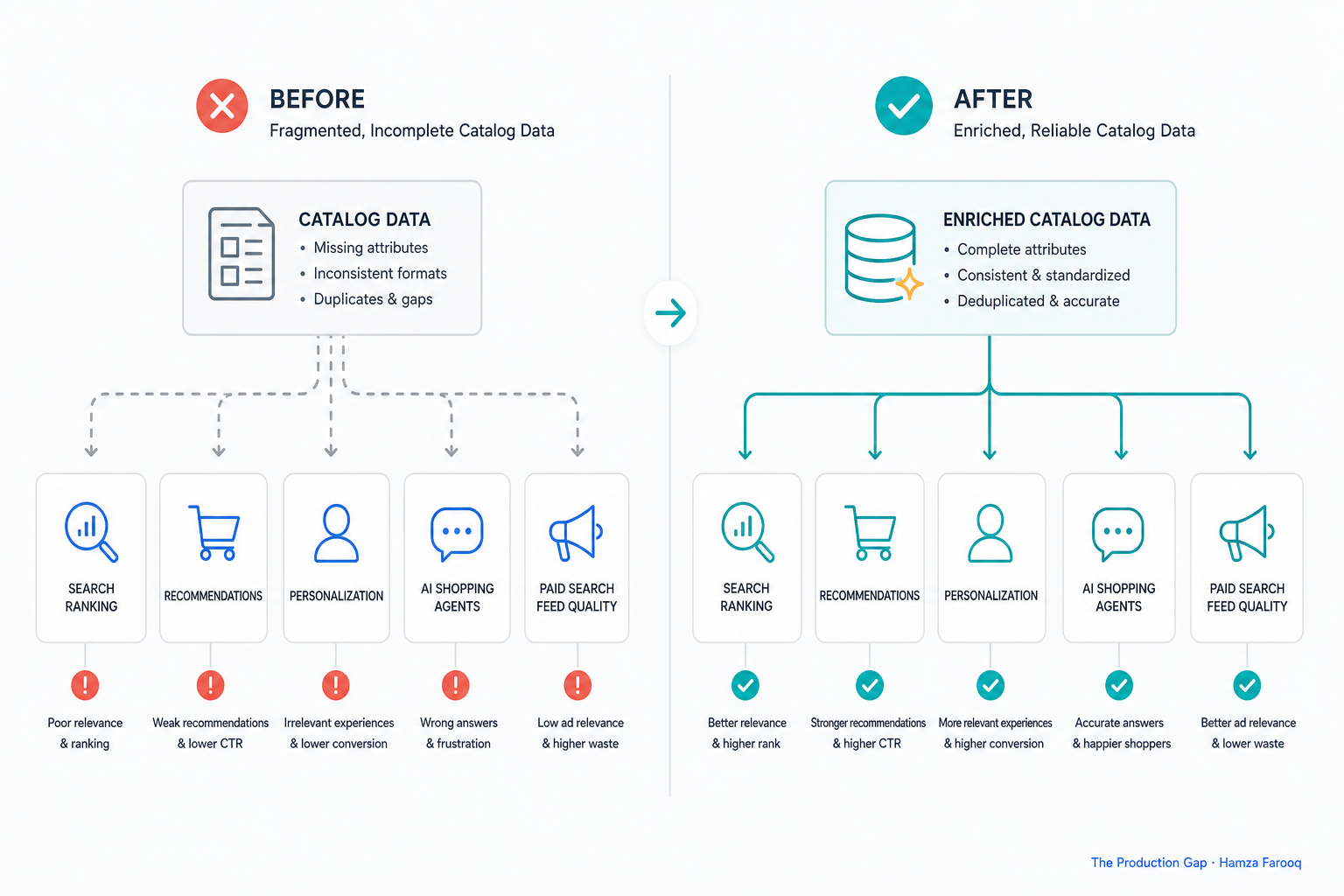
- Dirty catalog data cripples every downstream AI system: Search ranking, recommendation engines, and personalization layers all perform proportionally to the completeness and accuracy of the product attributes feeding them.
- Human review thresholds must be set before the first pipeline runs: Production pipelines require confidence-gated human review; teams that define these thresholds in advance move significantly faster than those that retrofit governance after launch.
Introduction
Your board wants agentic AI ROI by Q1, and customer-service pilots have produced attribution problems finance cannot resolve. The core question, did the chatbot cause the purchase, has no clean answer at the session level.
Retail AI catalog enrichment does. As of mid-2026, the output is a data record: the attribute is either present and accurate, or it is not. AI catalog enrichment tools handle attribute completion, error correction, and structural normalization at catalog scale. The fastest agentic ROI in retail sits in the least glamorous place.
Why Do Catalog Enrichment Agents Outperform Customer-Service Agents on ROI?
Catalog enrichment agents outperform customer-service agents on ROI measurability because they produce deterministic, verifiable outputs at the SKU level rather than probabilistic signals at the session level. You can measure attribute completeness, search rank lift, and conversion delta per product, none of which are cleanly available from a chatbot conversation.
Customer-service agents are easy to demo but hard to attribute. Catalog enrichment sidesteps the attribution problem entirely: either search rank improved after enrichment, or it did not. AI product data enrichment applies structured, standardized, shopper-friendly information to every SKU.
The real benchmark is the prior failure rate. Retailers running manual catalog operations typically show incomplete attributes on long-tail SKUs, visible in PIM error logs and search rank gaps. AI product enrichment automates attribute completion so every SKU is discoverable in both traditional search and by AI agents downstream. Replace a broken, measurable process with a better one, and the delta is your return.
What Makes Catalog Enrichment Results Auditable, and Why Does That Change Budget Conversations?
The strongest argument for catalog enrichment in a mid-2026 budget discussion is not a single vendor metric. It is that results are auditable at the SKU level in a way that customer-service pilots have consistently failed to deliver. That structural difference is what shifts finance from skeptical to receptive.
What matters is that the measurement method itself is sound. Attribute completeness before and after enrichment is a countable fact, not a probabilistic inference. NVIDIA's blueprint confirms the underlying direction: transforming basic product images into comprehensive catalog entries with the stated goal of driving discovery and conversion.
How Does NVIDIA's Blueprint Lower the Entry Bar for Mid-Market Retailers?
Before reference architectures like this existed, building a multimodal pipeline meant sourcing a foundation model, a structured output layer, a quality scoring mechanism, and human review integration, a substantial ML engineering undertaking. The blueprint is open-source and designed to ingest basic product images and output comprehensive catalog entries .
| Dimension | Custom Build | NVIDIA Blueprint Approach |
|---|---|---|
| Time to first enrichment | Author estimate: substantially longer due to pipeline assembly | Author estimate: reduced because components are pre-integrated |
| ML expertise required | Deep multimodal experience across multiple systems | Lighter configuration skillset working from a validated architecture |
| Model | Custom fine-tuned or API-dependent | Nemotron 3 Nano Omni (open, on-prem capable) |
| Output structure | Bespoke schema designed from scratch | Configurable to an existing catalog schema |
| Data sovereignty | Variable, often dependent on external APIs | On-prem deployable, no mandatory API dependency |
The barrier has rarely been the AI model itself. Integration engineering is where projects stall, and a vetted reference architecture directly addresses that. The comparison above reflects author synthesis based on general ML deployment patterns and NVIDIA's published blueprint documentation, not independently measured benchmarks.
Does Catalog Data Quality Determine Whether Every Other AI Investment Pays Off?
Catalog data quality is a direct input to every downstream system, and yes, that dependency makes it a foundational investment rather than a single-use-case deployment. Search ranking, recommendation engines, and personalization layers all perform proportionally to the completeness and accuracy of the product attributes feeding them.
Sparse attributes give downstream systems nothing to work with. Retail data enrichment transforms a basic product catalog into a highly structured foundation for e-commerce AI readiness . Enriching a large SKU base improves search, recommendations, and AI agent responses across every query touching those products simultaneously. That compounding effect is, in this guide's framework, the strongest case for prioritizing catalog work over higher-profile agent deployments.
Human oversight remains essential throughout. AI catalog enrichment accuracy requires human-in-the-loop validation because model confidence alone is insufficient for production trust. The teams moving fastest set their review thresholds before running the first pipeline, not after.
Frequently Asked Questions
Q: Why are catalog enrichment agents showing faster ROI than customer-service agents in retail deployments?
Catalog enrichment produces verifiable, SKU-level outputs such as attribute completeness, search rank, and conversion delta that are measurable without attribution guesswork. Customer-service ROI depends on probabilistic causal claims that remain contested even after extended pilots. Catalog enrichment ROI is auditable as soon as the pipeline runs because the output is a structured data record, not a session-level inference.
Q: What level of human-in-the-loop oversight is required before AI-enriched catalog data can be trusted in production?
Production pipelines require human review gates triggered by model confidence thresholds, because confidence alone is insufficient at production scale. The bypass threshold is an operational design decision set per attribute type and category risk level, and it should be defined before the first pipeline runs rather than retrofitted after errors appear in live data.
Q: How does NVIDIA's Retail Catalog Enrichment Blueprint differ from building a custom catalog enrichment pipeline?
NVIDIA's blueprint, built on Nemotron 3 Nano Omni, provides a pre-integrated reference architecture that reduces the assembly burden of a multimodal pipeline . It is on-prem deployable, which addresses data sovereignty concerns that API-dependent solutions cannot match. The practical difference, as a rule of thumb used in this guide, is that integration engineering becomes a configuration task rather than an open-ended build.
Q: How does catalog data quality affect the performance of downstream AI agents in retail search and personalization?
Catalog data quality is a direct input to search ranking, recommendation engines, and AI shopping agents, all of which perform proportionally to attribute completeness. Enriching catalog data improves all downstream systems simultaneously, making it a compounding infrastructure investment rather than a single-use-case deployment. A catalog with high attribute completeness returns value across every AI system already running against it.
Conclusion
Catalog enrichment works because it replaces a process that was already broken and already tracked. The AI's benchmark is the prior failure rate, one that is visible in your PIM error logs before a single model runs.
A practical prioritization framework for mid-2026 and beyond has three considerations, offered here as author synthesis rather than externally validated methodology. First, favor deployments with deterministic, SKU-level outputs over probabilistic, session-level outcomes. Second, use productized tooling or NVIDIA's Nemotron blueprint to avoid an open-ended build. Third, treat catalog quality as AI infrastructure, because improvements here return value across every downstream system already in production.
Audit your catalog's current attribute completeness rate this week. That number is your ROI baseline, and it will tell you more than any vendor demo whether catalog enrichment belongs at the top of your next agent budget.
Learn from me

Agentic AI for Product Managers, my Maven cohort. Learn how to design, evaluate, and ship reliable AI systems: the technical fluency PMs need to lead agentic products, no engineering background required. Join the next cohort →
Hire us
Traversaal.ai. We're a team of forward deployed engineers solving the toughest AI problems for Fortune 100 companies: document intelligence, agentic data platforms, and real-time web intelligence, deployed in production. Work with our team to deploy your next agentic ecosystem. Talk to Traversaal.ai →
Join us
Want to solve these problems with us? We're always looking for forward deployed engineers who want to ship production AI. jobs@traversaal.ai