Why Most AI Agent Pilots Never Reach Production; And a PM's Pre-Launch Checklist to Fix That
AI agent production ROI stalls at 52% adoption. Use this PM pre-launch checklist to close the gap, name owners, and hit payback faster.


TL;DR: 88% of agentic AI adopters report positive ROI, yet only 52% of executives have deployed agents in production. That gap is not a technology problem, it is an accountability and scoping problem. PMs who run a six-item pre-launch checklist before approving pilot work close that gap by naming owners, defining metrics, and modeling payback before a single line of code is written.
Key Takeaways
- Pilots fail before they launch: Weak problem framing and missing accountability structures kill deployments, not the technology.
- PMs need a go/no-go checklist: A structured readiness review catches organizational and scoping gaps before they become sunk costs.
- Cost-per-resolution is your north star: Track what one task costs with and without the agent. That number justifies continued investment.
- Payback period sets honest expectations: Know the break-even timeline before leadership hears the word "deployment."
- Pilot ROI and production ROI are different: A successful pilot proves concept. Production scale requires separate planning for cost, oversight, and integration.
- Single-agent pilots rarely survive multi-agent scale: Skipping coordination and handoff design early creates a hard wall when you try to expand.
What stops AI agents from reaching production?
the majority of AI agent pilots stall before they reach production, not because the technology fails, but because no one owns the transition from staging to live. That single accountability gap is the dominant structural cause of stalled deployments, and it is visible in the data: 88% of agentic AI adopters report positive ROI, yet only 52% of executives have deployed agents in production. That gap is organizational, and it is draining pilot budgets across the industry. PMs can no longer greenlight pilots on demo performance alone. This article names the root cause and gives you a six-item pre-launch checklist to run before approving a single hour of pilot work.
Why do most AI agent pilots fail before reaching production?
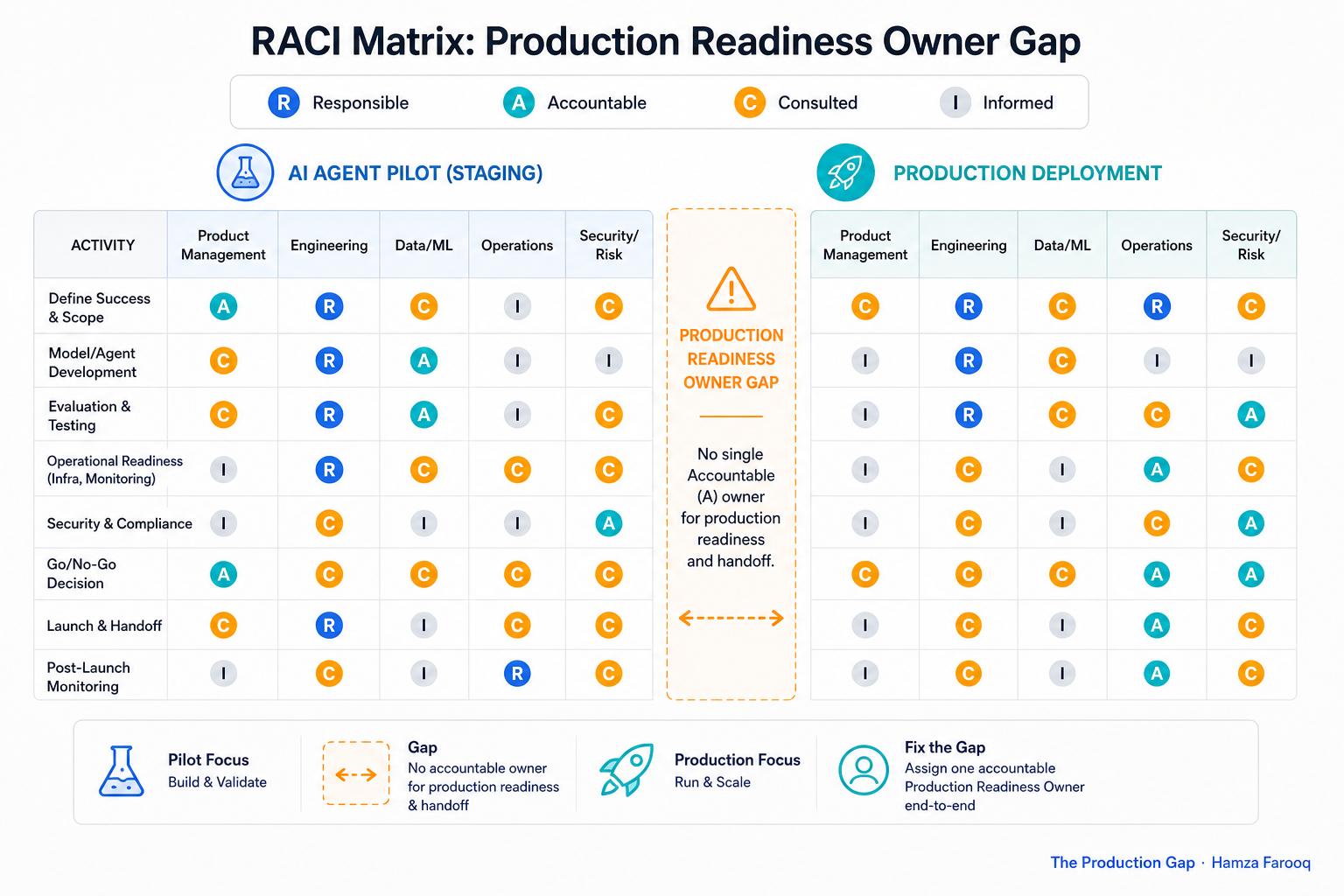
This is an org-design problem wearing a technology disguise. PMs approve pilots on demo performance. Engineers build to staging specs. Then a gap opens: no RACI row exists for "owns the transition from 'it works in staging' to 'it runs reliably in prod.'" This guide calls that gap the Production Readiness Owner (PRO) gap, an author-named structural pattern observed consistently across stalled deployments. It is the accountability failure behind most pilots that never ship.
Consider a restaurant that nails its soft opening under controlled conditions but never decides who owns the shift to full service. It stays perpetually in soft-open mode. That is the pattern when a pilot clears its demo milestone with no named stakeholder accountable for the last mile. The technology works where it runs. The failure lives in the handoff.
What does real AI agent production ROI actually look like?
AI agent production ROI is most reliably measured by two numbers: cost-per-resolution and payback period. Everything else is a secondary metric until those two move.
Pilot ROI proves a concept under controlled conditions. Production ROI is what happens when volume, edge cases, and real users hit your agent every day. PMs who treat pilot metrics as production baselines leave leadership unprepared for the cost reality at scale.
The Resolution Economics Framework is the benchmarking model used in this guide to compare pilot baselines against production targets across four key metrics. It is a practical planning tool, not an externally validated standard, and is offered here as a structured way to pressure-test production viability before launch. Table data reflects sourced benchmarks as of mid-2025.
| Metric | Pilot Baseline | Production Target | Source |
|---|---|---|---|
| Cost per resolution | ~$15 (human-handled) | ~$2 (agent-handled) | 2026 Pricing & ROI Guide |
| Payback period | N/A | 4–8 months | 2026 Pricing & ROI Guide |
| Year-1 ROI | Proof-of-concept | 3x–6x return | AI Agent ROI Framework |
| Top-quartile ROI | Varies | Up to 8x (customer service) | McKinsey via CX Reality |
| Executives reporting positive ROI yr-1 | Varies | 74% | AI Agent ROI Framework |
If you cannot model cost-per-resolution before launch, you do not have a production plan.
What should a PM's pre-launch checklist include to greenlight an AI agent pilot?
A PM should not greenlight an AI agent pilot until six criteria are confirmed: a named production readiness owner, a defined success metric, a clear escalation path, a realistic payback window, a scoped failure boundary, and an integration handoff plan.
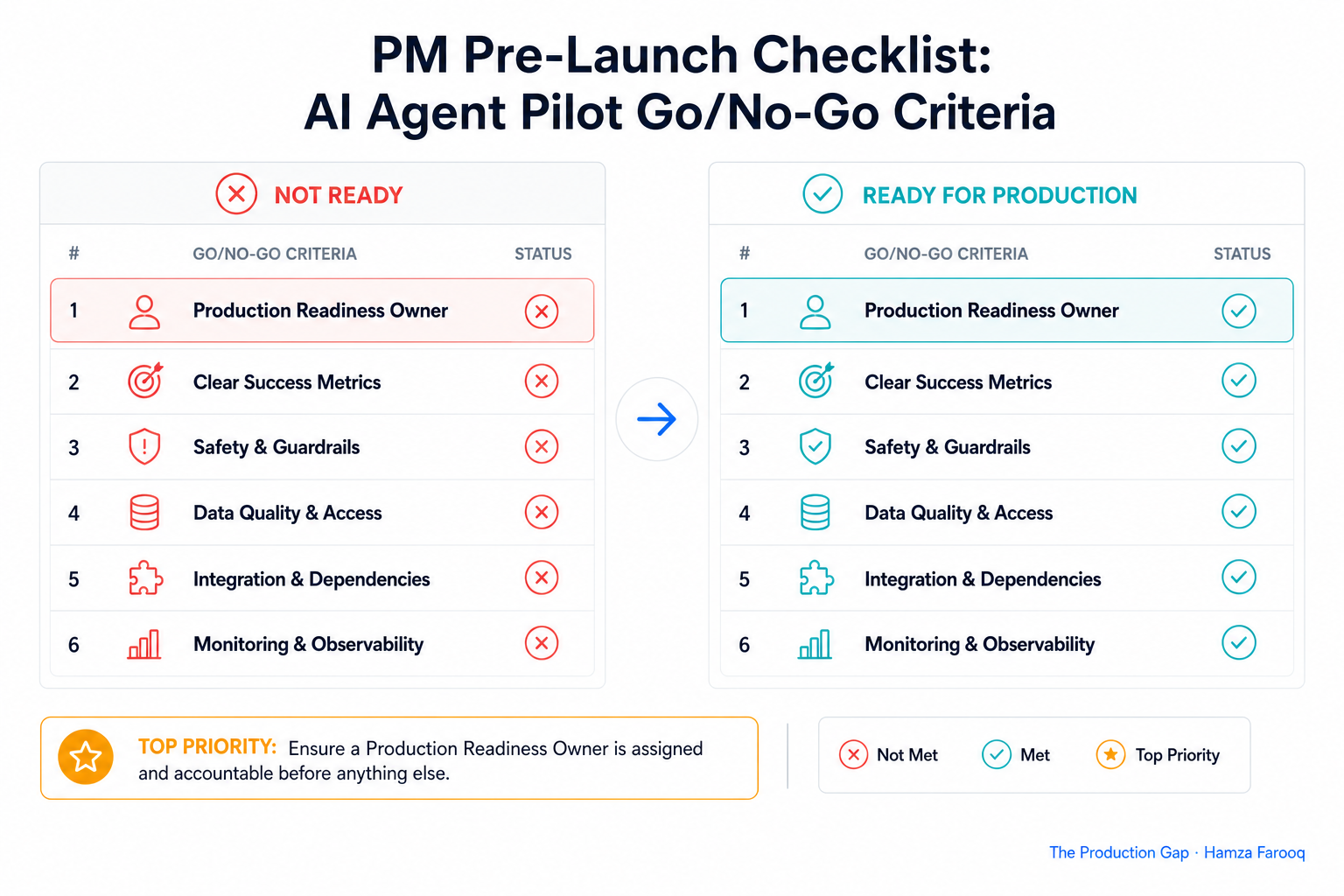
The six go/no-go criteria:
- Named Production Readiness Owner. One person is accountable for the staging-to-prod transition. Not a committee. If this row is blank, stop here.
- Defined north-star metric. Cost-per-resolution or resolution rate, not "user satisfaction." Vague metrics produce vague accountability.
- Scoped failure boundary. What does the agent not handle? Undefined scope is one of the most consistent silent killers of production timelines.
- Payback period modeled. The benchmark is 4–8 months. If the math does not work at current volume, say so before the kickoff call.
- Escalation and override path. Who catches the agent when it is wrong, and how fast? An agent with no escalation owner means edge-case failures sit unresolved. The agent may perform correctly while the system fails around it.
- Integration handoff plan. Which systems, APIs, and human workflows does this touch? An agent with no integration owner stalls at the first API boundary.
If any criterion is blank, the pilot is not ready. Approving it anyway delays the failure by three months, it does not prevent it.
Why do single-agent pilots fail when organizations try to scale to multi-agent production?
Single-agent pilots fail at scale because coordination, handoffs, and error propagation between agents require architectural decisions that most pilot teams defer until reversal is expensive.
Only 39% of organizations have launched more than one AI agent in production. That figure and the 52% production adoption rate come from the same source; the relationship between them reflects the compound difficulty of reaching production at all and then scaling beyond a single agent, a pattern this guide treats as an author synthesis rather than a directly stated causal claim. Three deferred decisions drive the scaling ceiling:
Handoff protocol. In a single-agent pilot, downstream handoffs are irrelevant. In multi-agent production, defining what Agent A passes to Agent B is the critical path. Teams that skip this discover the omission mid-deployment, when reversal is costly.
Error propagation boundary. A failure in one agent compounds silently through downstream agents when no circuit-breaker logic exists. By the time it surfaces as a user-facing problem, the root cause is three agents back.
Shared context management. Multiple agents drawing from the same data context without coordination produce inconsistent outputs. One unreliable agent degrades confidence in the entire deployment.
Frequently Asked Questions
What is the most common reason AI agent pilots fail to reach production? The most common reason AI agent pilots fail is the absence of a named Production Readiness Owner, no single stakeholder is accountable for bridging staging to production. 88% of adopters see positive ROI, yet only 52% have reached production. That gap comes from accountability failures, not technical underperformance.
How do you measure ROI for an AI agent in production? The most reliable way to measure AI agent production ROI is to track cost-per-resolution (targeting a drop from ~$15 to ~$2) and payback period (benchmark: 4-8 months). Organizations at production scale report 3x–6x year-one returns, with top performers reaching 8x per McKinsey.
What go/no-go criteria should a PM require before greenlighting an AI agent pilot? A PM should require six confirmed criteria before greenlighting any AI agent pilot: a named production readiness owner, a north-star metric, a scoped failure boundary, a modeled payback period, a documented escalation path, and a cross-system integration handoff plan. All six must be confirmed before work begins, any blank row is a reason to pause, not a detail to resolve later.
Why do enterprises struggle to scale from one AI agent to many? Enterprises struggle to scale beyond one agent because single-agent pilots do not require handoff protocols, error propagation boundaries, or shared context management, and those three architectural decisions become load-bearing the moment a second agent is added. Only 39% of organizations have launched more than one agent in production, which shows how often the scaling wall stops teams cold.
Conclusion
The pilot failure rate is not an indictment of the technology. It is an indictment of the org chart. The ROI is real, up to 8x for top performers. The agent that could be running in production next quarter is probably sitting in your staging environment right now, waiting for someone to own the last mile.
Run the six-item pre-launch checklist on your current pilot today. If any row is blank, that is your first fix, before writing another line of code.
Learn from me
Agentic AI for Product Managers, my Maven cohort. Learn how to design, evaluate, and ship reliable AI systems: the technical fluency PMs need to lead agentic products, no engineering background required. Join the next cohort →
Hire us
Traversaal.ai. We're a team of forward deployed engineers solving the toughest AI problems for Fortune 100 companies: document intelligence, agentic data platforms, and real-time web intelligence, deployed in production. Work with our team to deploy your next agentic ecosystem. Talk to Traversaal.ai →
Join us
Want to solve these problems with us? We're always looking for forward deployed engineers who want to ship production AI. jobs@traversaal.ai