Agent Egress Firewall Sandboxing: Why Default-Deny Outbound Networking Is Your Highest-Leverage Control Before AI Agents Go Live
Agent egress firewall sandboxing stops AI exfiltration before it starts. Learn how a default-deny outbound policy collapses your biggest risks in one rule.

As of July 2025. AI egress threat tooling and sandbox bypass research evolve rapidly; check linked sources for updates.
Disclosure: Clawker, cited throughout this article as a reference implementation, is the product published by this site. All architectural claims about Clawker are drawn from its public documentation.
TL;DR: Agent egress firewall sandboxing is the highest-leverage pre-deployment control because a default-deny outbound policy collapses exfiltration, prompt-injection callbacks, and runaway API spend in a single rule before any other mitigation has a chance to fail. Locking outbound traffic to an explicit allowlist means an agent can only reach destinations you have deliberately approved, turning unknown-unknowns into a manageable enumeration problem.
An agent on a client network reads a document, follows a link, and quietly sends your API tokens somewhere you do not control. The only question is whether you closed that door before it opened.
Key Takeaways
- Default-deny egress is the master control: Blocking all outbound traffic by default does more to shrink agent risk than any other single pre-deployment measure.
- Allowlists must name specific destinations: Vague permissions defeat the purpose. Every API and domain must be explicitly listed before the agent goes live.
- Credential brokering alone is not enough: Any token that generated code can read can also be forwarded outbound. Only network-layer enforcement stops that.
- Prompt injection can trigger exfiltration: A hidden instruction in a document can direct an agent to send data externally. A strict egress firewall is the only reliable block.
- Enforcement must live outside the agent process: Rules enforced inside the same process the agent runs in can be circumvented by generated code that calls system libraries, spawns subprocesses, or uses low-level sockets. The firewall must sit at the network layer.
- Unconstrained egress multiplies blast radius: Open egress means the agent can reach almost anything. Deny-by-default limits it to a short, audited list.
Why do AI agents need egress firewall sandboxing before deployment?
Tool-using LLM agents run inside client networks, reading files, executing shell commands, calling APIs, and following links inside a single task loop. Documented sandbox bypass research from Penligent confirms that in-sandbox controls alone cannot stop exfiltration when outbound networking is open. Most teams plan to add egress restrictions after the agent proves itself in practice. That sequencing is the wrong order.
This article explains why default-deny outbound networking is the single highest-leverage control, how to scope an AI agent egress allowlist correctly, and why credential brokering does not substitute for network-layer enforcement. Clawker, a self-hosted AI coding agent sandbox, ships every agent behind a deny-by-default egress firewall as a first-class architectural guarantee.
Why does unconstrained egress turn a well-intentioned agent into an exfiltration vector?
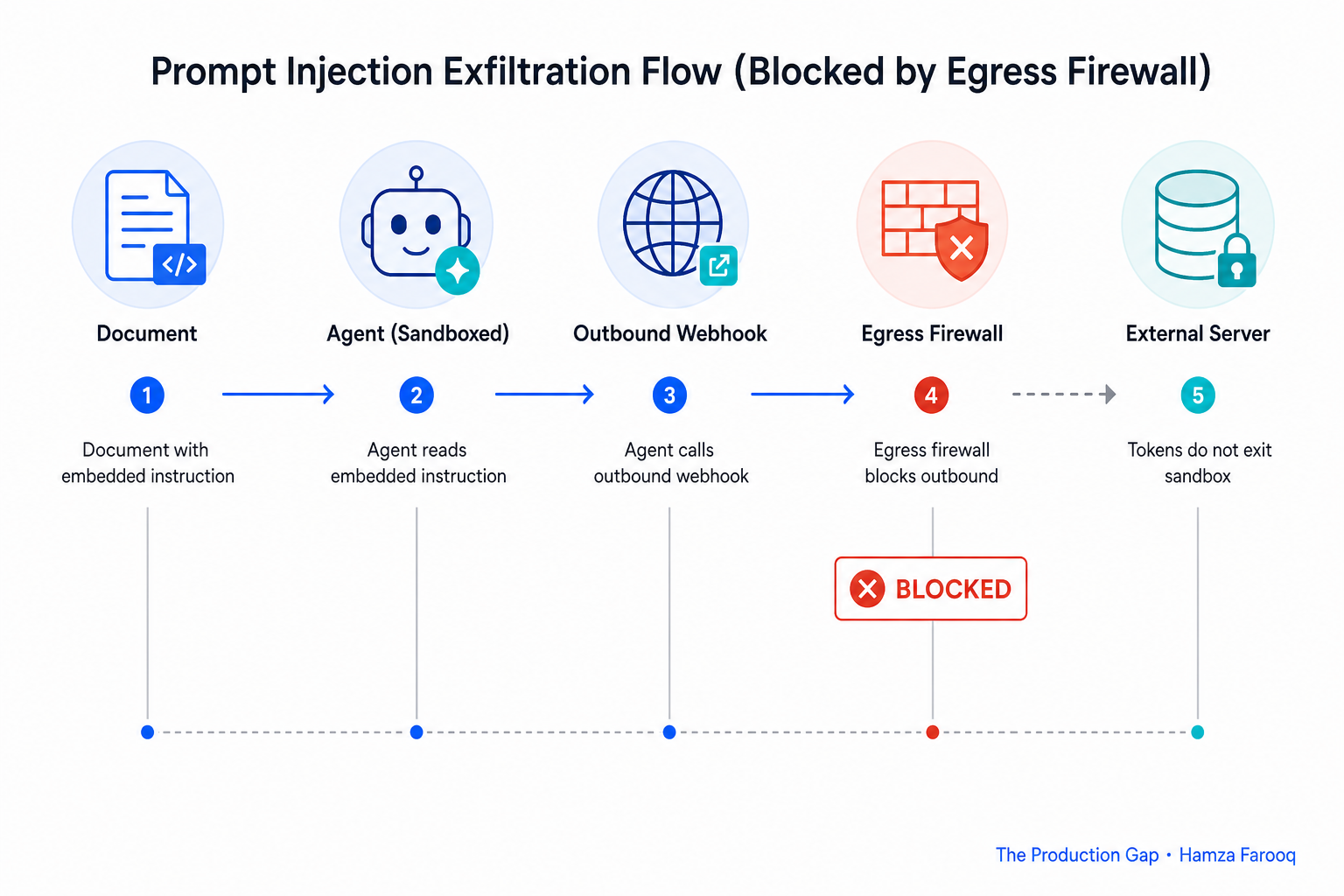
An AI agent with unconstrained outbound networking becomes an exfiltration vector the moment a prompt-injection payload lands in any document it reads. No malicious agent is required.
The path is direct: a coding agent inside a sandbox can read files, run commands, install dependencies, inspect logs, and follow links. A hidden instruction embedded in any document the agent reads can direct it to forward credentials outbound. That is normal tool use, not a sandbox escape. Sandbox egress exposure is a defined threat category: a synthetic subject inside a constrained environment reaching external networks without explicit policy authorization.
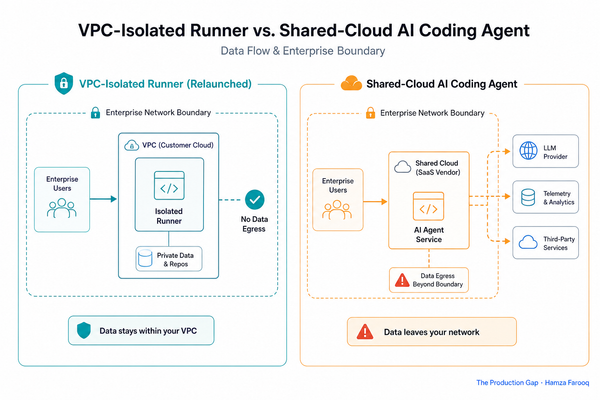
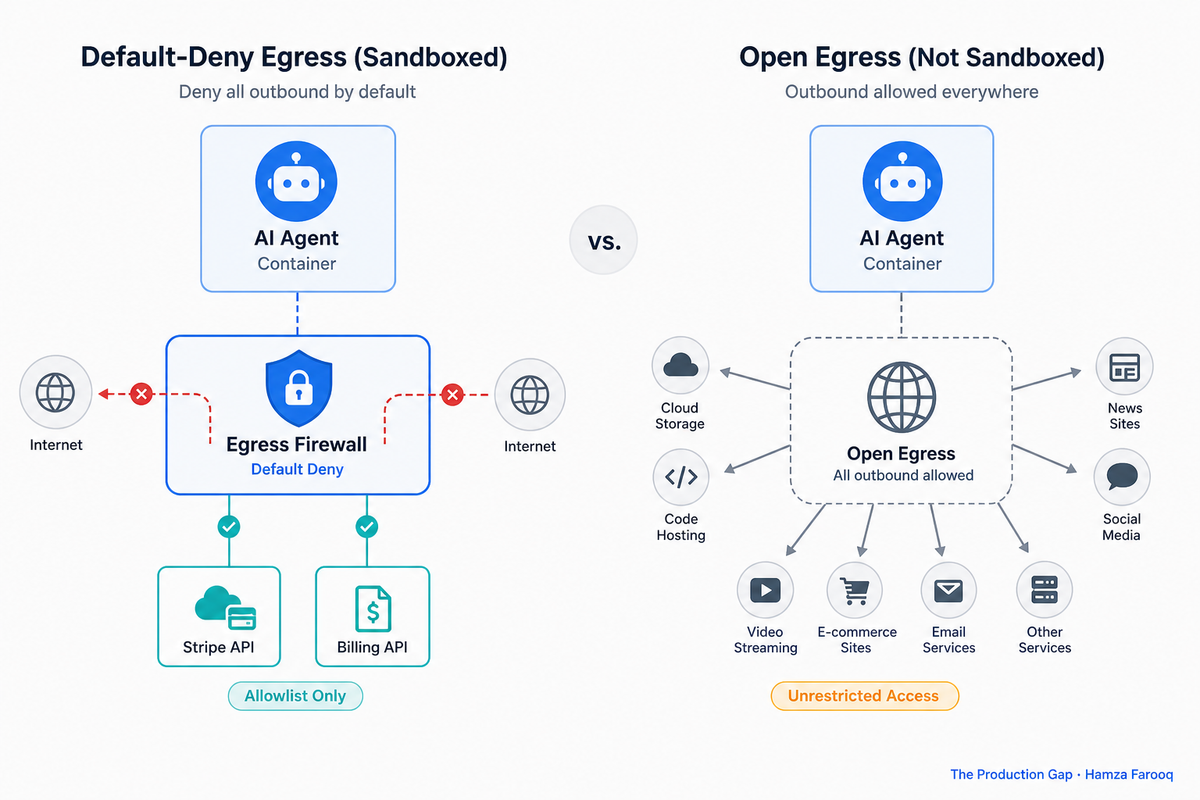
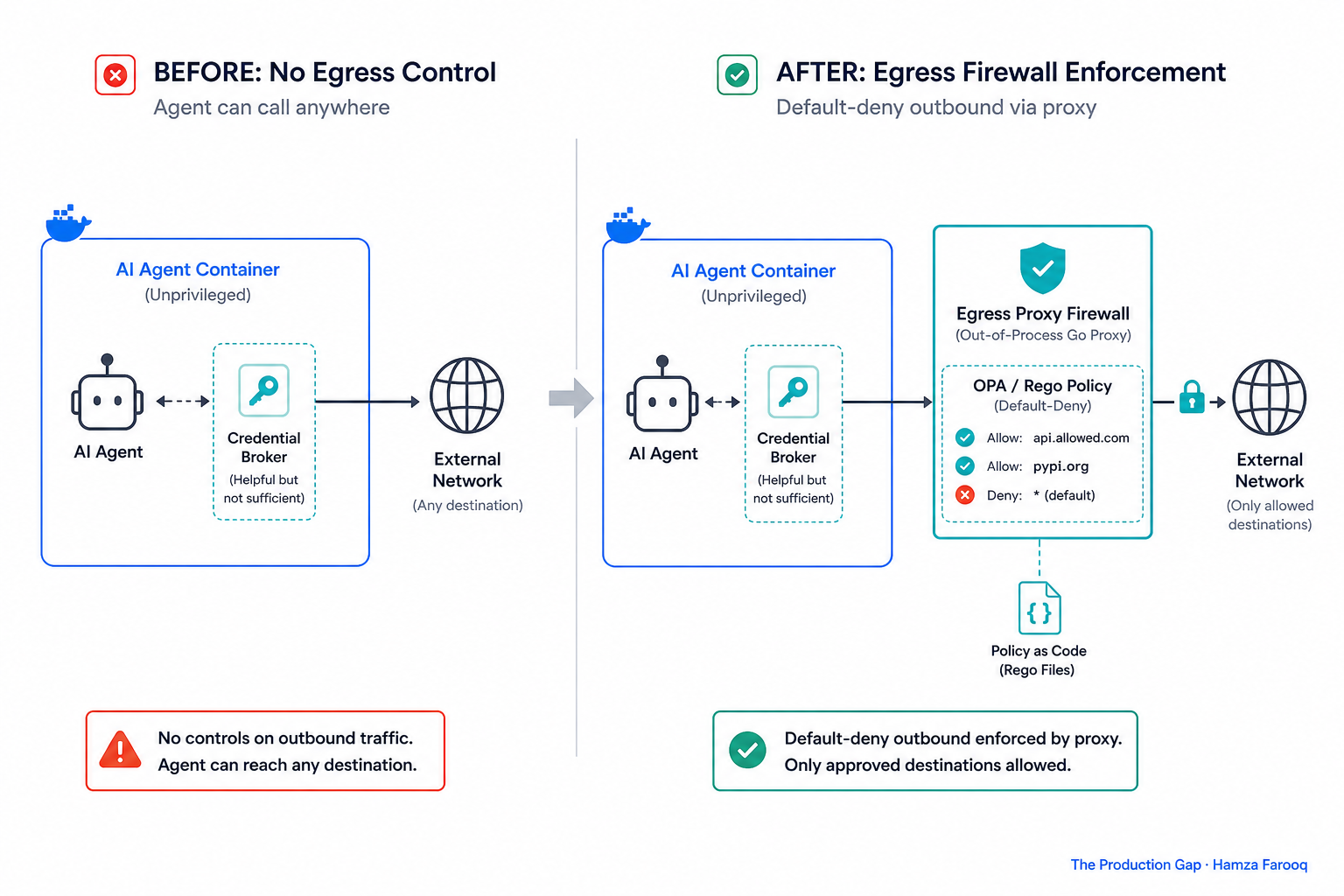
The blast-radius contrast is straightforward. An agent with open egress can reach any internet host. One behind a deny-by-default firewall is limited to a short, audited allowlist. The difference is practical: a contractor with a universal building pass versus one with access only to their assigned floor.
What does a correctly scoped egress allowlist actually look like, and why is "the internet" not an answer?
A correctly scoped AI agent egress allowlist names every specific destination the agent legitimately needs and blocks everything else by default.
Treat allowlist construction as a design exercise: enumerate every API call the agent's declared tools are built to make. That list is the allowlist. If you cannot enumerate it, the agent's capability surface is not defined, and that is a design problem, not a security afterthought. The framing that applies here, as a practical rule of thumb used throughout this guide, is "this agent can call Stripe and our billing API," not "this agent can reach the internet." For runtime dependencies, either name the package registry explicitly or pre-bake dependencies into the container image and block all registry egress.
The table below summarizes egress policy tiers using the framework applied in this guide. The "Risk rationale" column describes the failure mode for each tier and the structural reason the lowest tier succeeds.
| Egress policy | Example rule | Risk level | Risk rationale |
|---|---|---|---|
| Default-allow (open internet) | Agent can reach any host | Critical | Prompt injection can exfiltrate to any attacker-controlled endpoint |
| Vague allowlist | Allow *.amazonaws.com | High | An attacker-controlled S3 bucket qualifies as "allowed" |
| Named-destination allowlist | Allow api.stripe.com, billing.internal | Low | Exfiltration requires the destination to already be approved |
| Named-destination + OPA/Rego policy | Allow api.stripe.com; enforce per-request budget circuit breaker | Lowest | Policy is enforced out-of-process; agent code cannot override it |
Why does enforcement have to live outside the agent process, and what does that look like in practice?
Egress firewall rules built into the same process the agent runs in can be circumvented by generated code that calls system libraries, spawns subprocesses, or uses low-level sockets. Enforcement must sit at the network layer, fully outside the agent's reach.
On credential brokering: if generated code can read a token, it can forward that token outbound. Brokering credentials without network-layer egress enforcement leaves the exit path open. Full agent security requires four layers: network isolation, storage security, credential management, and runtime monitoring. Removing egress enforcement leaves a gap the other three cannot close.
What is the blast-radius difference between an agent that escapes with and without default-deny egress in place?
An agent that escapes a sandbox with open outbound access can contact almost any internet host. One behind a default-deny egress policy is constrained to a short, audited list regardless of what the agent does next.
Frequently Asked Questions
What outbound destinations should be on an agent's egress allowlist before it is deployed? Every destination named by the agent's declared tools: specific API hostnames, internal service endpoints, and exactly one named package registry if runtime dependency installation is required. If you cannot enumerate the full list before deployment, the agent is not ready to ship. This enumeration requirement is the framework used in this guide and is consistent with the allowlist scoping guidance in Modexa's sandbox cuts framework.
Is credential brokering inside the sandbox sufficient to prevent token exfiltration? No. Any token that generated code can read can also be forwarded outbound.Network-layer enforcement via a deny-by-default egress firewall is what closes the gap. Credential brokering and egress control are complementary, not interchangeable.
How do out-of-process policy rules translate into practical egress enforcement for a tool-using LLM agent? Each allowlist entry becomes a rule evaluated by an out-of-process proxy on every outbound request. The proxy enforces policy at the network layer regardless of what the agent's generated code attempts, because the agent process has no path to the external network that bypasses the proxy.
Conclusion
Default-deny egress changes what category of incident is possible, which is why it does more than any other single pre-deployment control. An agent behind a correctly scoped allowlist cannot exfiltrate to arbitrary attacker infrastructure, regardless of what prompt injection lands in its context window.
Writing the allowlist before the agent goes live forces the agent's intended capability surface into the open. If you cannot write that list, you have an experiment running with production credentials, not a deployment-ready agent. Without egress control, runtime monitoring, storage security, and identity management all share a gap that a compromised agent can move through.If the allowlist is growing faster than the agent's declared tool surface, that is a signal for a design review, not a longer list.
Ready to operationalize? Start with Clawker's security documentation for a production-grade deny-by-default egress architecture, and work through the Modexa "8 Sandbox Cuts" framework to pressure-test every other containment layer before your agent goes live.
Learn from me
Forward Deployed Engineering Bootcamp for Full-Stack Developers, my Maven cohort. Build and ship complete AI products end to end, from React and Node.js frontends to deployed models with caching and observability. Join the next cohort →
Hire us
Traversaal.ai. We're a team of forward deployed engineers solving the toughest AI problems for Fortune 100 companies: document intelligence, agentic data platforms, and real-time web intelligence, deployed in production. Work with our team to deploy your next agentic ecosystem. Talk to Traversaal.ai →
Join us
Want to solve these problems with us? We're always looking for forward deployed engineers who want to ship production AI. jobs@traversaal.ai