AI Code Review Automation: Why Your Reviewer Model Choice Is an Architectural Decision (With Data to Prove It)
AI code review automation has a blind spot: same-model self-review shares bias. Learn how cross-model CI gates catch more bugs without slowing your pipeline.

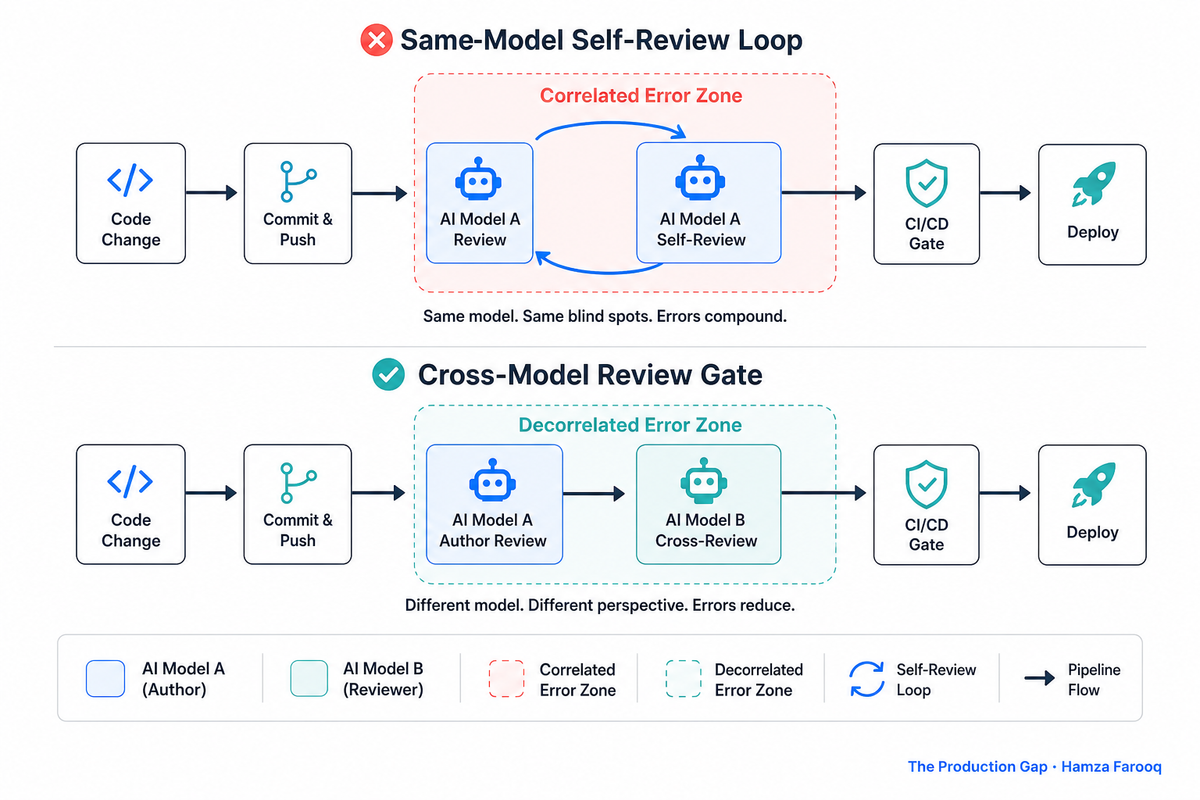
TL;DR: Choosing which AI model reviews your code is an architectural decision, not a product preference. When the same model that generates code also reviews it, correlated training distributions mean shared blind spots survive the review gate. A sufficiently different second model breaks that correlation. This guide explains the mechanism, shows how to wire a second-model gate into CI, and frames the cost math so any team can evaluate the tradeoff.
Key Takeaways
- Reviewer model choice is architecture: which AI model reviews your code directly affects how many bugs reach production.
- Cross-model review catches what self-review misses: the same model that wrote the code repeats its own blind spots; a different model finds what the first structurally cannot.
- Model pair direction is worth testing deliberately: the decorrelation between two models is likely asymmetric, making reviewer order a variable worth measuring rather than assigning arbitrarily.
- CI-native review gates are production-ready: Cloudflare ships a working second-model review stage in CI without breaking build speed.
- The cost math warrants evaluation: per-PR token spend is predictable and estimable before you commit to the approach.
Why Has AI Code Review Become the New Bottleneck?
Review is now the chokepoint, not generation. In high-velocity engineering teams, AI-generated code has become a normal contribution pattern, and the review step has not kept pace architecturally. CI-native AI code review is a documented production approach: Cloudflare has published their OpenCode-based implementation, and tools like Qodo, CodeRabbit, GitHub Copilot review, Sourcery, and CodeAnt have staked out the market.
Why Does Self-Review With the Same AI Model Fail as a Quality Gate?
When the same model generates and reviews code, correlated failure modes mean the reviewer can statistically approve the exact errors the generator produced. Models trained on similar corpora with similar fine-tuning pipelines are likely to develop overlapping blind spots. If a model generates a subtle off-by-one error in a recursive boundary condition, the same model reviewing that output may not surface it because its internal sense of correct-looking code won't flag what it already considers normal.
Self-review is architecturally equivalent to no second opinion: the gate exists, but it does not filter independently. Volume does not fix this. As developers on the r/ExperiencedDevs thread have pointed out, AI can generate far more comments than a human reviewer, which makes it easy to mistake noise for signal. A model producing many comments on its own code may still be approving its own structural errors, just verbosely.
What Does the Cross-Model Review Asymmetry Argument Claim, and What Should You Verify?
The core argument is that the direction of a model pair in cross-model AI code review automation is not neutral. The proposed mechanism is epistemic decorrelation: two models trained on sufficiently different corpora fail on different code patterns, so each catches what the other misses.
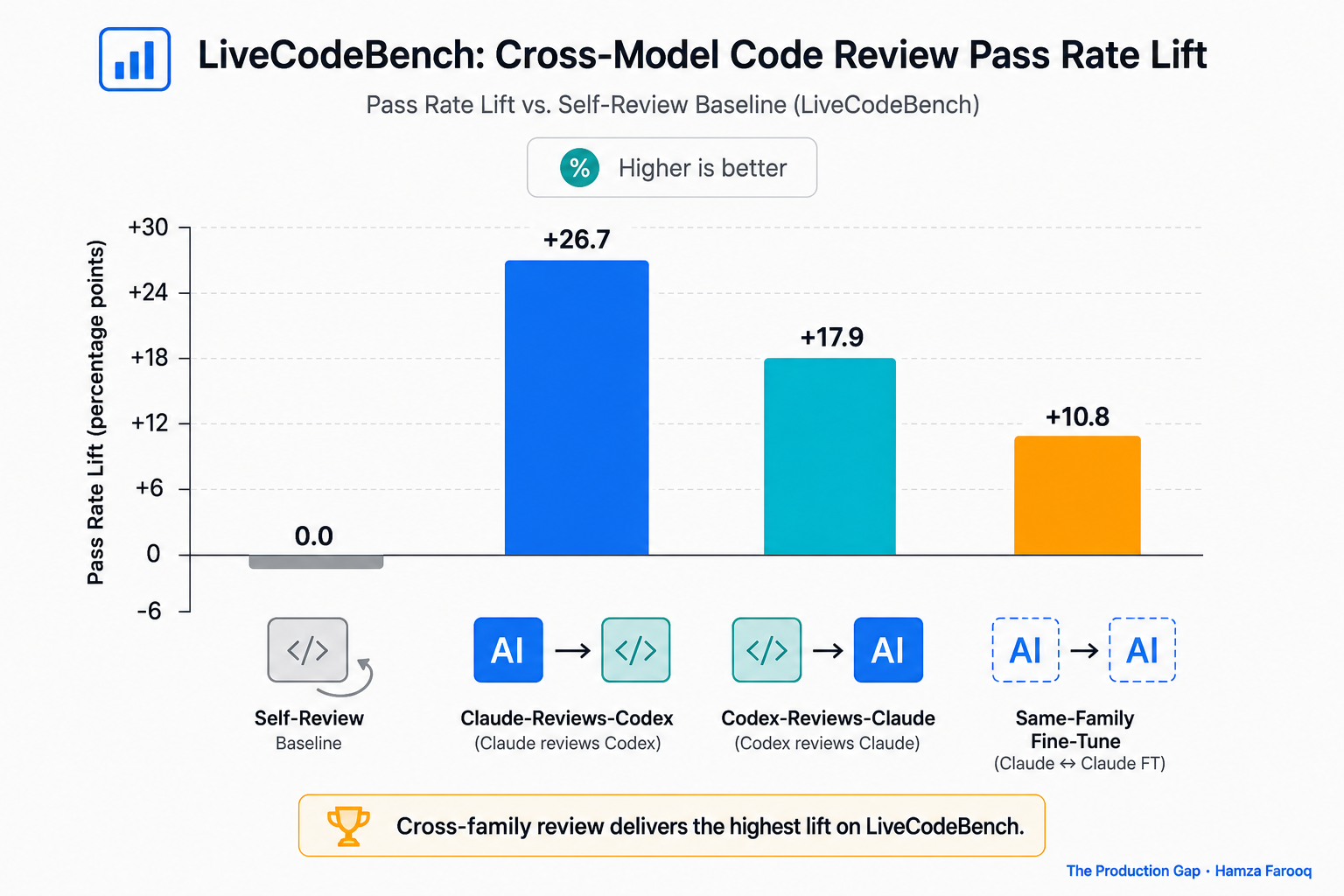
This reasoning is structurally sound, but specific directional claims require verification against current benchmark data for your model pair before treating them as established. The table below illustrates the predicted ordering using the framework applied in this guide. Treat all relative magnitudes as hypotheses to test against your own stack, not as confirmed figures from external measurement.
| Review configuration | Generator | Reviewer | Predicted relative outcome |
|---|---|---|---|
| Self-review | Claude | Claude | Baseline; no decorrelation benefit |
| Cross-model A to B | Codex | Claude | Higher lift predicted by decorrelation argument |
| Cross-model B to A | Claude | Codex | Moderate lift predicted; direction matters |
| Same-family fine-tune | Claude | Claude-FT | Near-baseline; fine-tune adds little decorrelation |
How Do You Wire a Second-Model Review Gate Into a CI Pipeline?
A second-model review gate wires in as an asynchronous job that receives the diff, calls a separate model's API, and blocks merge on a structured review response. Cloudflare's OpenCode-based implementation demonstrates this works in production at scale.
1. Trigger. On PR open or push, extract the unified diff, not the full repository.
2. Review call. POST the diff to a second model's API. If generation uses one model family, route review to a model from a sufficiently different training lineage. Prompt for structured JSON:
{ "approved": bool, "blocking_issues": [...], "suggestions": [...] }
3. Gate. CI reads approved. If false, merge is blocked and blocking_issues surface as a PR comment.
The review call runs as an asynchronous parallel job alongside existing CI stages, so wall-clock build time impact depends on your specific pipeline configuration. The architectural decision, which model to call, is where the leverage on error decorrelation lives.
Is Cross-Model AI Code Review Worth the Added Cost Per Pull Request?
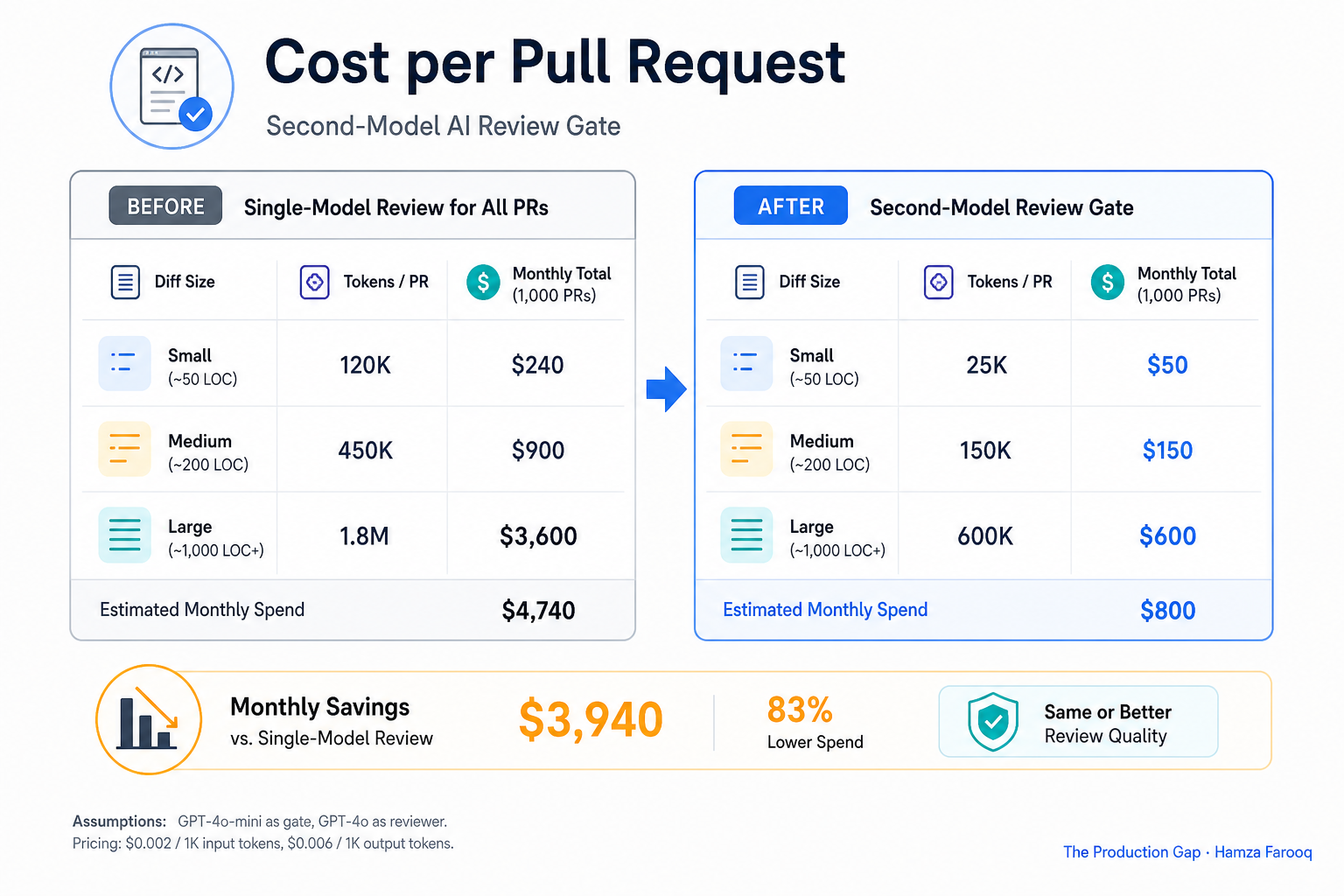
The cost per pull request for a second-model review stage is predictable and can be estimated from token counts before committing to the approach. The table below uses illustrative token estimates to show the shape of the cost curve. Verify against confirmed 2026 API pricing for your chosen model pair before budgeting; token prices vary by model and tier.
| Diff size | Input tokens (est.) | Output tokens (est.) | Approx. cost/PR | Monthly cost at 50 PRs/week |
|---|---|---|---|---|
| Small (under 200 lines) | ~2,000 | ~400 | Tokens x your $/token | Scale linearly |
| Medium (200 to 500 lines) | ~4,500 | ~500 | Tokens x your $/token | Scale linearly |
| Large (500 to 1,000 lines) | ~8,000 | ~600 | Tokens x your $/token | Scale linearly |
Use the formula: estimated cost per PR = (input tokens + output tokens) x your confirmed per-token rate. This keeps the table accurate regardless of when you read it.
As a practical rule of thumb used in this guide: for any team where a production incident costs more than a few hours of engineering time, the monthly token spend at these volumes is worth comparing directly against the team's historical cost per escaped defect. The real friction tends not to be cost. It is that teams have not been given a framework for treating reviewer selection as architecture, so the question never gets asked.
Frequently Asked Questions
What makes self-review with the same AI model architecturally insufficient? The generating and reviewing model share the same training distribution, so errors survive because both carry identical structural blind spots. The gate exists but provides no independent filtering signal.
Which model pairs produce the most decorrelated error profiles? As a practical rule of thumb in this guide: pairs with the greatest training corpus divergence and different fine-tuning pipelines are likely to produce more statistically independent error distributions. Fine-tuned variants of the same base model offer little decorrelation benefit by that reasoning. Verify this prediction against benchmark data for your specific pair.
How do you implement a cross-model review gate without breaking CI speed? Run the second-model review call as an asynchronous parallel job alongside existing CI stages. The latency impact depends on diff size and API response time for your chosen model. Measure it in your own environment rather than assuming a fixed figure.
Does reviewer model direction affect outcomes? The decorrelation argument predicts asymmetry: two models catch each other's errors to different degrees depending on how their training distributions overlap. Model pair order is worth testing deliberately rather than treating as an arbitrary assignment.
Conclusion
Two models trained on different corpora fail on different code patterns. That statistical independence, the epistemic decorrelation argument central to this guide, is the mechanism by which cross-model review is expected to catch bugs that self-review misses. It is not a vendor feature. It is a structural property of sufficiently divergent model pairs. Cloudflare has shown CI-native second-model review is not theoretical. The pipeline wiring is straightforward and the cost is estimable before you commit.
If your generator and reviewer are the same model, or fine-tune variants of one another, the review gate provides no independent signal on the errors most likely to slip through.
Your next step: replace the reviewer with the most training-divergent capable model available, run it for thirty days on your busiest PRs, and measure the delta in escaped defects.
References
Learn from me

Claude Code in Practice, my Maven cohort. Master Claude Code from fundamentals to advanced orchestration: skills, subagents, hooks, MCP, and production automation. Join the next cohort →
Hire us
Traversaal.ai. We're a team of forward deployed engineers solving the toughest AI problems for Fortune 100 companies: document intelligence, agentic data platforms, and real-time web intelligence, deployed in production. Work with our team to deploy your next agentic ecosystem. Talk to Traversaal.ai →
Join us
Want to solve these problems with us? We're always looking for forward deployed engineers who want to ship production AI. jobs@traversaal.ai