Reasoning Model Inference Cost: How to Budget Test-Time Compute Before It Breaks Your Agent Deployment
Reasoning model inference cost is silently draining budgets. Learn to cap thinking tokens, tier models, and monitor agent deployments before costs spiral.

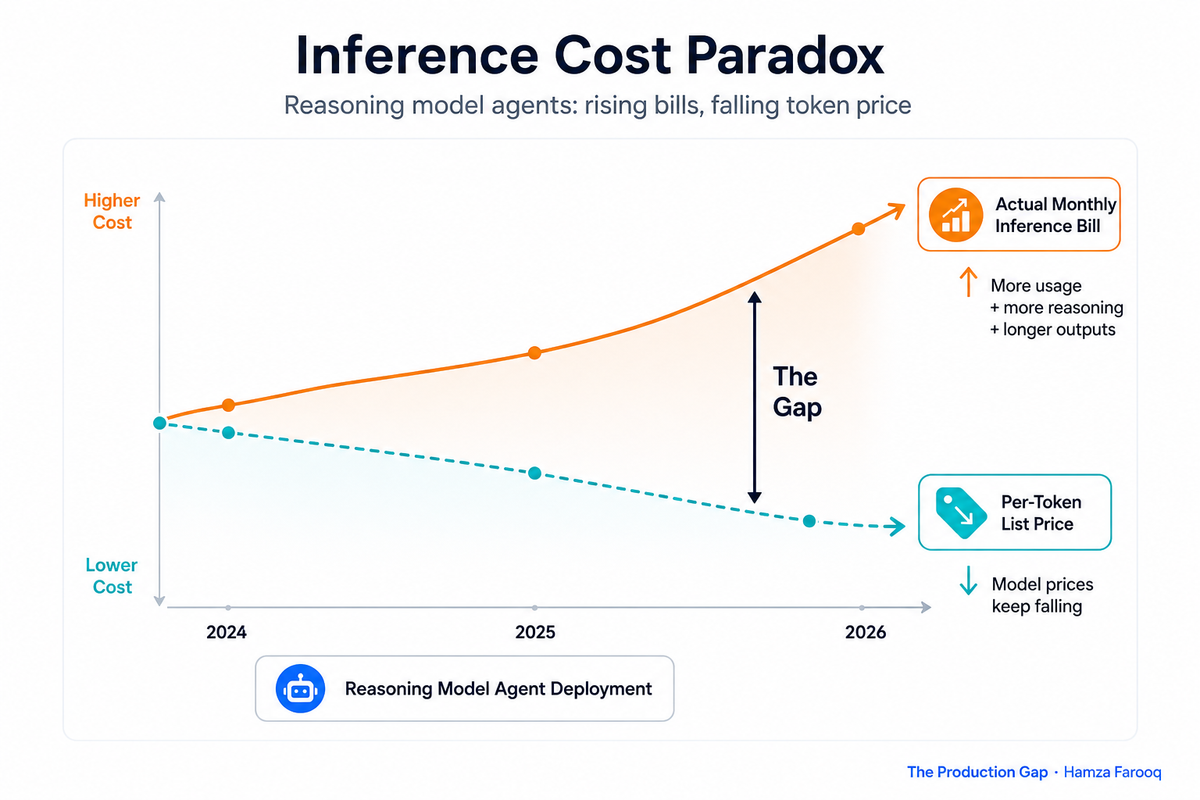
TL;DR: Reasoning model inference cost scales far beyond standard per-token pricing because models generate large volumes of internal "thinking" tokens before producing any visible output, multiplying your bill with every call. Budget test-time compute by setting explicit token limits per reasoning step, tiering model complexity to task difficulty, and monitoring hidden token consumption in real time before agent loops compound costs at scale. Prices and figures reflect conditions as of June 2026.
Key Takeaways
- Reasoning tokens are the hidden cost driver: chain-of-thought tokens dwarf output tokens, making standard per-token estimates unreliable.
- Falling list prices mask rising real bills: reasoning models generate far more tokens per call than earlier generations.
- Reasoning depth is configurable: token budgets cap deliberation length, creating a direct tradeoff between quality and spend.
- True cost-per-call must include reasoning overhead: excluding chain-of-thought tokens will blow agent deployment budgets at scale.
- Monitor for token overruns: without per-call alerting, a single model upgrade can silently inflate costs before anyone notices.
- GPU optimization is now a reasoning-specific problem: strategies for standard LLM inference do not map cleanly onto reasoning workloads.
What Is the Reasoning Model Inference Cost Problem?
Reasoning model inference cost is higher than standard LLM inference cost because reasoning models generate large volumes of internal chain-of-thought tokens before every visible response, and those tokens are billed but invisible in final output.
Reasoning models are now the default backend for many enterprise agent deployments. Many platform teams priced those deployments using per-token list rates that have been falling, and are now receiving invoices that contradict that math entirely.
The cause is test-time compute: reasoning models generate long internal chain-of-thought token sequences before any visible output, and those tokens carry costs that standard pricing calculators never captured. This dynamic is part of why inference has come to cost more than training across the aggregate AI stack. The LLM cost paradox is real: lower list prices, higher actual bills.
Why Do Reasoning Models Cost So Much More Per Call Than Standard LLMs?
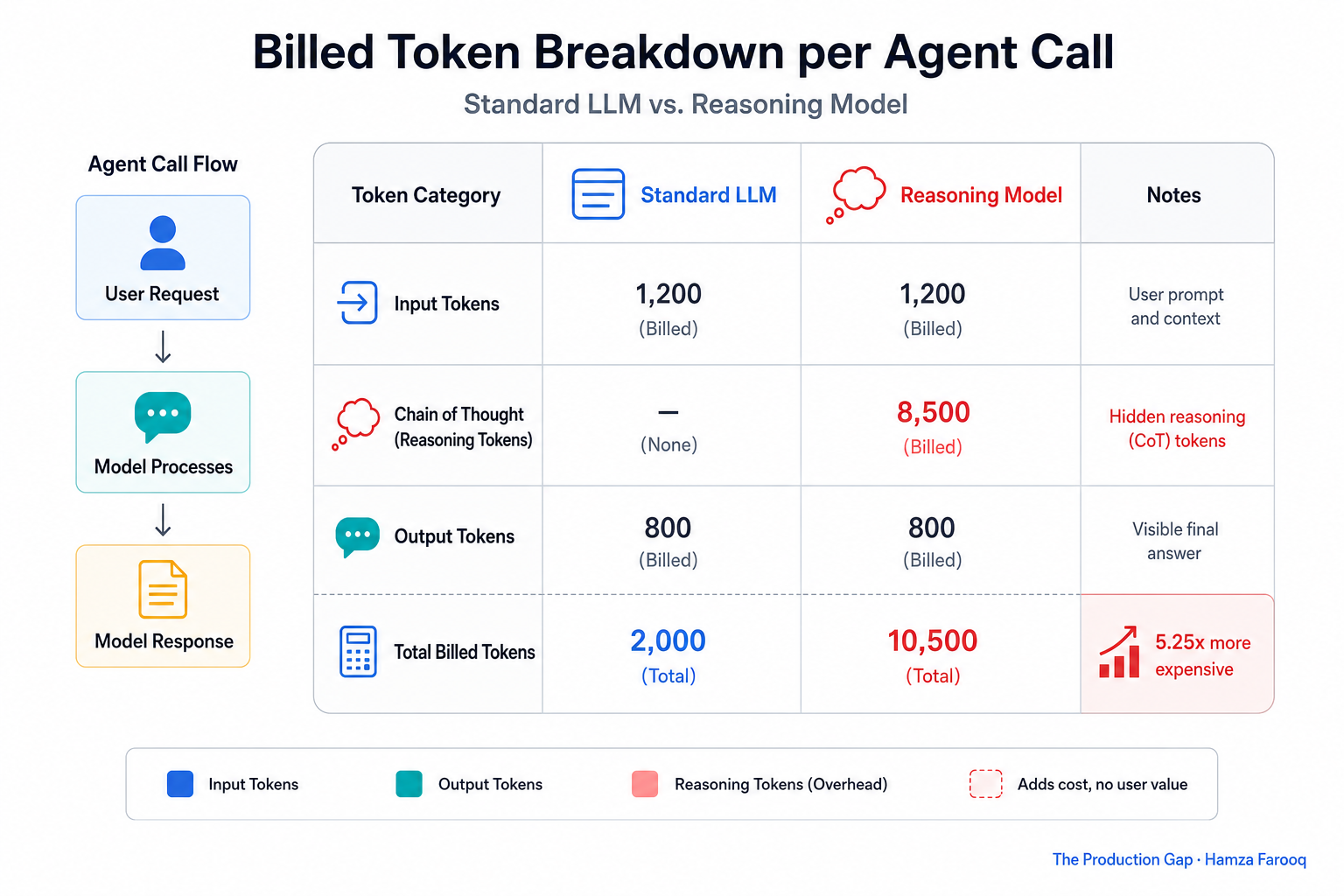
Reasoning models generate a hidden layer of chain-of-thought tokens before every response, tokens that consume compute and appear on your bill but are invisible in the final output.
This cost inversion is structural and will not be solved by finding a cheaper API endpoint.
Why Is Your Inference Bill Rising Even Though Per-Token Prices Are Falling?
Per-token list prices have fallen, but actual monthly bills can rise because reasoning models generate far more tokens per call than the standard LLMs they replaced.
When a team upgrades their backend to a reasoning-default model, the compute profile changes with zero configuration change. The model deliberates more by default, a behavior that is part of its design.
Table 1: Token Cost Profile Comparison, Standard LLM vs. Reasoning Model
| Cost Factor | Standard LLM | Reasoning Model |
|---|---|---|
| Output tokens per call | Present | Present |
| Reasoning/CoT tokens per call | None | Potentially large, variable volume |
| Billed token total per call | Output tokens only | Output plus reasoning tokens |
| Cost impact of model upgrade | Baseline | Significantly higher effective cost |
| Visibility to platform team | Full | Partial (CoT often not surfaced in standard logs) |
The True Cost-Per-Call Formula
The single most common budgeting error in reasoning model deployments is omitting reasoning tokens from the per-call cost calculation entirely.
The following formula, used as the primary cost accounting framework in this guide, corrects that omission:
True Cost Per Call = (Reasoning Tokens x Reasoning Token Rate) + (Output Tokens x Output Token Rate) + (Input Tokens x Input Token Rate)
Any model omitting reasoning tokens will underestimate actual spend. Running this formula against last month's actual call volume and comparing the result to your current cost model is a practical first diagnostic step for identifying where the gap lives. The first term, reasoning tokens multiplied by their rate, is the component most frequently absent from existing cost models.
How Should Platform Teams Budget and Control Reasoning Token Spend?
Lever 1: Token-budget-aware reasoning
Set an explicit maximum reasoning token budget per call at the API or infrastructure layer. Token-budget-aware LLM reasoning constrains the model to complete its chain-of-thought within a token ceiling, so quality degrades gracefully rather than cost scales without warning. This is, in practice, a direct dial between answer quality and compute cost.
Lever 2: Task-tier routing
Not every call needs deep reasoning. Routing simpler tasks such as classification, slot-fill, or retrieval-augmented lookups to a non-reasoning or shallow-reasoning model, while reserving full-depth reasoning for multi-step planning, is a unit economics decision with a direct dollar impact.
What Monitoring and Infrastructure Strategies Prevent Reasoning Token Overruns at Scale?
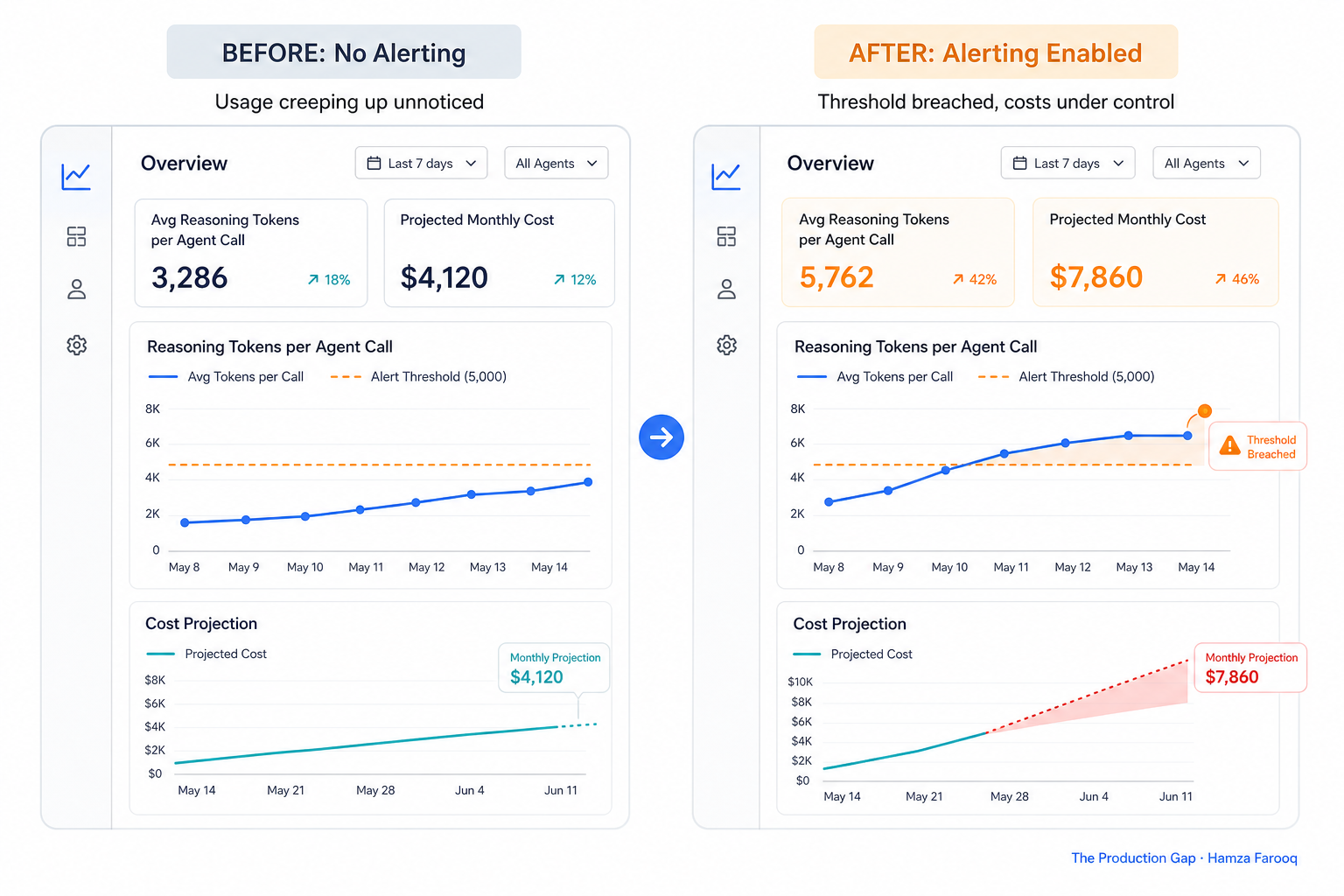
Without per-call alerting on reasoning token consumption, a single model upgrade or prompt change can inflate costs significantly before anyone notices.
Instrument reasoning tokens as a dedicated metric
Most logging pipelines track input and output tokens. Reasoning tokens are frequently absent from default dashboards. Adding a dedicated reasoning_tokens_per_call metric and alerting when the rolling average crosses a defined budget threshold gives teams an early warning before an invoice surprise.
Enforce hard ceilings at the serving layer
Defining reasoning token budgets per task category and enforcing them at the serving layer, rather than the prompt layer, is the more reliable approach. Prompt-level instructions can be overridden by model behavior. Infrastructure-level caps are harder to bypass.
Apply GPU optimization strategies designed for reasoning workloads
Standard inference optimization does not transfer cleanly to reasoning workloads. Adaptations such as speculative decoding and KV cache tuning for long chain-of-thought sequences are designed for this problem and can yield substantial cost reductions, up to 8x on qualifying workloads.
FAQ
Q1: How do reasoning tokens differ from output tokens in cost accounting for agent deployments? Reasoning tokens are internal chain-of-thought tokens generated before the visible response, billed but invisible to the user. Excluding them causes systematic cost underestimation on complex agent tasks.
Q2: What is test-time compute scaling and how does it affect inference bills? Test-time compute scaling means the model spends more compute at inference time generating internal reasoning tokens before producing an answer. Every reasoning model call generates a variable token count that directly inflates the invoice, independent of any list price change.
Q3: Why are inference bills rising even as per-token prices decline? Reasoning models generate substantially more tokens per call than the standard LLMs they replaced, primarily internal chain-of-thought tokens that did not exist in earlier models. This is the LLM cost paradox: total monthly spend can rise even as unit price falls.
Q4: How should platform teams set reasoning token budgets per agent call? The recommended approach is to define explicit token maximums by task category, enforce them at the serving layer rather than the prompt layer, and track reasoning tokens as a dedicated metric separate from output token logging. Token-budget-aware reasoning is the active technique for implementing this control at the infrastructure level.
Conclusion
The cost problem is not that tokens got expensive. It is that tokens-per-call scaled upward with every model upgrade, invisible to cost models built for a world without reasoning tokens. Treating reasoning depth as a product parameter with an explicit budget is the fix.
Three next steps:
- Audit your agent calls now. Pull reasoning token counts per call type. If that metric does not exist in your observability stack, adding it is the first action.
- Rebuild your cost model using the True Cost-Per-Call Formula above, run against last month's actual volume.
- Review the GPU optimization strategies at spheron.network. Meaningful cost reduction is available if your workload qualifies.
The cost increase was a product behavior that most pricing models were never built to account for. Surfacing it is the first step to controlling it.
Learn from me

Forward Deployed Engineering Bootcamp for Full-Stack Developers, my Maven cohort. Build and ship complete AI products end to end, from React and Node.js frontends to deployed models with caching and observability. Join the next cohort →
Hire us
Traversaal.ai. We're a team of forward deployed engineers solving the toughest AI problems for Fortune 100 companies: document intelligence, agentic data platforms, and real-time web intelligence, deployed in production. Work with our team to deploy your next agentic ecosystem. Talk to Traversaal.ai →
Join us
Want to solve these problems with us? We're always looking for forward deployed engineers who want to ship production AI. jobs@traversaal.ai