AI Feature Adoption Is Broken: Why 54% of Workers Bypass the Tools You Shipped (and What to Do About It)
AI feature adoption is failing—54% of workers bypass your tools by choice. Learn why, fix your value prop, and turn avoidance into real, lasting engagement.

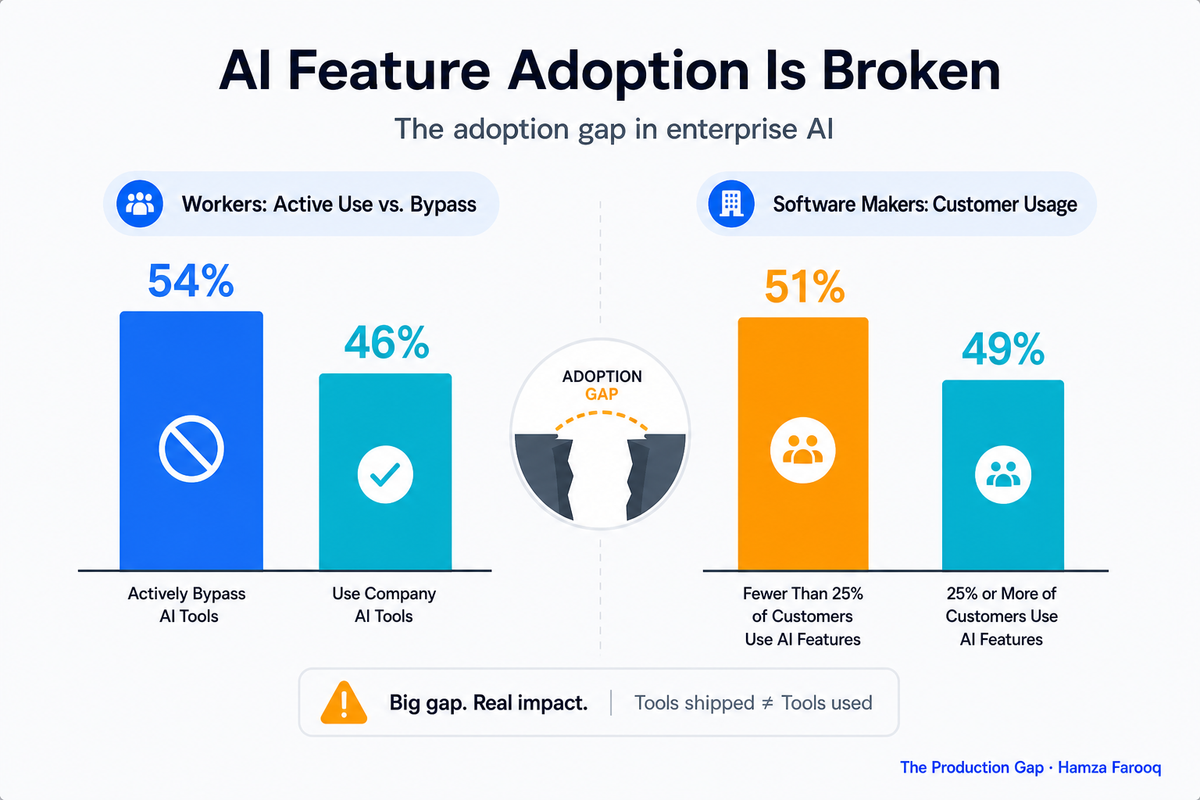
TL;DR: Most product teams diagnose a sluggish AI launch as an onboarding problem and ship another walkthrough. The real failure is a broken value proposition. Workers who bypass enterprise AI tools have usually made a deliberate, rational decision that the tool does not serve their personal interests. Fixing adoption requires identifying whether the failure is at discovery, first use, or sustained return, and then choosing the right intervention for each gate.
Key Takeaways
- Shipped does not mean used: A successful release and successful adoption are two different problems.
- Workers bypass by choice: The problem is most often a broken value proposition, not a broken onboarding flow.
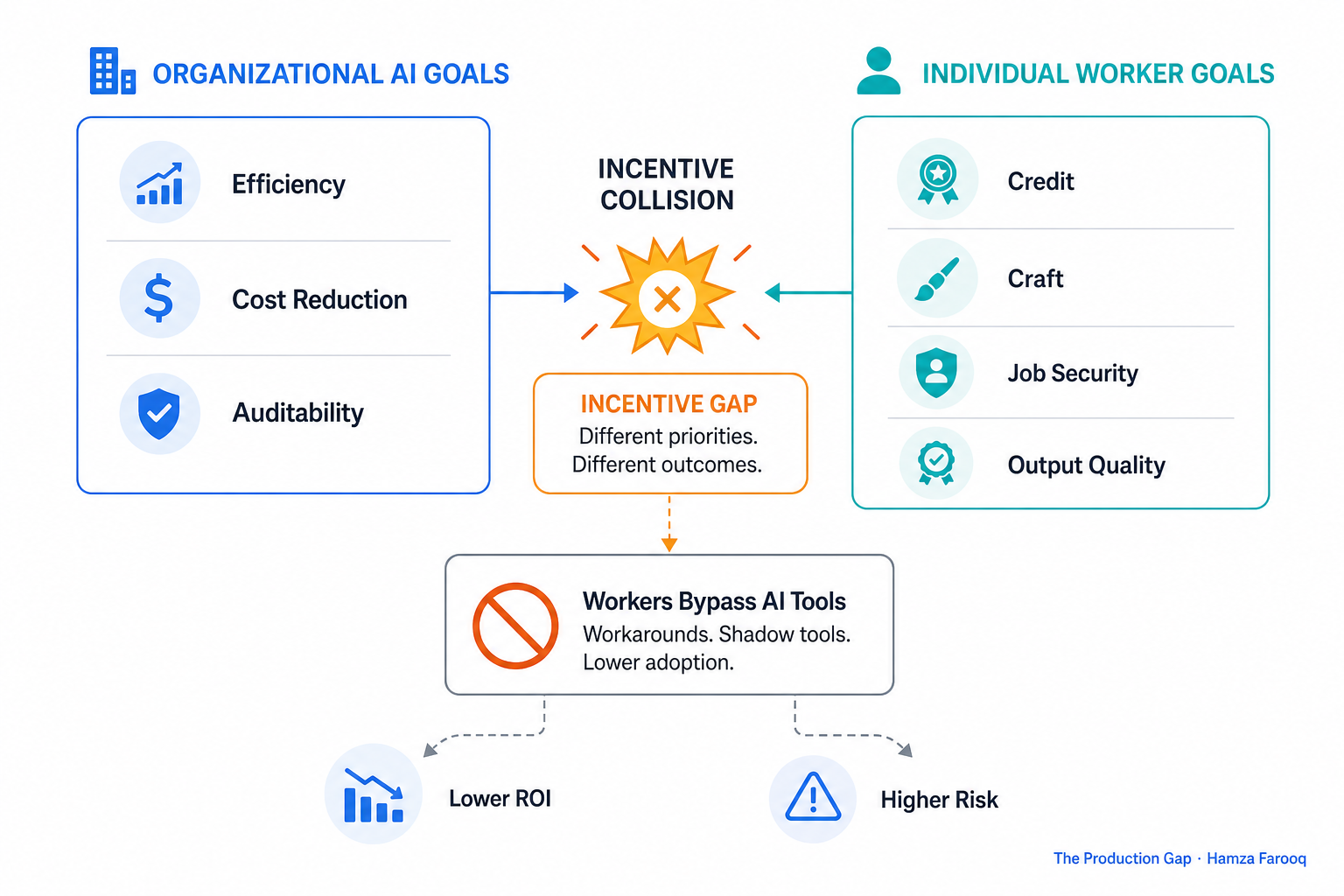
- Incentives collide: AI features are frequently designed to benefit the company first, giving workers little personal reason to change how they work.
- Traditional metrics hide the gap: DAU and session counts show who opened a feature, not whether it helped anyone. Roughly 30% of teams cannot tell the difference.
- Discovery failure and deliberate avoidance need opposite fixes: Conflating them wastes time and money.
- Fix, reframe, or kill: Product managers need a clear decision process, not another onboarding campaign.
Why are employees deliberately skipping AI features they have already been shown?
Most employees who bypass enterprise AI tools have made a deliberate, rational decision that using the tool does not serve their personal interests.
Are your adoption metrics showing real usage or just vanity activity?
Tracking AI feature adoption with DAU and session duration tells you who clicked, not whether the feature delivered value, and nearly 1 in 3 product teams have no metric that can tell the difference.
AI features break the standard discover-engage-habit model in two ways. First, value often arrives in a single interaction, a summary generated or a draft accepted, so return visits look flat even when the feature is working. Second, AI outputs are invisible in analytics: a user asks the AI to draft an email, edits it heavily, and sends it. The log records a session, not whether the feature was adopted or merely touched. Userflow's research confirms only 33% of teams trust their AI value metrics. Tianpan.co's 2026 analysis documents the core problem: applying DAU and session duration to AI-native interactions is a category error.
| Metric | What it measures | What it misses for AI features |
|---|---|---|
| Daily Active Users (DAU) | Who opened the feature | Whether the output was used or discarded |
| Session duration | Time spent in the UI | Value delivered per interaction |
| Feature click-through rate | Discovery and entry rate | Repeat intentional use vs. accidental activation |
| Task completion rate | Process finished | Quality of AI output vs. user's own baseline |
| Outcome-linked metric | Downstream result (e.g., deal closed, ticket resolved) | Closest to a real adoption signal |
If your team lacks a reliable AI value metric, you are diagnosing noise rather than an adoption problem.
How do you tell the difference between a discovery problem and a deliberate avoidance problem?
A feature no one can find needs a visibility fix; a feature people are actively choosing to skip needs a value proposition redesign. Conflating the two is the most expensive mistake a product team can make after a failed AI launch.
Discovery failure shows up as low exposure rates relative to eligible users. Deliberate avoidance shows up as measurable entry rates, near-zero repeat usage, and users completing the same workflows the old way immediately after touching the AI feature.
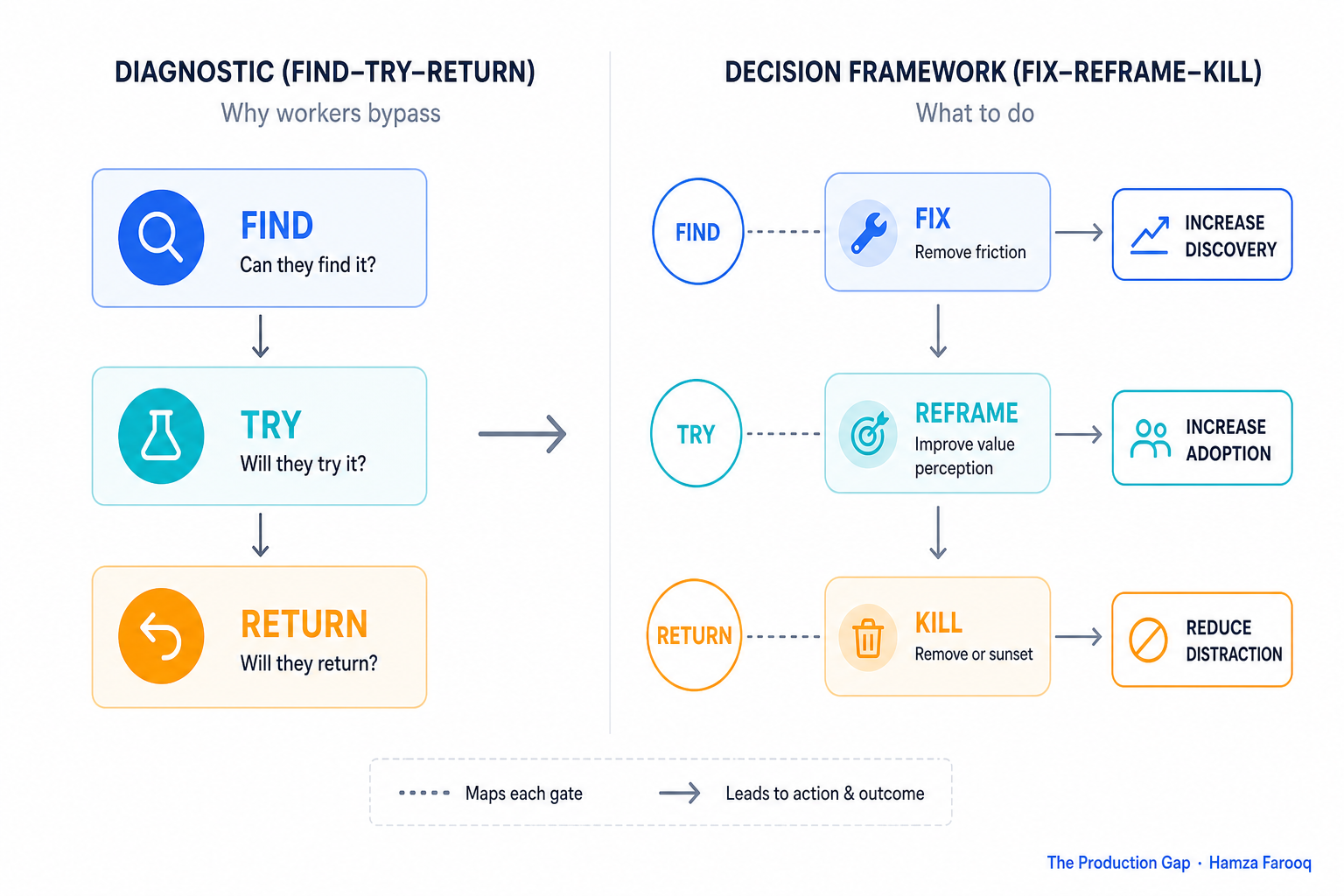
Use the Find-Try-Return diagnostic: The Find-Try-Return diagnostic is a three-gate funnel that isolates whether an AI feature fails at discovery, first use, or sustained value.
- Find: What percentage of eligible users were exposed to the feature entry point?
- Try: Of those exposed, what percentage initiated at least one AI interaction?
- Return: Of those who tried, what percentage used it again within 14 days?
How should product managers decide whether to fix, reframe, or kill an underperforming AI feature?
When an AI feature underperforms, product managers have three options: fix the implementation, reframe who the feature is for, or kill it before it consumes more roadmap capital. The Find-Try-Return gates indicate which path to take. The table below represents the framework used in this guide as an author synthesis of common product decision patterns.
| Find-Try-Return failure gate | Diagnosis | Correct intervention | Wrong default |
|---|---|---|---|
| Gate 1: Low exposure | Discovery problem | Improve placement and contextual surfacing | Rewrite the onboarding tooltip |
| Gate 2: Low first try | Friction or trust at entry | Reduce activation friction; address privacy concerns | Push more email campaigns |
| Gate 3: Low return | Broken value proposition | Redesign the worker-facing benefit or reframe the target segment | Add a walkthrough |
| All gates low with no measurement | Measurement blindspot | Build outcome-linked metrics before any intervention | Assume the feature needs more time |
| All gates low with confirmed avoidance | Fundamental mismatch | Consider killing; redeploy roadmap capital | Ship a v2 of the same concept |
Userpilot's 2026 guide notes that adoption strategies now need separate tracks for human users and AI agents, making reframing the target audience a legitimate and underused lever. Assuming a feature needs more time is not a strategy.
Frequently Asked Questions
Why do employees avoid AI tools their company has mandated or provided? Employees bypass mandated AI tools because those tools were designed to benefit the organization rather than the individual worker. When a tool does not protect credit, craft, or output quality as the worker defines it, bypassing is the rational choice.
How should product managers measure whether an AI feature is actually delivering value? Replace session-based metrics with outcome-linked ones: track whether downstream tasks improve for users who engage the AI feature versus those who do not. Roughly 30% of teams currently have no reliable way to make this comparison.
What is the difference between low AI feature discovery and deliberate avoidance? Discovery failure appears at Gate 1, meaning users were never exposed to the feature. Deliberate avoidance appears at Gate 3, meaning users tried it and chose not to return. These two failure modes require opposite fixes, and conflating them is how teams spend budget on tooltips when the underlying product has a value problem.
When should a product team stop investing in an underperforming AI feature? When Gate 3 return rates are near zero and qualitative research confirms active avoidance rather than confusion, the team has a value proposition problem, not a timing problem. Continuing to invest without redesigning the worker-facing benefit locks the team in a sunk-cost cycle.
Conclusion
Walkthroughs and nudges can surface a feature no one has found. They cannot rehabilitate a feature people have evaluated and rejected. Per Gainsight's product adoption research, unused features directly predict churn, which makes this a revenue problem, not a UX concern.
The durable path is building features where the individual worker wins: designing for credit, craft, and output quality as the worker defines it, not for the efficiency metrics an executive dashboard celebrates.
Before planning your next AI feature, run the Find-Try-Return diagnostic on the ones you have already shipped. Gate 3 will tell you whether you have a marketing problem or a product problem, and that answer should drive your next roadmap review.
References
Learn from me
Agentic AI for Product Managers, my Maven cohort. Learn how to design, evaluate, and ship reliable AI systems: the technical fluency PMs need to lead agentic products, no engineering background required. Join the next cohort →
Hire us
Traversaal.ai. We're a team of forward deployed engineers solving the toughest AI problems for Fortune 100 companies: document intelligence, agentic data platforms, and real-time web intelligence, deployed in production. Work with our team to deploy your next agentic ecosystem. Talk to Traversaal.ai →
Join us
Want to solve these problems with us? We're always looking for forward deployed engineers who want to ship production AI. jobs@traversaal.ai