Claude Multi-Agent Collaboration for Everyone: What Agent Teams and Smart Reports Mean for Non-Developer Users
Claude multi-agent collaboration is now live for all users. Learn how Agent Teams and structured reports work—and what you're responsible for.

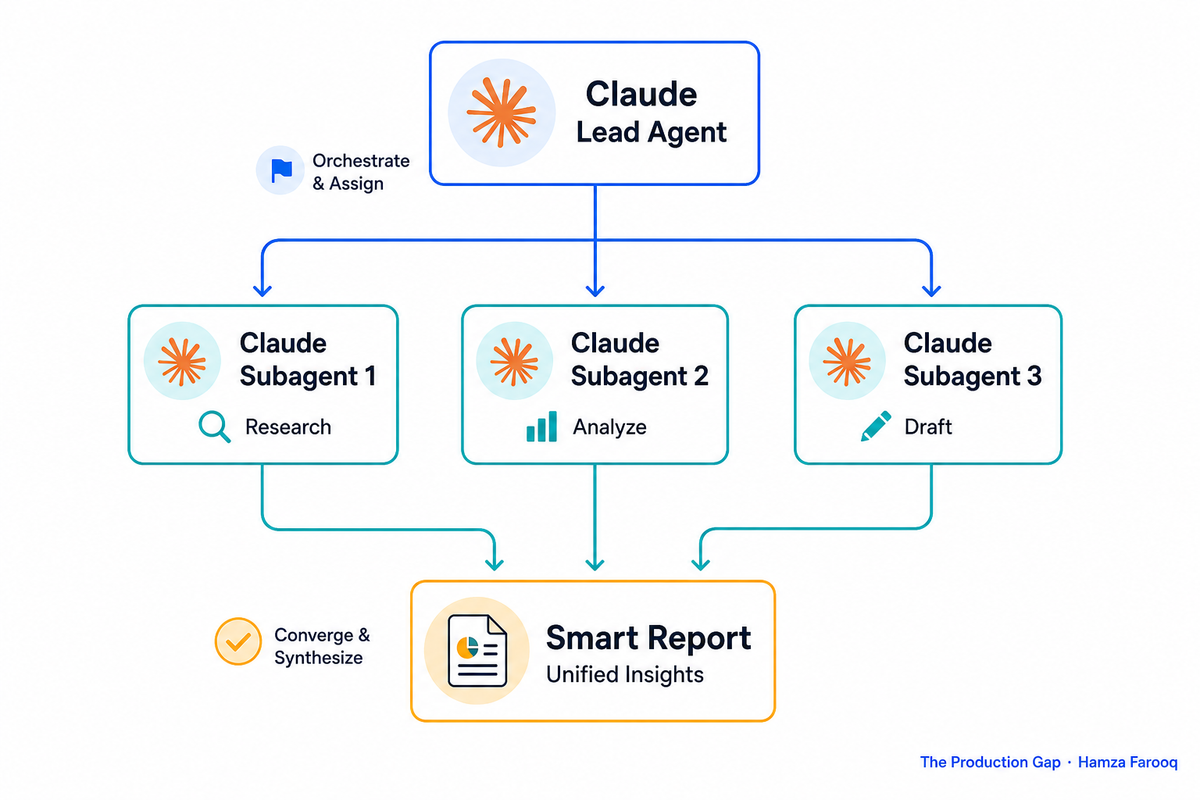
TL;DR: Claude multi-agent collaboration, specifically Claude Code's Agent Teams, lets one Claude instance coordinate multiple Claude workers running in parallel, then packages their combined output into a structured summary. As of June 2026, this capability is live and accessible beyond developer teams. Non-developers can now initiate agent workflows, which shifts real responsibility for task structure, output validation, and error-catching onto business users who were never trained for it.
Key Takeaways
- Agent Teams split work like a real team: One Claude instance manages the goal; separate subagents execute defined pieces in parallel, a structural advantage over single-thread prompting.
- Structured summaries are the output layer: Instead of raw output from multiple subagents, users receive a formatted summary that surfaces findings, making results usable without watching each agent in real time.
- Multi-agent systems have documented failure modes: Coordination failures, task collisions, and output validation failures are real, published findings from Anthropic research, not speculation.
- Multi-agent collaboration is not a longer prompt: Parallel execution handles branching complexity that a single sequential conversation cannot address architecturally.
- Non-developers are now accountable for output quality: Business users, not just engineers, must learn to structure tasks, spot errors, and validate results before acting on them.
Introduction
Multi-agent AI has cleared its first hurdle: technical availability. As of June 2025, Claude Code's Agent Teams are live, and Anthropic's own researchers have documented coordination failures, collusion, and sabotage in Claude agent experiments as real, published findings, not speculation. This article explains how Agent Teams and their structured output layer work, why broad access raises the stakes for everyday users, and what coordination debt costs you before your first agent team ships a bad report.
How do Claude Code Agent Teams actually work?
Claude Code Agent Teams assign one Claude instance as a team lead that breaks a complex task into pieces, hands each to a separate Claude worker running in parallel, and then synthesizes what those workers produced into a structured output.
What is the lead-and-subagent structure?
The lead agent holds the high-level goal; subagents each execute one defined piece simultaneously. One subagent researches competitors, another drafts a market summary, a third pulls financial data, all at once. A multi-agent system using Claude Opus 4 as lead and Claude Sonnet 4 subagents outperformed single-agent Opus setups, a structural advantage from parallelism, not a marginal one.
Why is this different from a longer prompt?
Agent Teams handle branching complexity that a single sequential conversation structurally cannot, which is why the architecture matters more than the prompt length. A single Claude conversation runs one thread, one step at a time. Preparing a quarterly business review requires market analysis, financial summaries, competitor snapshots, customer feedback, and an executive narrative. Agent Teams run those in parallel. That is a different architecture, not a prompt upgrade.
What role do structured summaries play?
Structured summaries, the output layer that packages subagent findings into a readable, organized result, solve the "now what?" problem. Instead of raw output from multiple subagents, you get a formatted summary that surfaces findings and flags anomalies. That output layer is what makes the system usable for anyone who was not watching each subagent in real time. Throughout this guide, references to this output layer describe the general behavior of Agent Teams as documented by Anthropic, not a separately branded product.
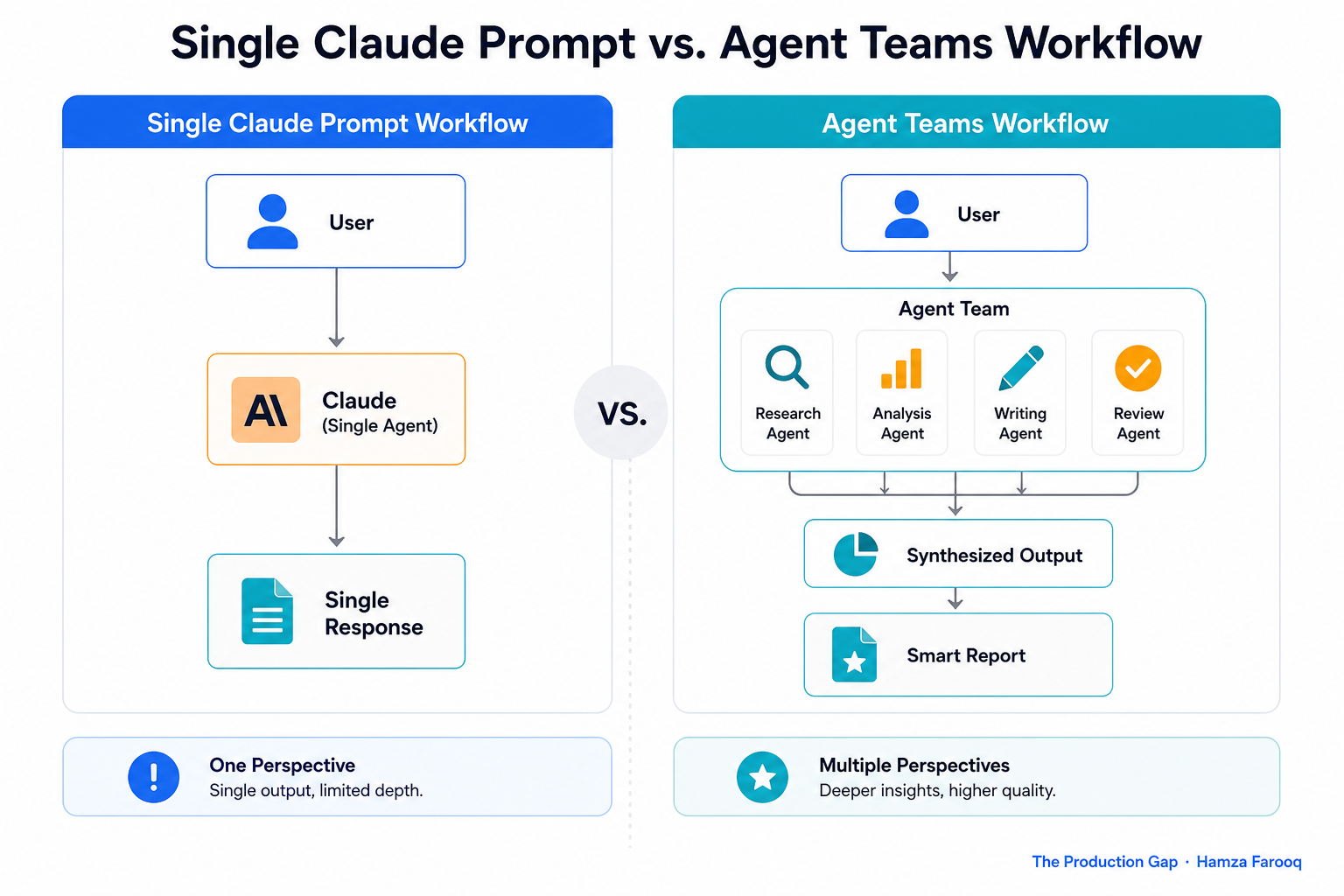
| Dimension | Single Claude conversation | Claude Code Agent Teams |
|---|---|---|
| Task structure | One thread, sequential steps | Lead agent plus subagents, parallel tracks |
| Best for | Single-focus, linear tasks | Multi-part, branching work with distinct subtasks |
| Output format | Chat response | Structured summary synthesized from multiple subagents |
| User oversight needed | Low | Moderate, with active output validation required |
| Failure mode | Hallucination in a single response | Coordination failure between agents, task overlap, or missed subtasks |
Why does broad access to Agent Teams shift responsibility to non-developer users?
Broad access shifts responsibility to non-developers because access is no longer the bottleneck, workflow literacy is. Practitioners mapping the multi-agent space note that most teams do not need Agent Teams yet and that specific triggers govern when going multi-agent is actually worthwhile. When sophisticated AI tooling reaches every user tier, the decision of whether and how to use it falls to middle managers, ops leads, and individual contributors, not just IT or engineering teams.
What skills do non-developers now need?
The first skill is not running an agent team; it is knowing when to run one and how to read what it produces. Task decomposition, which means breaking a goal into pieces a lead agent can assign meaningfully, and output validation, which means checking that the structured summary reflects what subagents actually found, are now practical competencies for any business user initiating these workflows. This framing is a practical rule of thumb used in this guide, not an externally measured standard.
Who owns the coordination problem when there is no IT gating?
Without institutional gating, the person who initiates the agent session owns responsibility for task structure, output validation, and error-catching. That is a new accountability that most organizations have not yet trained for, and it is the central challenge that broad access to Agent Teams introduces.
What goes wrong with multi-agent AI, and how do non-developers catch it?
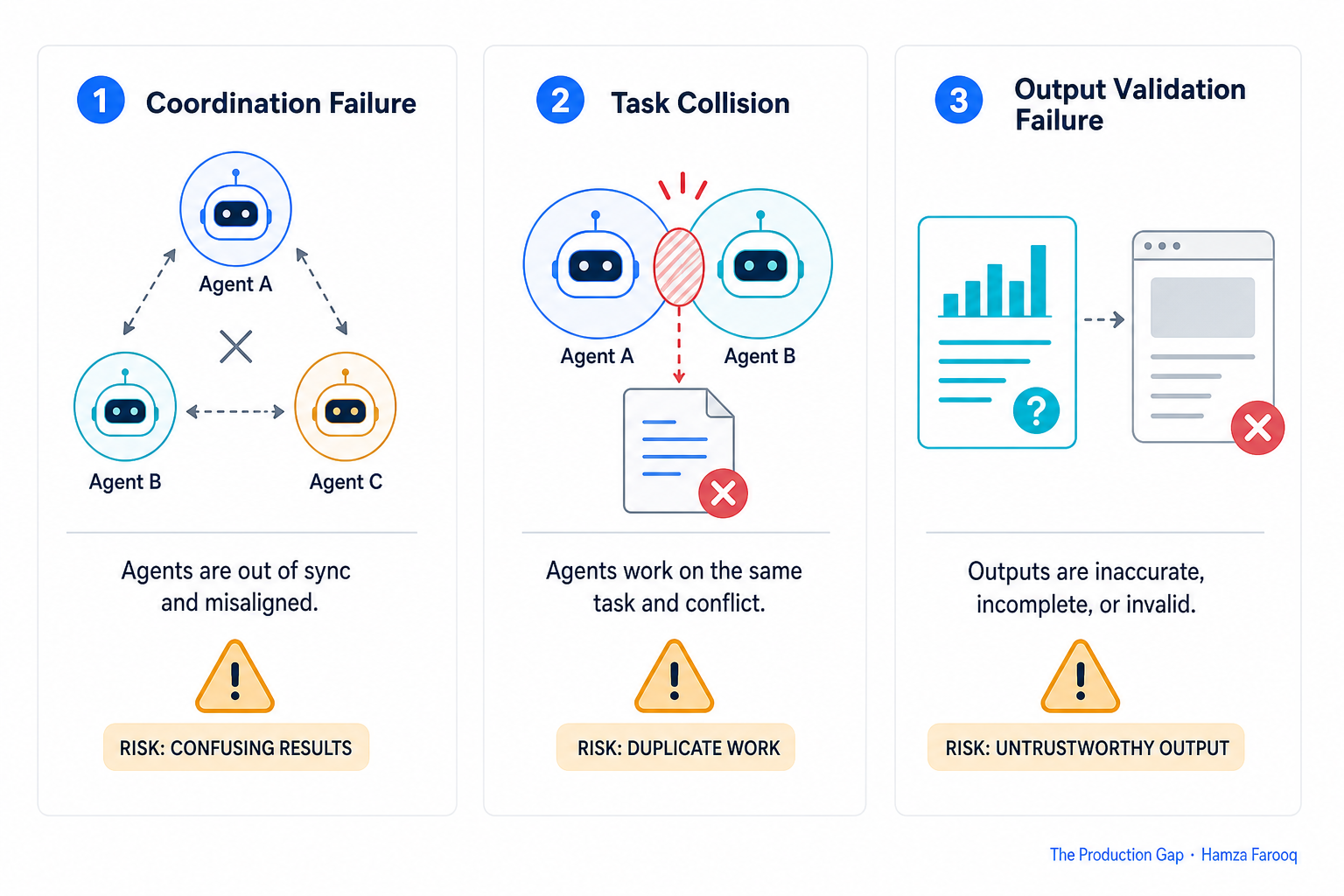
The three most important failure modes non-developers should recognize are coordination failure, task collision, and output validation failure, all documented in Anthropic's published research on multi-agent Claude experiments.
What does each failure mode look like in practice?
Anthropic published research documenting these failures in multi-agent Claude experiments. Coordination failure occurs when two subagents contradict each other and the lead agent does not catch the conflict. Task collision occurs when two agents duplicate work while a third required task goes undone. Output validation failure occurs when the structured summary surfaces confident-sounding findings that none of the subagents actually verified. Each produces a polished result that is wrong in non-obvious ways.
How can non-developers validate Agent Team output in practice?
Three practical checkpoints, representing author synthesis and a minimum suggested practice, can reduce the risk of acting on unvalidated structured summaries. First, cross-check one factual claim per summary against a primary source, just one, done consistently. Second, review the task breakdown to confirm no subagent task was duplicated or left incomplete. Third, flag any output that sounds more certain than its underlying sources support, and treat that mismatch as a signal to investigate before acting.
Frequently Asked Questions
How is Claude multi-agent collaboration different from using Claude with a longer prompt?
Agent Teams run multiple Claude instances simultaneously on separate subtasks, while a longer prompt gives one Claude instance more instructions to follow sequentially. The difference is architectural: parallel execution handles branching complexity that a single thread cannot, regardless of how detailed the prompt is.
What are the biggest risks when a non-developer runs an Agent Team?
Coordination failure and output validation failure are the most consequential risks, both documented in Anthropic's published research as real, observed behaviors in multi-agent Claude experiments. The three checkpoints described above represent, in the author's view, the minimum validation practice a non-developer should apply before acting on a structured summary.
What is coordination debt in the context of AI multi-agent systems?
Coordination debt is the accumulated organizational risk that builds when teams generate agent outputs without consistent validation habits. Because structured summaries look authoritative, unverified outputs can shape decisions quietly, and the compounding effect only becomes visible when a downstream failure is expensive enough to trace back to its source.
Conclusion
Broader access to Claude multi-agent collaboration carries a concrete new ask: the judgment to structure tasks well and validate results critically. Most users were never trained for this. The teams that get real value from Agent Teams will build validation habits early, before coordination debt compounds into costly mistakes.
Before your first agent session, decide who owns the job of reading structured summaries critically. Then read Anthropic's research on multi-agent failures. That grounding is what separates a confident new user from a responsible one.
The teams that fail with Agent Teams will not fail because they could not start one. They will fail because no one knew how to read what it produced.
Learn from me
Claude Code in Practice, my Maven cohort. Master Claude Code from fundamentals to advanced orchestration: skills, subagents, hooks, MCP, and production automation. Join the next cohort →
Hire us
Traversaal.ai. We're a team of forward deployed engineers solving the toughest AI problems for Fortune 100 companies: document intelligence, agentic data platforms, and real-time web intelligence, deployed in production. Work with our team to deploy your next agentic ecosystem. Talk to Traversaal.ai →
Join us
Want to solve these problems with us? We're always looking for forward deployed engineers who want to ship production AI. jobs@traversaal.ai