Kubernetes AI Agents Deployment: The Production Architecture Pattern for Autoscaled, Multi-Agent Systems
Kubernetes AI agents deployment done right: learn the 4-layer architecture using KEDA autoscaling, vLLM, and Redis to run multi-agent systems reliably in production.

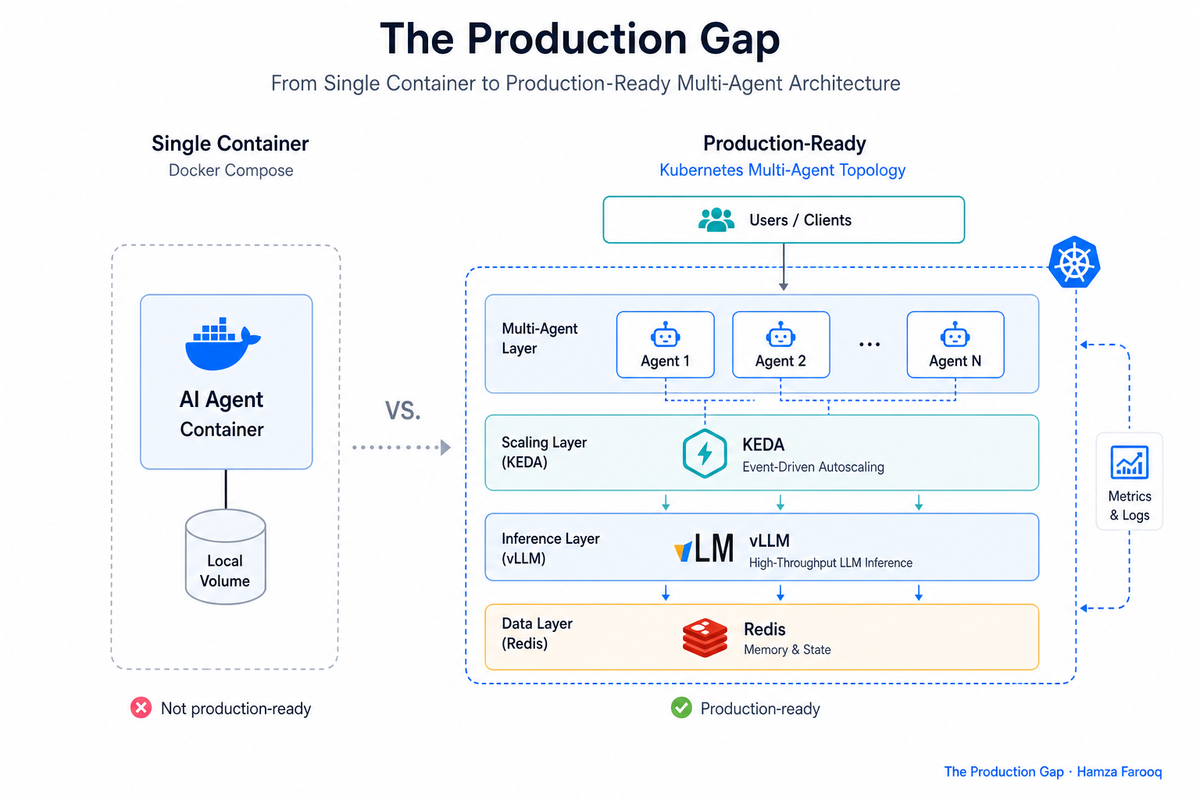
TL;DR: Kubernetes AI agents deployment at production scale requires a multi-pod architecture where each agent runs as an isolated, stateless container backed by Redis for shared state, vLLM for GPU-efficient inference serving, and KEDA for event-driven autoscaling tied to queue depth rather than CPU load.
Key Takeaways
- Prototype-to-production gap is architectural: Docker Compose to Kubernetes is not a configuration change.
- KEDA scales on work, not CPU: Queue depth adds pods when tasks pile up; CPU is a lagging signal for agent workloads.
- Redis is the connective tissue: Externalized memory lets pods spin down without losing context.
- vLLM runs as a shared service layer: One inference backend all replicas call avoids GPU memory duplication per container.
- Zero-trust RBAC is load-bearing: Many autonomous agent pods require locked-down blast radius, not process-level isolation alone.
- Graceful drain prevents mid-inference failures: Pods must finish in-flight requests before Kubernetes pulls them from rotation.
Introduction
How do you deploy AI agents on Kubernetes at production scale? The answer is a four-layer architecture: vLLM as a shared inference backend, Redis as externalized state and coordination bus, KEDA for queue-driven autoscaling, and zero-trust RBAC with graceful pod drain. Each layer is required, removing any one leaves a gap that will surface in production.
The Four-Layer Production Architecture
Every production AI agent deployment organizes into four layers, each with a single responsibility:
- vLLM (Shared Inference Backend): A standalone Deployment behind a ClusterIP Service that all agent replicas call, avoiding GPU memory duplication across every replica.
- Redis (Stateful Backbone): A StatefulSet with persistent volumes serving as agent memory store, task queue, and inter-agent coordination bus simultaneously.
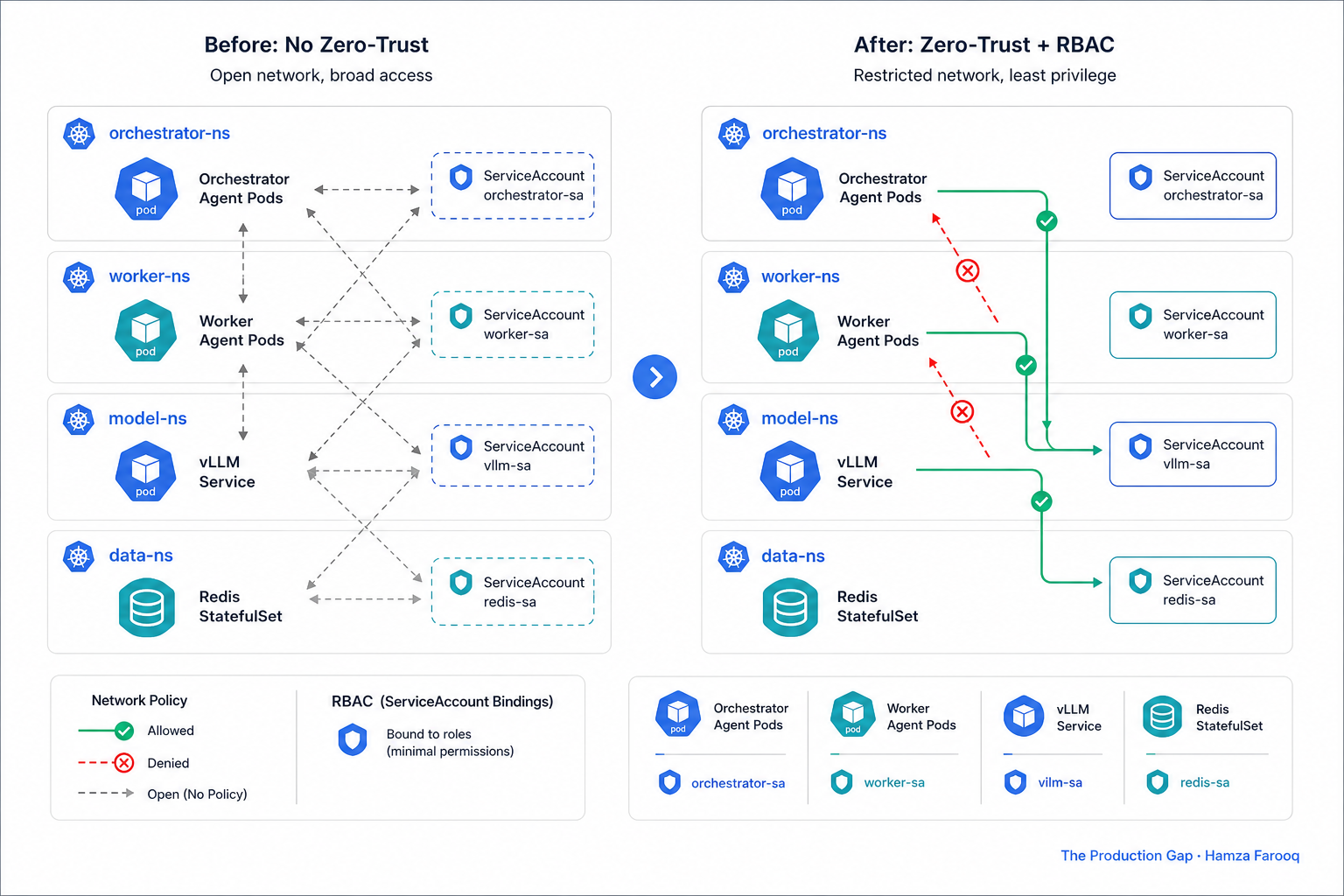
- Zero-Trust RBAC with Graceful Drain: Per-agent ServiceAccounts scoped to minimum required permissions, NetworkPolicies restricting pod-to-pod traffic, and preStop lifecycle hooks that allow in-flight requests to complete before termination.
Why does lifting a Docker Compose agent file into Kubernetes still leave you one pod away from failure?
Translating a Docker Compose AI agent into a Kubernetes Deployment gives you container portability but none of the production guarantees: no queue-aware autoscaling, no externalized state, and no graceful handling of preemption or rolling updates.
Without a configured preStop hook, Kubernetes can kill an agent pod mid-inference during preemption or a rolling update, the task is partially written to in-process memory that no longer exists. That is the default result of a naive lift-and-shift, not a corner case. SimplAI has documented why Kubernetes is a necessary substrate for agentic AI at scale; closing the gap requires four specific components wired together.
Table 1: Docker Compose Prototype vs. Production Kubernetes Pattern for AI Agents
| Dimension | Docker Compose Prototype | Production Kubernetes Pattern |
|---|---|---|
| Autoscaling trigger | Manual or CPU-based HPA | KEDA ScaledObject on Redis queue depth |
| Agent memory | In-process (lost on crash) | Externalized to Redis (persistent across pods) |
| Inference backend | Bundled model per container | Shared vLLM Deployment (Service endpoint) |
| Rolling update behavior | Hard restart, drops in-flight calls | Graceful drain via preStop hook and termination grace period |
| Multi-agent coordination | Not supported | Redis pub/sub or task queue shared across replicas |
| Security posture | Process-level isolation only | Namespace RBAC, network policies, zero-trust service mesh |
How do you configure KEDA to autoscale AI agent pods based on Redis queue depth rather than CPU?
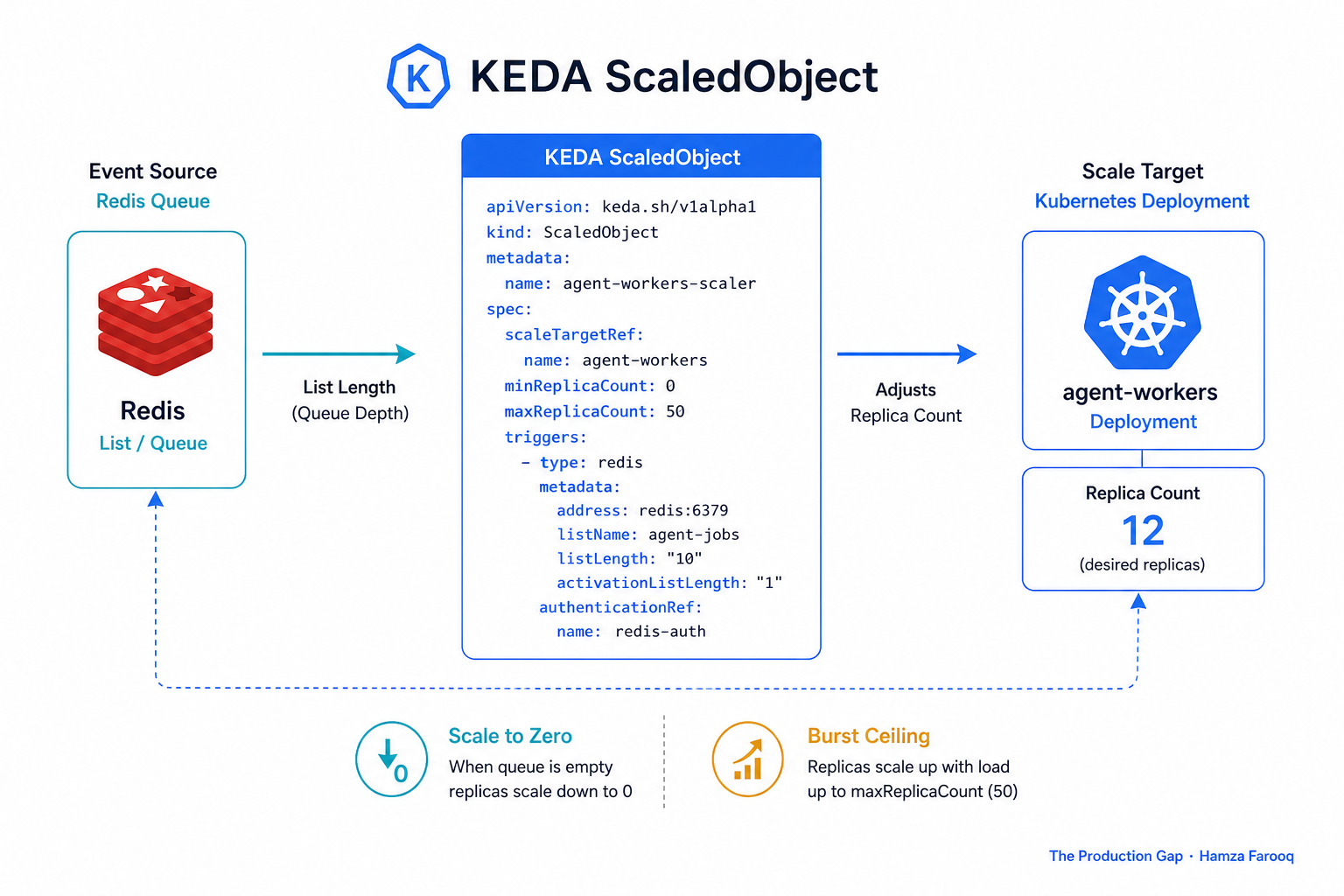
Configure a KEDA ScaledObject targeting your agent Deployment with a redis-lists trigger pointed at your task queue key. KEDA polls the list length and adds replicas when pending tasks exceed your threshold, scaling to zero when the queue empties.
Three components must be in place:
- The Redis task queue. Agents push task payloads to a Redis list, this key is the scaling source of truth.
- The KEDA ScaledObject manifest. Set
minReplicaCount: 0for scale-to-zero,maxReplicaCountto your burst ceiling, andthresholdto your load-tested per-pod concurrency. - The
listLengthtrigger. Use theredis-liststrigger type pointed at your queue key and Redis Service endpoint.
What is the correct Kubernetes architecture for running vLLM as a shared inference backend and Redis as the stateful agent backbone?
Deploy vLLM as a standalone Deployment behind a ClusterIP Service so all agent replicas share a single inference endpoint, and deploy Redis as a StatefulSet with persistent volumes to serve as externalized memory, task queue, and coordination bus.
Redis as the stateful backbone
Redis serves three roles simultaneously: agent memory store (session context keyed by agent and session, resumable by any replica), task queue (the Redis list KEDA watches), and coordination bus (pub/sub channels for inter-agent signaling). Deploy Redis as a StatefulSet with a PersistentVolumeClaim, stable pod identity and storage are required for this role.
Red Hat's Kagenti deployment learnings document multi-agent state coordination as a first-class architectural concern. Kagent is a purpose-built cloud-native project for this pattern. vLLM and Redis are not optional infrastructure, they are the two load-bearing components that make stateless agent pods possible.
How do you implement zero-trust RBAC and graceful pod drain for multi-agent Kubernetes deployments?
Assign each agent type its own ServiceAccount with a Role scoped to only the Secrets and ConfigMaps it needs, add NetworkPolicies to restrict pod-to-pod traffic to declared routes only, and configure a preStop lifecycle hook timed to your inference latency profile to drain in-flight requests before termination.
Tight per-agent RBAC limits the blast radius if any single pod is compromised, a compromised pod with narrow RBAC cannot reach model weights or other agents' session state, a benefit Red Hat's Kagenti findings identify as a primary motivation for zero-trust design in multi-agent deployments.
Graceful drain for rolling updates
Set terminationGracePeriodSeconds to reflect observed inference latency with buffer for in-flight requests to complete. Add a preStop hook that signals the agent process to stop accepting new tasks while finishing its current one. Without this, every rolling update risks interrupting pods mid-inference. Zylos Research documents zero-downtime patterns as a core production concern for 2026 AI agent deployments.
FAQ
Q1: How do you configure KEDA to autoscale AI agent pods based on Redis queue depth rather than CPU metrics? Deploy a KEDA ScaledObject with a redis-lists trigger on your task queue key, set threshold to your load-tested per-pod concurrency, minReplicaCount: 0, and cooldownPeriod long enough to account for agent warm-up. KEDA handles replica math automatically, no HPA required.
Q2: What is the correct Kubernetes architecture for running vLLM as a shared inference backend across multiple agent replicas? Deploy vLLM as a standalone Deployment on a GPU node pool behind a ClusterIP Service so all agent pods call that internal endpoint. Sharing one inference backend avoids the GPU memory duplication that bundling a model inside every agent container would create.
Q3: How do you externalize AI agent session state to Redis on Kubernetes? Key all agent memory to a consistent agent-and-session identifier and write every tool call result and intermediate step to Redis immediately, not at session end. Any replica resuming a task reads from the same key prefix without context loss.
Q4: What are the differences between deploying a single-agent container and a production multi-agent topology on Kubernetes? A single agent needs a Deployment, resource limits, and a liveness probe. A production multi-agent topology adds KEDA ScaledObjects per tier, a shared vLLM Service, a Redis StatefulSet, per-tier Namespaces with NetworkPolicies, ServiceAccount-scoped RBAC, and graceful drain hooks. Kagent exists specifically to reduce that operational surface area.
Conclusion
The production architecture is four components most teams have not wired together: vLLM as shared inference, Redis for memory and coordination, KEDA scaling to queue depth, and zero-trust RBAC with graceful drain. Red Hat's Kagenti findings and Kagent show the ecosystem catching up, but the wiring remains an engineering problem each team must solve for their workloads. Start with KEDA and Redis, validate against a real task backlog, and let that surface the remaining gaps.
Learn from me
Forward Deployed Engineering Bootcamp for Full-Stack Developers, my Maven cohort. Build and ship complete AI products end to end, from React and Node.js frontends to deployed models with caching and observability. Join the next cohort →
Hire us
Traversaal.ai. We're a team of forward deployed engineers solving the toughest AI problems for Fortune 100 companies: document intelligence, agentic data platforms, and real-time web intelligence, deployed in production. Work with our team to deploy your next agentic ecosystem. Talk to Traversaal.ai →
Join us
Want to solve these problems with us? We're always looking for forward deployed engineers who want to ship production AI. jobs@traversaal.ai