AI Content Watermarking Is Now Default: What Output Provenance Actually Means for Your Content Pipeline
AI content watermarking is now on by default. Learn how output provenance affects your content pipeline, disclosure duties, and audit trail compliance.

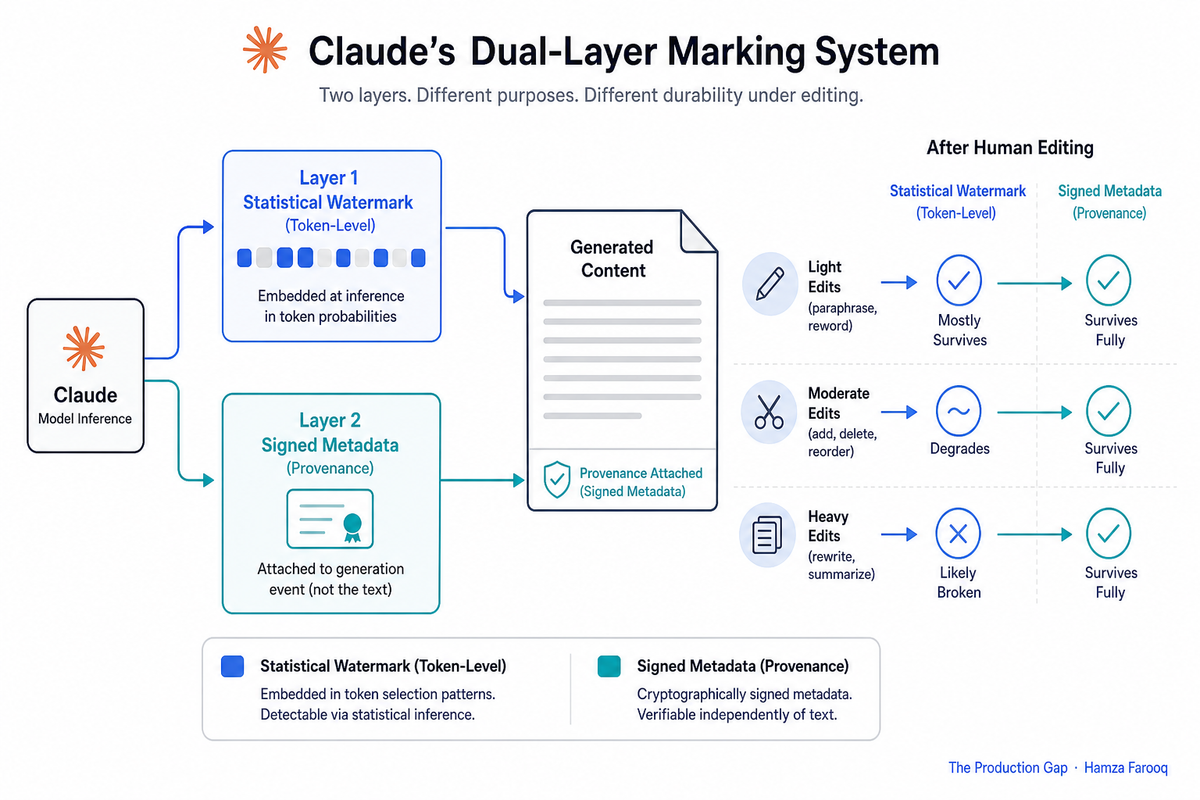
TL;DR: Claude automatically embeds a statistical watermark in every output and attaches signed metadata to every generation event, with no opt-in required. Any content pipeline using Claude is already emitting watermarked text. The practical risk is not the watermark itself but provenance liability: a detector hit proves the model was in the loop, not who wrote what, and without structured generation logs your team cannot rebut a false-positive authorship claim in a contract dispute.
Key Takeaways
- Watermarking is on by default: Claude automatically embeds a hidden statistical signal with no opt-in required, meaning your pipeline is already emitting marked content.
- A detection hit proves processing, not authorship: A positive result confirms a model touched the text, not that it wrote every word of the final version.
- Human edits create false-positive risk: Heavily rewritten AI drafts can still trigger detectors, misrepresenting the human contribution to buyers and regulators.
- The Generation Receipt framework defines the minimum six-field log that makes provenance defensible: timestamp, model version, prompt hash, raw output, edit delta, and surface identifier.
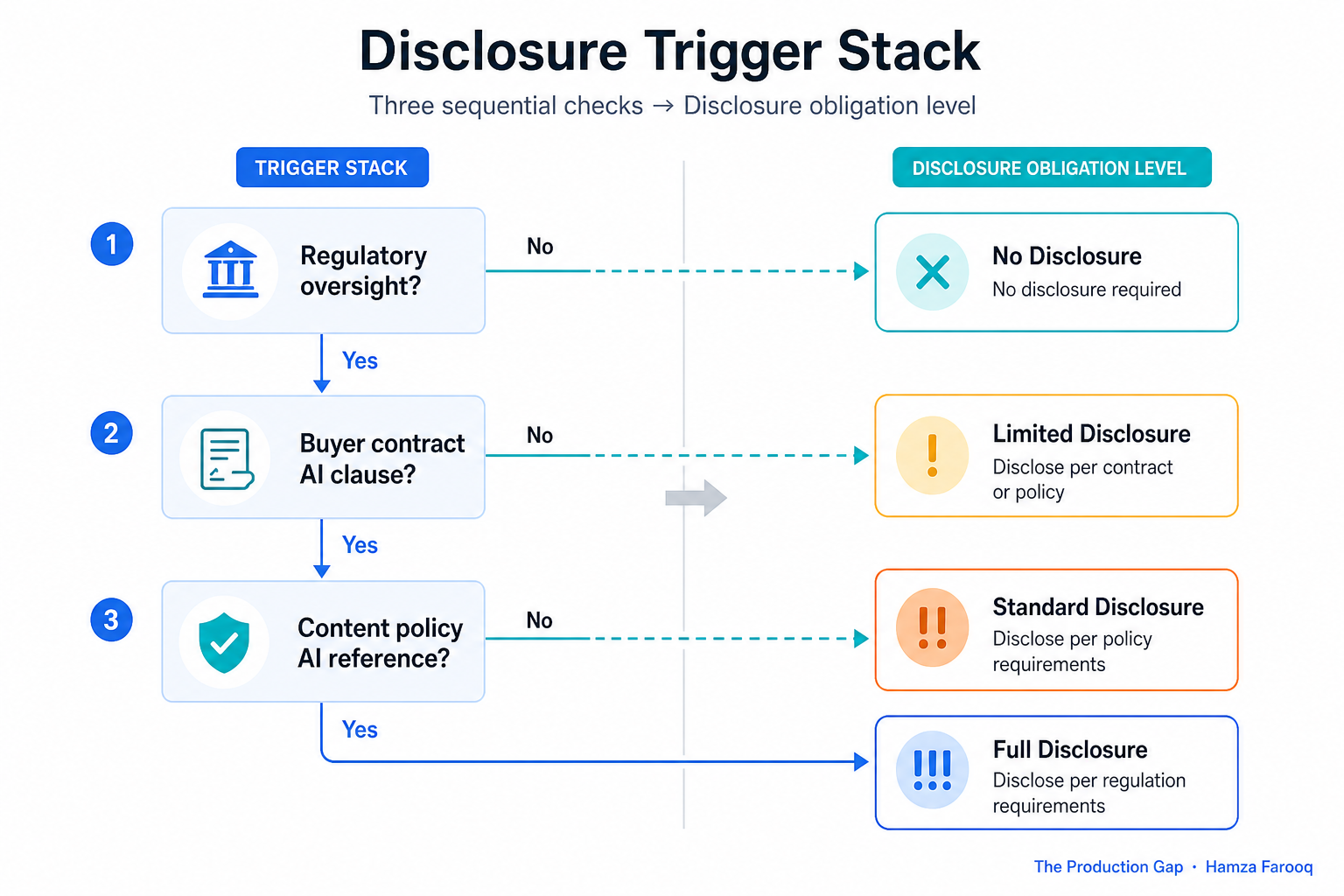
- The Disclosure Trigger Stack framework gives teams three ordered decision points to determine whether disclosure is mandatory before publishing AI-assisted content.
- Structured generation logs beat detector scores: Logging what the model produced, when, and under which prompt is the only defensible audit trail in a compliance dispute.
- Disclosure obligations are rising: Default watermarking makes AI involvement objectively detectable as of this writing, raising the practical bar on labeling requirements across regulated surfaces.
What is AI content watermarking and why does it matter now?
AI content watermarking is the practice of embedding a detectable signal into model-generated text at the moment of creation, so that the origin of that content can be verified later. As of mid-2025, Claude applies this by default to every output, meaning teams shipping AI-drafted support replies, marketing copy, or documentation are already emitting watermarked content whether they have accounted for it or not. The downstream effects concentrate in three places: disclosure obligations on regulated publishing surfaces, procurement relationships where buyers are beginning to include AI content requirements in contracts, and audit workflows that still rely on detector scores instead of generation logs.
How does Claude's default watermarking actually work, and what does a detection hit prove?
Claude uses two complementary techniques: a statistical signal embedded at the token-sampling level during inference, and signed metadata attached to the generation event. AI watermarking works by influencing token selection during decoding so the resulting pattern is invisible to readers but detectable by an algorithm with the right key. Character-level techniques such as unicode homoglyph substitution can be trivially removed by replacing all homoglyphs with standard equivalents, which is one reason statistical token-level approaches are considered more robust.
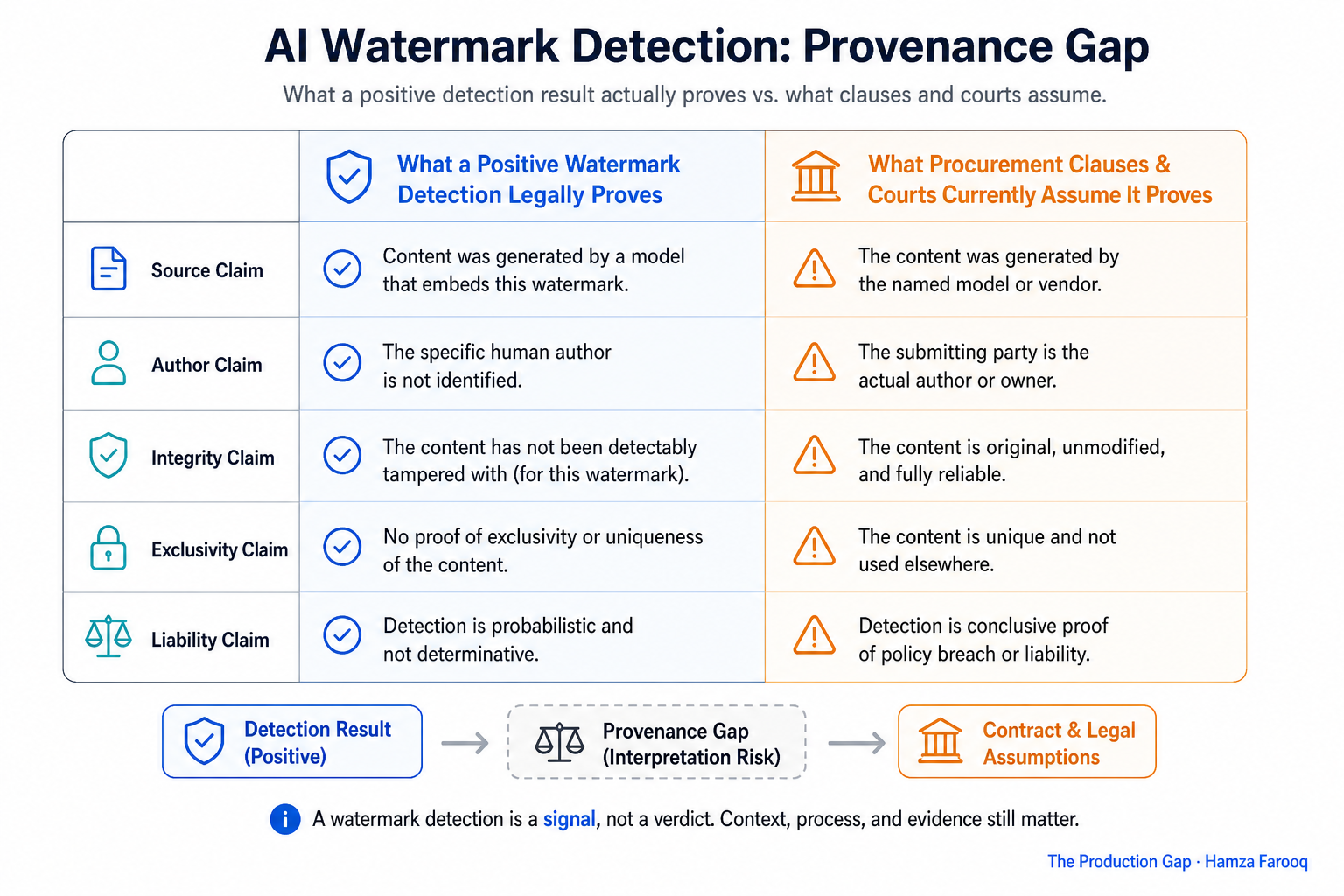
The watermark carries no identifying information and cannot be traced to a specific person, organization, or session. A detector hit confirms the model was in the loop. It does not confirm the model wrote the final version. Detection is not authorship.
Where do false positives hit human-edited AI drafts?
False positives occur when human edits change a draft's meaning but do not destroy enough of the underlying statistical signal to flip the detector.
The table below reflects editorial judgment about likely risk exposure, not empirically established detection rates, and is offered as a practical decision aid rather than a measured finding.
Table 1: AI Draft Detection Risk Matrix
| Scenario | Watermark signal survives? | What detection proves | Procurement and legal risk |
|---|---|---|---|
| Claude draft, published unedited | Yes | Model authored full text | Low, straightforward disclosure |
| Claude draft, moderate human edits | Possibly yes | Model processed text | Medium, authorship ambiguous |
| Claude draft, extensive human edits | Uncertain | Model was in workflow | High, false-positive exposure |
| Human-written text, zero AI involvement | No | No model involvement | No detection risk |
| Claude used only for outline or research | Uncertain | Model touched adjacent text | Unpredictable, log everything |
Consider a practical scenario: a technical writer uses Claude to draft documentation, rewrites most paragraphs, and submits to an enterprise buyer whose contract includes an AI content requirement. The scan returns positive, and the clause assumes full AI authorship, but the team has no generation log to contest that interpretation. Detector scores alone cannot distinguish "Claude wrote this" from "Claude drafted something a human substantially rewrote."
What are procurement clauses and disclosure rules now requiring from AI content pipelines?
The Disclosure Trigger Stack provides three ordered decision points for determining whether disclosure is mandatory:
- Does your surface face regulatory oversight? If yes, disclosure is mandatory.
- Does your buyer contract define AI disclosure or include a watermark-scan clause? If yes, disclosure is contractually required.
- Does your content policy reference AI generation? If yes, you have already implicitly committed to disclosure.
Each "yes" is an immediate disclosure obligation. Work through the stack before publishing on any new surface.
What should your content pipeline log at generation time to replace detector dependency?
The only defensible audit trail is a structured generation log captured at the moment of creation, because no after-the-fact detector scan can reconstruct what the model produced, when it was produced, or under which prompt.
A detector score tells you whether a watermark pattern is present in text submitted today. Cryptographic approaches to watermarking are designed to offer stronger verifiability, but even these require that provenance data be preserved from the moment of generation. No detection method can reconstruct what the model generated three weeks ago, which prompt version was active, or what the human contribution looked like.
The Generation Receipt is the minimum spec for every AI content generation event:
- Timestamp, exact UTC time of API call
- Model version, which Claude model and access channel
- Prompt hash, a hash of the system prompt and user turn
- Raw output, the unedited model response before any human editing
- Edit delta, a structured diff between raw output and the published version
- Surface identifier, which product feature or pipeline generated the call
Frequently asked questions
Does a positive watermark detection mean the AI wrote the content? A positive Claude watermark detection confirms the model processed the text at some point, not that it authored the final version. Treating a positive result as proof of full AI authorship is a legal and contractual overreach, because the signal survives partial human rewriting and cannot on its own distinguish model-originated text from heavily edited drafts.
How do Claude's watermarks behave across different access channels? Claude's watermarking is not specific to individual users, organizations, or sessions, so the signal does not reveal who made the API call. Teams integrating through third-party platforms should verify with their cloud provider whether signed metadata is preserved end-to-end in their specific integration, as intermediary systems may strip or alter metadata before it reaches your storage layer.
What should teams log at generation time to satisfy procurement and audit requirements? Teams should log, at minimum, a timestamp, model version, access channel, prompt hash, raw output before editing, and a diff of the published version against the raw output. This six-field record, the Generation Receipt framework used in this guide, is the only artifact that reconstructs the model's contribution versus the human contribution, and it is the record a buyer or regulator would need to evaluate an authorship dispute.
How do false positives affect contracts that include AI content requirements? A human-edited draft that returns a positive detection can trigger a contract clause written to assume full AI authorship, creating a false compliance violation. Only a generation log showing the edit delta can rebut that assumption. A detector score alone cannot demonstrate how much of the final text originated with a human editor, which is precisely the question a procurement clause is asking.
Conclusion
The operational risk here is not detection fragility. It is provenance liability inversion.
A watermark hit proves the model was in the loop. It does not prove who wrote what or in what proportion. Edited drafts will return positive detections, buyers may assume full AI authorship, and without generation logs there is no record to contest that assumption.
Detector scores are evidence of processing. Generation logs are evidence of what actually happened. Only one holds up in a contract dispute.
Audit your AI content pipeline now. Does every generation event write a timestamped log with raw output and an edit delta? If not, implementing the Generation Receipt framework is the first fix to make.
Learn from me

Agentic AI for Product Managers, my Maven cohort. Learn how to design, evaluate, and ship reliable AI systems: the technical fluency PMs need to lead agentic products, no engineering background required. Join the next cohort →
Hire us
Traversaal.ai. We're a team of forward deployed engineers solving the toughest AI problems for Fortune 100 companies: document intelligence, agentic data platforms, and real-time web intelligence, deployed in production. Work with our team to deploy your next agentic ecosystem. Talk to Traversaal.ai →
Join us
Want to solve these problems with us? We're always looking for forward deployed engineers who want to ship production AI. jobs@traversaal.ai