AWS Bedrock AgentCore at GA: What the Adoption Numbers Reveal About Framework-Agnostic Agent Hosting in Production
AWS Bedrock AgentCore is GA—but do the adoption numbers hold up? Learn what VPC isolation and credential rotation actually deliver before you commit.

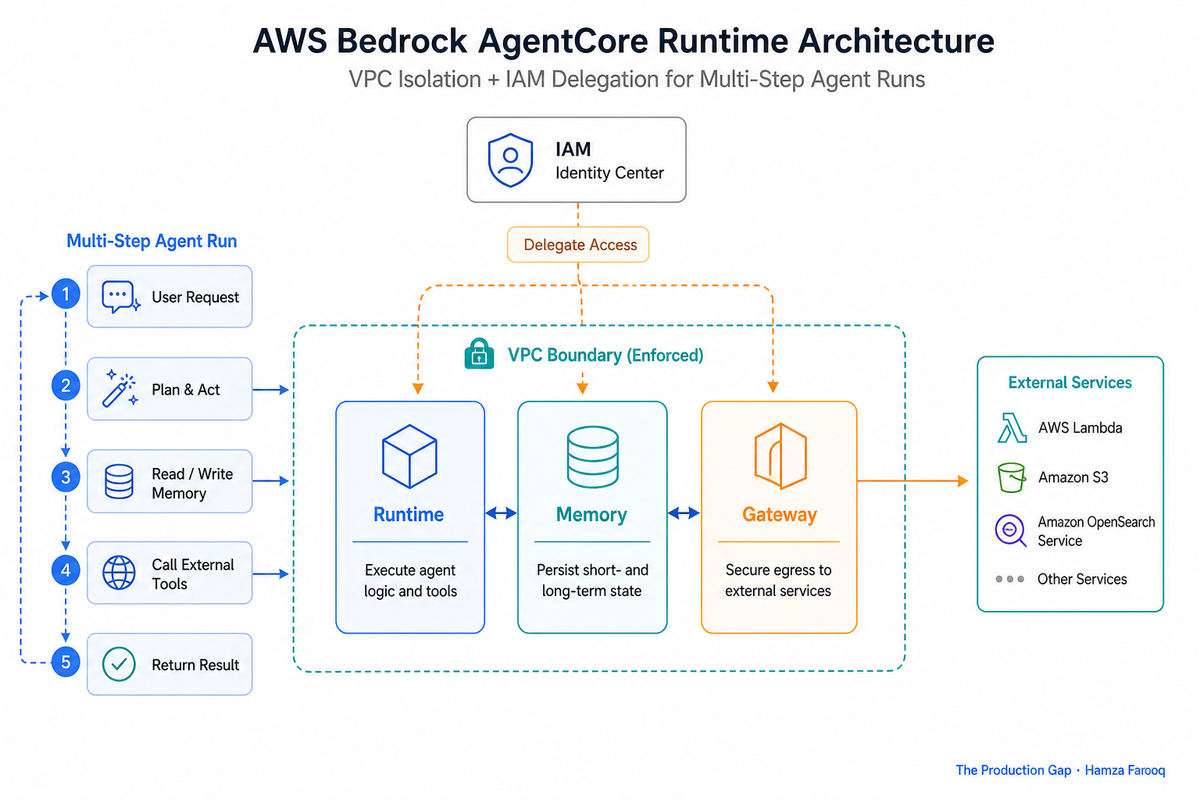
TL;DR: As of June 2025, AWS Bedrock AgentCore reached general availability as a framework-agnostic agent hosting platform that handles VPC isolation, short-lived credential rotation, and distributed tracing so engineering teams do not build that infrastructure themselves. Adoption figures cited at launch are largely unverified marketing claims, but the infrastructure primitives are concrete and auditable against AWS documentation before committing to the platform.Key takeawaysFramework-agnostic means real work remains: AgentCore supports any framework, model, or protocol, but you must containerize your code and meet AWS's invocation contract first.Credential sprawl is the hidden ops tax: AgentCore handles IAM delegation natively, eliminating hardcoded keys and manual rotation across agent runs.VPC isolation closes a real security gap: Network boundaries are enforced at the platform layer, not left to per-team configuration, which satisfies containment mandates in financial services and healthcare.Observability comes included: AgentCore provides native tracing across multi-step agent runs without requiring custom instrumentation from the developer.Build-vs-buy math favors managed hosting at scale: AgentCore eliminates IAM plumbing, logging setup, and container orchestration your team would otherwise own indefinitely.GA adoption figures deserve scrutiny: Download counts and named enterprise adopters circulating at launch are not independently verified by any audited primary source.
Introduction
AWS Bedrock AgentCore, generally available as of June 2025, is a managed hosting platform that gives engineering teams VPC isolation, native credential rotation, and distributed tracing for AI agents built on any framework, model, or protocol, without requiring teams to build or maintain that security and observability infrastructure themselves.
Before you migrate, you need to know what AgentCore actually solves and which GA adoption claims hold up under scrutiny. This article addresses both questions directly, using only verified sources, and flags where vendor claims outrun available evidence.
What does "framework-agnostic" actually require before AgentCore Runtime works?
AgentCore Runtime is a secure, serverless hosting environment, but "any framework" support requires you to containerize your agent code and conform to AWS's invocation contract before the managed layer takes over.
AgentCore is built around three components: Runtime for hosting, Memory for state persistence, and Gateway for tool and MCP server hosting. In this author's reading of the available documentation, the containerization requirement applies regardless of which agent framework you bring. Your framework logic stays intact; what changes is how you package and expose it.
How does AgentCore solve credential sprawl and VPC isolation compared to self-managed ECS or EKS?
AgentCore handles IAM authentication natively so agents can call multiple AWS services mid-run without accumulating credential debt, while enforcing VPC boundaries at the platform layer rather than leaving network configuration to individual teams.
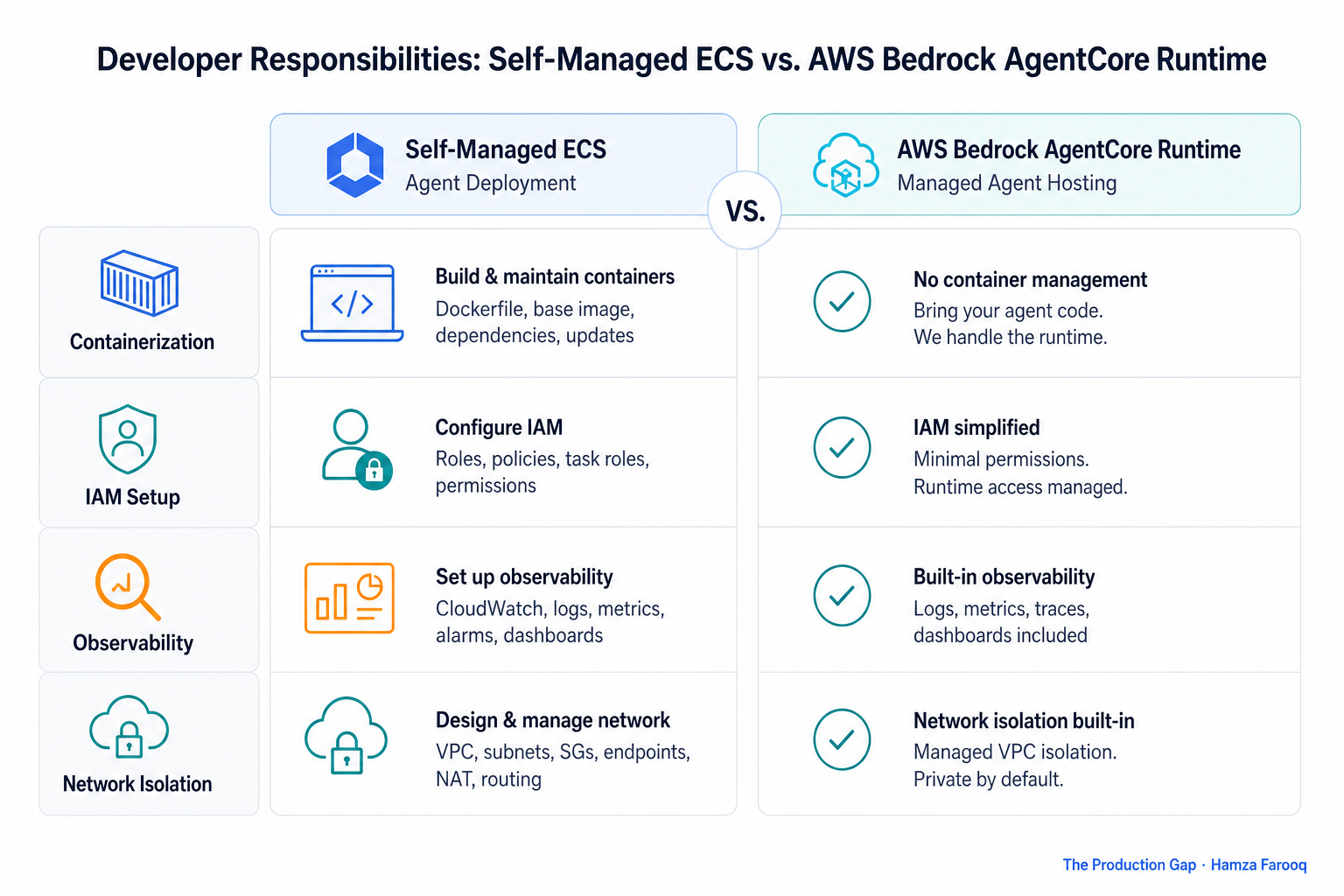
In a self-managed setup, an agent calling multiple AWS services mid-run typically runs under a single over-permissioned role, or requires custom rotation logic your team owns indefinitely. AgentCore's documented approach is to handle authentication and access control at the platform layer so developers focus on what an agent does rather than how it gets permission to do it. As a practical rule of thumb drawn from this author's reading of AWS documentation: credential management shifts from a developer-owned ongoing task to a platform-owned structural guarantee.
VPC isolation carries comparable operational weight. In self-managed ECS or EKS, VPC configuration is the developer's responsibility and a frequent audit finding. AgentCore enforces network boundaries structurally rather than configuration-dependently. For teams operating in regulated industries, that distinction matters because structural enforcement is auditable without inspecting individual deployments.
AgentCore GA capability checklist: infrastructure ownership by concern
| Infrastructure concern | AgentCore (managed) | Self-managed ECS or EKS | Notes |
|---|---|---|---|
| IAM / credential management | Platform-owned | Developer-owned | AgentCore delegates natively; no manual rotation required |
| VPC boundary enforcement | Platform-owned | Developer-owned | Structural enforcement, not configuration-dependent |
| Container orchestration | Platform-owned | Developer-owned | Teams must containerize but do not manage the scheduler |
| Observability instrumentation | Platform-owned (native) | Developer-owned | No custom OpenTelemetry wiring required |
| Memory and state persistence | Platform-owned (Memory component) | Developer-owned | Covered by the Memory component of the three-part architecture |
| Tool and MCP server hosting | Platform-owned (Gateway component) | Developer-owned | Covered by the Gateway component |
| Ongoing operational burden | Shared with AWS | Developer-owned | Scope of sharing depends on workload; verify SLA terms |
The build-vs-buy decision comes down to one question: how much IAM plumbing and network configuration can your team sustainably own across the agent fleet you are planning to operate?
What observability does AgentCore expose natively, and does it close the tracing gap?
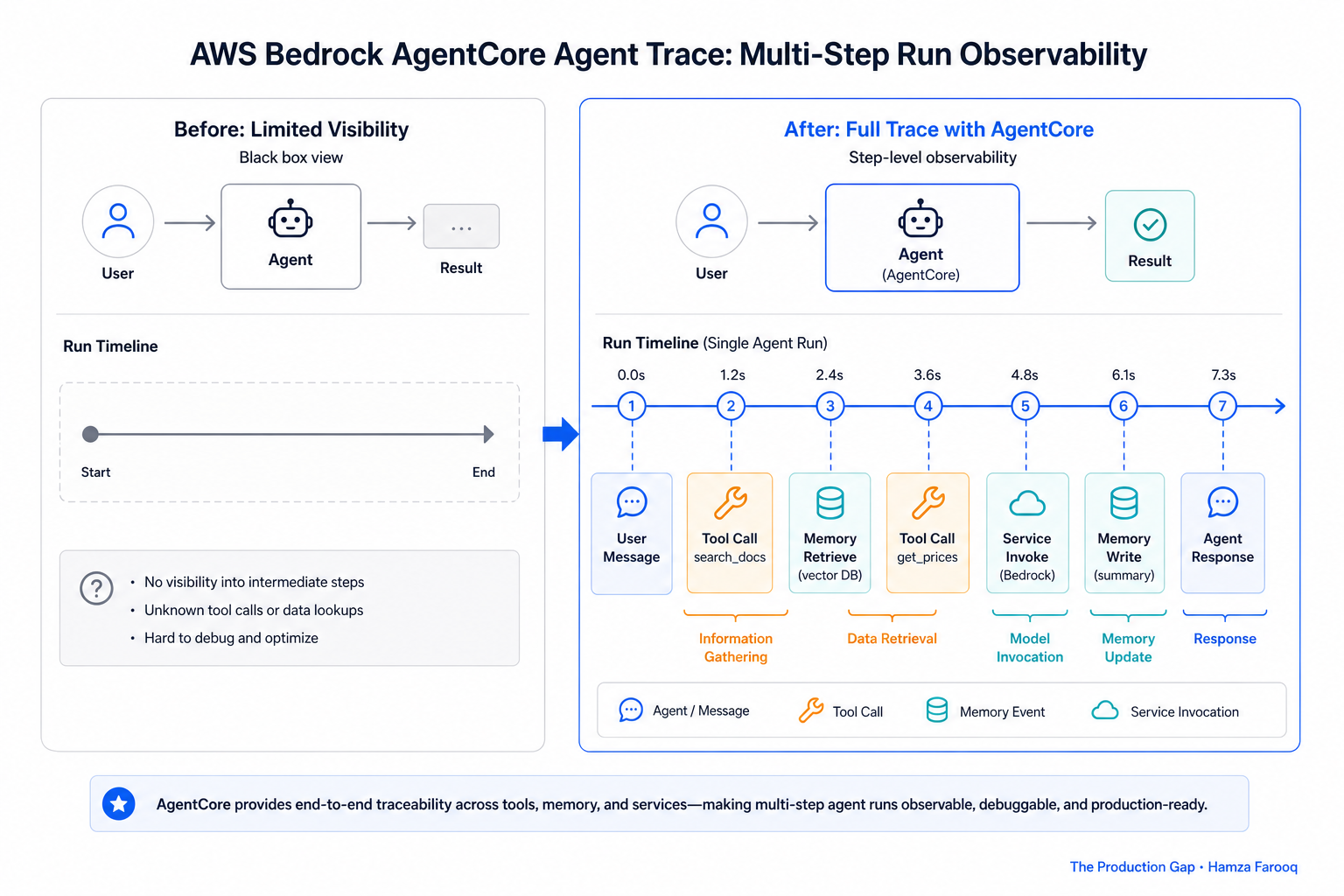
AgentCore provides native tracing that covers the execution of multi-step agent runs at the platform layer, so teams are not required to wire up custom instrumentation before they can observe what an agent did across tool calls and memory retrievals.
A multi-step agent run in a vanilla container produces no useful trace unless someone has explicitly wired up OpenTelemetry or a third-party APM tool. AgentCore's native tracing works at the platform layer, covering agent run execution without requiring that instrumentation work from the developer. The AgentCore Browser component, which lets agents interact with websites through a secure, cloud-based browser, extends the platform's reach into web-based tool use.
⚠️ Specific trace output formats, span structures, and integration with third-party tools such as Datadog, Grafana, or CloudWatch are not confirmed in the verified sources used for this article. Verify observability specifics against current AWS documentation before committing your monitoring architecture.
Are the GA adoption numbers real, and does it matter for your build-vs-buy decision?
None of the verified sources for this article (AWS official documentation, AWS Prescriptive Guidance, the Reddit community thread, the dev.to AWS Heroes post) confirm specific download figures or named enterprise adopters. That does not make AgentCore a poor platform. The architectural value is assessable independently of those figures, and the infrastructure primitives described above are concrete enough to evaluate in a proof-of-concept before committing.
A practical rule of thumb used in this guide: Weight vendor adoption claims at half until confirmed by a peer case study or independent audit. Conflating marketing metrics with production readiness is a common cause of costly re-platforming decisions.
The recommended evaluation sequence, as the framework used in this guide, is: assess technical architecture against your workload first, run a proof-of-concept with your actual agent second, and weigh vendor adoption claims last.
Frequently asked questions
What frameworks does AWS Bedrock AgentCore Runtime support out of the box? AWS describes AgentCore as supporting "any framework, model, or protocol," provided you containerize your code and meet the Runtime's invocation contract. Verify specific named framework support against current AWS documentation before migrating.
How does AgentCore handle IAM credentials when an agent calls multiple AWS services mid-run? AgentCore handles authentication and access control natively at the platform layer, so developers focus on what an agent does rather than how it gets permission to do it. Verify delegation mechanics against current AWS IAM documentation before production deployment.
How does AgentCore's VPC model compare to a customer-managed ECS cluster? AgentCore enforces network isolation structurally at the platform layer. In self-managed ECS, VPC configuration is the developer's responsibility and a common audit finding. AgentCore shifts that ownership to AWS without requiring custom network architecture work from your team.
Are the AWS Bedrock AgentCore GA adoption numbers independently verified? No independently audited source confirms specific download figures or named enterprise adopters. Evaluate AgentCore on architectural merit and your own proof-of-concept results, and apply skepticism to vendor adoption claims before building a business case around them.
Conclusion
AgentCore's Runtime, Memory, and Gateway components address real infrastructure debt at the platform layer: credential drift, missing traces, and network boundaries that otherwise require ongoing developer attention. That architectural case stands independently of the adoption narrative circulating at GA.
Evaluate the architecture first, run a proof-of-concept second, and weigh vendor claims last. Stand up a single AgentCore Runtime proof-of-concept with your existing agent this sprint. Measure credential setup time and trace coverage against your current self-managed container. That delta, not any vendor metric, is your actual build-vs-buy answer.
Learn from me
Forward Deployed Engineering Bootcamp for Full-Stack Developers, my Maven cohort. Build and ship complete AI products end to end, from React and Node.js frontends to deployed models with caching and observability. Join the next cohort →
Hire us
Traversaal.ai. We're a team of forward deployed engineers solving the toughest AI problems for Fortune 100 companies: document intelligence, agentic data platforms, and real-time web intelligence, deployed in production. Work with our team to deploy your next agentic ecosystem. Talk to Traversaal.ai →
Join us
Want to solve these problems with us? We're always looking for forward deployed engineers who want to ship production AI. jobs@traversaal.ai