Claude Agent SDK vs. Managed Agents API: A Decision Framework for Enterprise Deployment
Claude Agent SDK comparison made simple: discover which deployment path fits your compliance needs, budget, and team capacity before you commit.


TL;DR: The Claude Agent SDK comparison comes down to control versus convenience. Choose the SDK when your compliance requirements, customization depth, or data sovereignty demands exceed what a managed service can accommodate. Choose the Managed Agents API when operational overhead would slow your team more than the tradeoffs cost you. Most enterprises with strict regulatory environments or complex orchestration needs belong in the SDK path.
Key Takeaways
- Air-gapped deployment may require a self-hosted path: Workloads that prohibit outbound third-party connectivity cannot use a managed hosting model. Verify current Anthropic connectivity options at publication.
- Audit trails are structurally different: Self-hosting gives full log ownership. Managed API routes that data through the vendor's infrastructure under their retention policies.
- Cost math shifts at scale: Per-call API pricing wins early. Self-hosted compute ownership may become cost-favorable once volume crosses the infrastructure amortization threshold. Verify against current Anthropic pricing.
- Operational burden is the self-hosted path's hidden tax: Your team owns model versioning, uptime, and scaling.
- Observable compliance is the decisive criterion: The central question is whether your deployment model lets your team produce audit evidence independently, or whether it requires delegated trust in the vendor.
Introduction
Claude, developed by Anthropic for coding and knowledge work, is a large language model trained to be safe, accurate, and secure. For teams deploying Claude in regulated industries, the choice between a self-hosted SDK path and a managed API path carries real architectural and contractual weight. Choosing wrong in a compliance-sensitive context is not a refactor. It surfaces as a liability in the audit.
The common framing of this decision as cost versus control misses the more important axis. The real question is whether your deployment model gives you observable compliance or requires delegated trust in the vendor.
What Actually Separates the Claude Agent SDK from the Managed Agents API?
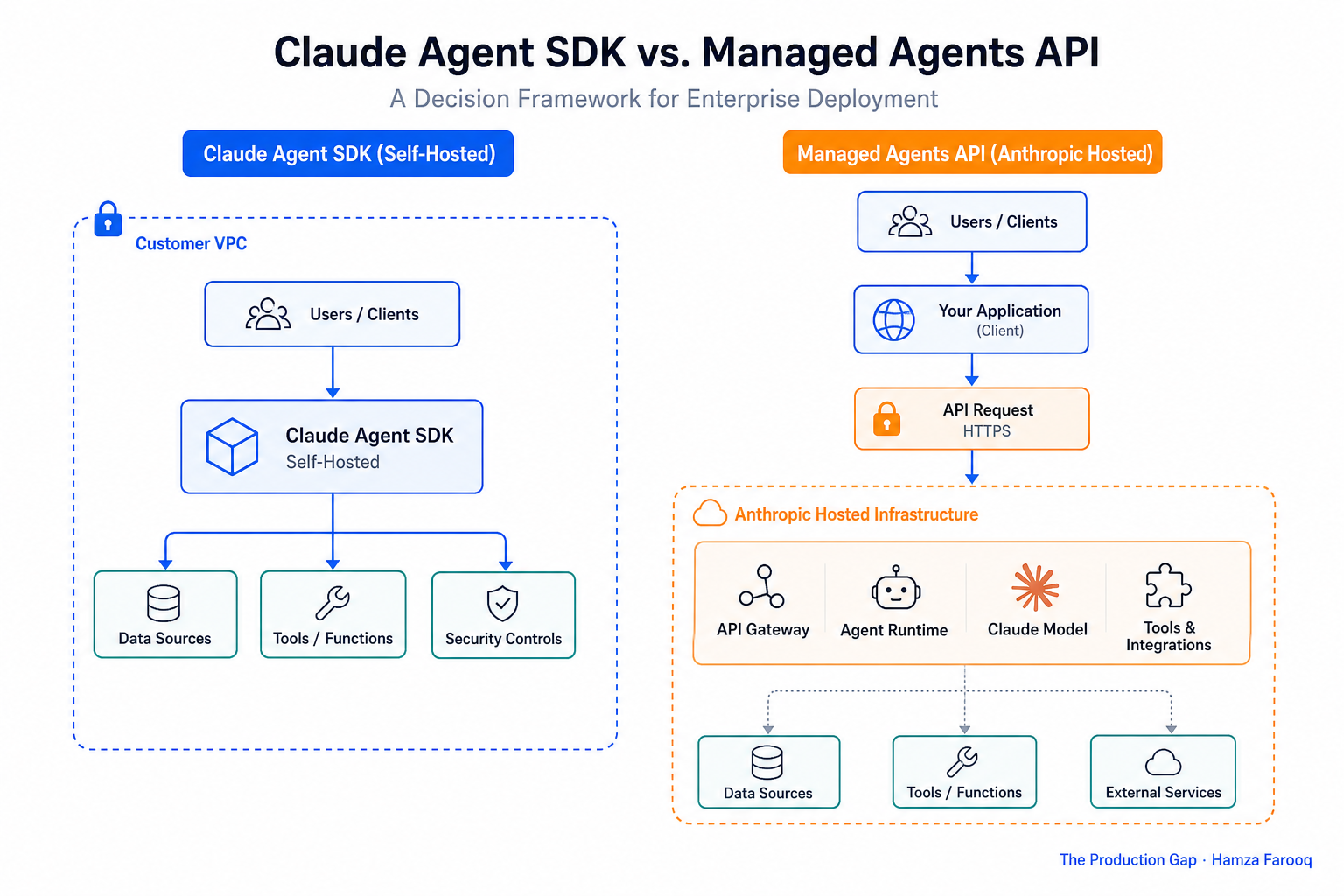
The Claude Agent SDK is a self-hosted framework your team deploys and operates. The Managed Agents API is a hosted service where Anthropic manages the agent runtime, model serving, and infrastructure on your behalf. Verify Anthropic's current product naming and feature boundaries at publication, as both offerings continue to evolve.
SDK path: Your team provisions compute, manages the runtime, and controls the full agent loop inside your infrastructure boundary. You own every layer.
Managed Agents API path: Anthropic hosts the runtime. You configure behavior within the API's allowed surface. Anthropic owns the process.
A useful analogy: the SDK path resembles running your own database server, while the managed API resembles a managed database service. The interface may feel similar, but who applies the patch and who reads the logs are entirely different answers.
The following table maps four capability gaps that are worth examining before committing to either path. Verify the current state of each against Anthropic's documentation before your architecture review.
| Capability dimension | Claude Agent SDK | Managed Agents API |
|---|---|---|
| System prompt ownership | Fully owned and versioned by your team | Configured through vendor interface; historical retrieval requires vendor export |
| Tool registration depth | Arbitrary tool definitions, including private internal APIs and proprietary connectors | Limited to what the API surface exposes; verify current limits with Anthropic |
| Agent memory persistence | Stored and controlled under your own access policies | Routes through vendor infrastructure under their retention policies |
| Model version pinning | Your team pins, tests, and rolls back versions | Version promotion managed by vendor; freezing on a specific version may not be available |
When Does the Managed Agents API's Customization Ceiling Become a Hard Blocker?
As a practical rule of thumb used in this guide, a managed API path becomes a hard blocker when your workflow requires system prompt versioning with audit trails your team controls, custom tool registration against private internal systems, or agent memory stored under your own access policies. Verify which of these constraints apply to Anthropic's current Managed Agents surface before finalizing your architecture.
System prompt control: In a managed model, prompt configuration runs through the vendor's interface. A compliance team may not be able to independently verify what the agent was instructed to do at a specific historical moment without going through the vendor's export process. That dependency is worth mapping before contract signature.
The ceiling identified in this guide typically surfaces once workflows grow beyond single-turn tasks into multi-step, stateful processes where each step must be independently auditable.
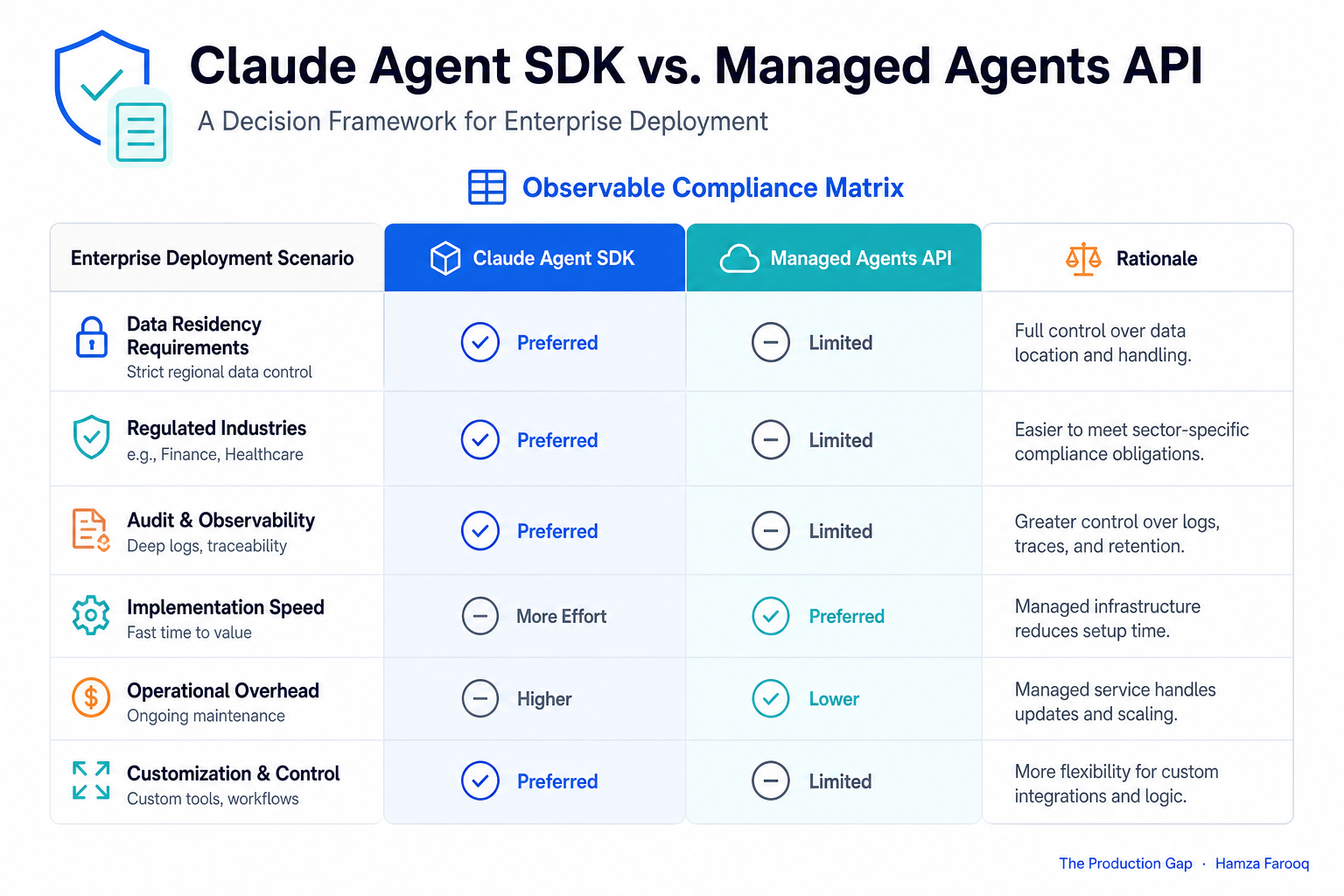
The Observable Compliance Matrix (SDK vs. Managed API, as of mid-2025)
The table below maps common enterprise deployment scenarios to the indicated path. Use it as a starting framework, then verify each compliance claim against current Anthropic trust documentation before your architecture review, as certifications and product capabilities change.
| Deployment scenario | Indicated path | Rationale |
|---|---|---|
| Air-gapped or classified environment | Self-hosted only | No outbound third-party connectivity permitted |
| HIPAA workload with BAA requirement | Self-hosted preferred | Audit trail ownership should reside with covered entity. Verify BAA availability with Anthropic |
| FedRAMP-scoped government workload | Verify with Anthropic | Data boundary requirements may preclude managed hosting. Confirm current authorization status |
| Standard enterprise SaaS with SOC 2 | Either path viable | Depends on client's specific audit trail clause language |
| Rapid prototype or pre-contract POC | Managed API preferred | Lower operational burden before compliance scope is set |
| High-volume, low-sensitivity automation | Cost-dependent | Verify current crossover benchmark against Anthropic pricing before committing |
Audit trail ownership is the structural difference between these paths. Self-hosted means your team owns all logs, prompt history, and versioning, retrievable on your own schedule. Managed API means the vendor holds that data under their retention policy, under terms your client's legal team likely did not negotiate directly.
The reframe worth internalizing: observable compliance means your team can produce the evidence. Delegated trust means asking auditors to accept the vendor's word instead.
Content flag: Verify Anthropic's current SOC 2, HIPAA BAA, and FedRAMP authorization status against Anthropic's trust documentation before publication. These certifications are material and frequently updated.
What Is the True Operational Cost of Owning the SDK Path in Production?
Choosing the Claude Agent SDK means your team absorbs model versioning, uptime SLAs, scaling events, and security patching. The Managed Agents API handles those responsibilities for you, at the cost of infrastructure visibility and control.
Uptime and scaling: The self-hosted SDK means your infrastructure delivers the client's SLA. Managed API scales automatically. Self-hosted requires provisioned capacity planning. That operational advantage is real, particularly early in the deployment lifecycle.
FAQ
Can the Claude Agent SDK be deployed in an air-gapped or VPC-isolated environment?
A self-hosted path is the only viable option for workloads that prohibit outbound third-party connectivity. Verify Anthropic's current private connectivity offerings at publication, as managed private link options may have evolved since this guide was written in mid-2025.
How does prompt versioning and rollback work differently between the two paths?
A self-hosted SDK gives your team full ownership of system prompt history and rollback authority. A managed API path mediates prompt configuration through the vendor's infrastructure, which means retrieving historical state for a compliance audit requires the vendor's data export process. This is the framework used in this guide for evaluating system prompt governance risk.
What compliance certifications does the Managed Agents API carry versus a self-hosted SDK deployment?
Conclusion
The unsolvable post-contract problem is being unable to produce a timestamped record of what your agent was instructed to do and when. That is a liability gap, not an engineering gap, and it lives in the prompt governance layer.
If your client has written auditability, data residency, or air-gap requirements into the SLA, evaluate the self-hosted SDK path first. The operational tax is recoverable. A compliance gap discovered post-deployment is not. The managed API path is appropriate for pre-contract proofs of concept, internal tooling with no regulated data, or workloads where Anthropic's compliance posture already satisfies your client's requirements without additional contractual coverage.
Map your client's SLA language against the Observable Compliance Matrix before your next architecture review. Where any self-hosted-only row matches your workload, treat that as a strong signal, not a starting point for negotiation.
Learn from me
Forward Deployed Engineering Bootcamp for Full-Stack Developers, my Maven cohort. Build and ship complete AI products end to end, from React and Node.js frontends to deployed models with caching and observability. Join the next cohort →
Hire us
Traversaal.ai. We're a team of forward deployed engineers solving the toughest AI problems for Fortune 100 companies: document intelligence, agentic data platforms, and real-time web intelligence, deployed in production. Work with our team to deploy your next agentic ecosystem. Talk to Traversaal.ai →
Join us
Want to solve these problems with us? We're always looking for forward deployed engineers who want to ship production AI. jobs@traversaal.ai