Claude Code Non-Developers: What Anthropic's Own Usage Data Reveals About Who's Actually Using Claude Cowork
Claude Code non-developers, meet Cowork. Discover how non-technical teams use Claude for research, drafting, and workflows—no coding required.

TL;DR: Claude Code and Claude Cowork share the same underlying engine but are designed for fundamentally different worker profiles. Despite its coding-adjacent name, Cowork is explicitly positioned for non-technical knowledge workers doing research, document drafting, and workflow coordination. Teams filtering it out based on the developer label are likely eliminating a tool built for their work, not against it.
Key takeaways
- Cowork and Code are different products: same engine, two distinct worker profiles.
- Non-technical teams have a real use case: operations, marketing, and research can run document-heavy workflows without any coding knowledge.
- The "developer tool" label has caused teams to opt out unnecessarily.
- The right filter is whether your team does multi-step research, drafting, or coordination work, not whether anyone on the team writes code.
- Orchestration depth and file-system access scope are now the meaningful evaluation criteria when comparing tools in this category.
- Panaversity's curriculum teaching non-coding agent use cases alongside Cowork signals that non-developer applicability has moved from niche to recognized.
- A practical three-gate readiness test (described in this guide) can help non-technical teams decide quickly whether a structured Cowork pilot is warranted.
Most business teams heard "Claude Code" and stopped reading. That was understandable. The name signals a developer tool, and for many non-technical teams, that framing ended the conversation before it started. The distinction between Claude Code and Claude Cowork makes that a costly misread.
What exactly is the difference between Claude Code and Claude Cowork for someone who doesn't write code?
Claude Code is a developer-specific tool for writing and reviewing software; Claude Cowork uses the same engine but is designed to complete multi-step work tasks, including research, drafting, file management, and coordination, without requiring any coding knowledge.
DataCamp frames this explicitly as "same engine, two jobs." Cowork is not a simplified version of Claude Code; it is a deliberate product fork aimed at a different worker profile. Claude Code lives in the terminal and IDE. Cowork is oriented toward documents, folders, and sequential work tasks. Dong Liang's analysis describes this as a genuine divergence in intent, not just interface.
Anthropic reportedly assembled Cowork in approximately 10 days by redirecting existing Claude Code infrastructure toward a different worker profile, which signals how transferable the underlying capability already was. What non-developers get in practice is concrete: an operations manager could assign Cowork to pull competitive pricing data, draft a summary memo, and organize outputs into a shared folder, with no code written and no developer consulted.
What does Cowork's non-coder positioning mean for how business teams should evaluate it?
Cowork is explicitly positioned as an AI automation tool for non-coders, meaning the coding identity attached to its name is a product-origin artifact, not a description of who the tool is built to serve.
aiflowreview.com positions Cowork directly as an AI automation tool for non-coders, not a technical product with a friendlier interface added on. That framing matters because it shifts the evaluation question. The relevant question is not whether your team writes code; it is whether your team does multi-step knowledge work involving research, synthesis, drafting, and file coordination.
The table below is author synthesis based on published positioning across DataCamp, aiflowreview.com, and Dong Liang and maps session types to the worker profiles each tool is described as serving:
| Session type | Primary users | Typical output | Coding required? |
|---|---|---|---|
| Research and synthesis | Analysts, ops leads, marketers | Summary memos, competitive briefs | No |
| Document drafting | Managers, legal, HR, comms | Reports, policies, proposals | No |
| Workflow management | Operations, project leads | Task tracking, file organization | No |
| Software development | Engineers, developers | Code, PRs, test scripts | Yes |
Three of the four session types map directly to standard knowledge-worker workflows. Non-technical teams filtering Cowork out based on its coding-adjacent name are likely eliminating a tool built for their work, not against it.
Should operations or marketing teams actually adopt Claude Cowork, or is the developer DNA still a practical barrier?
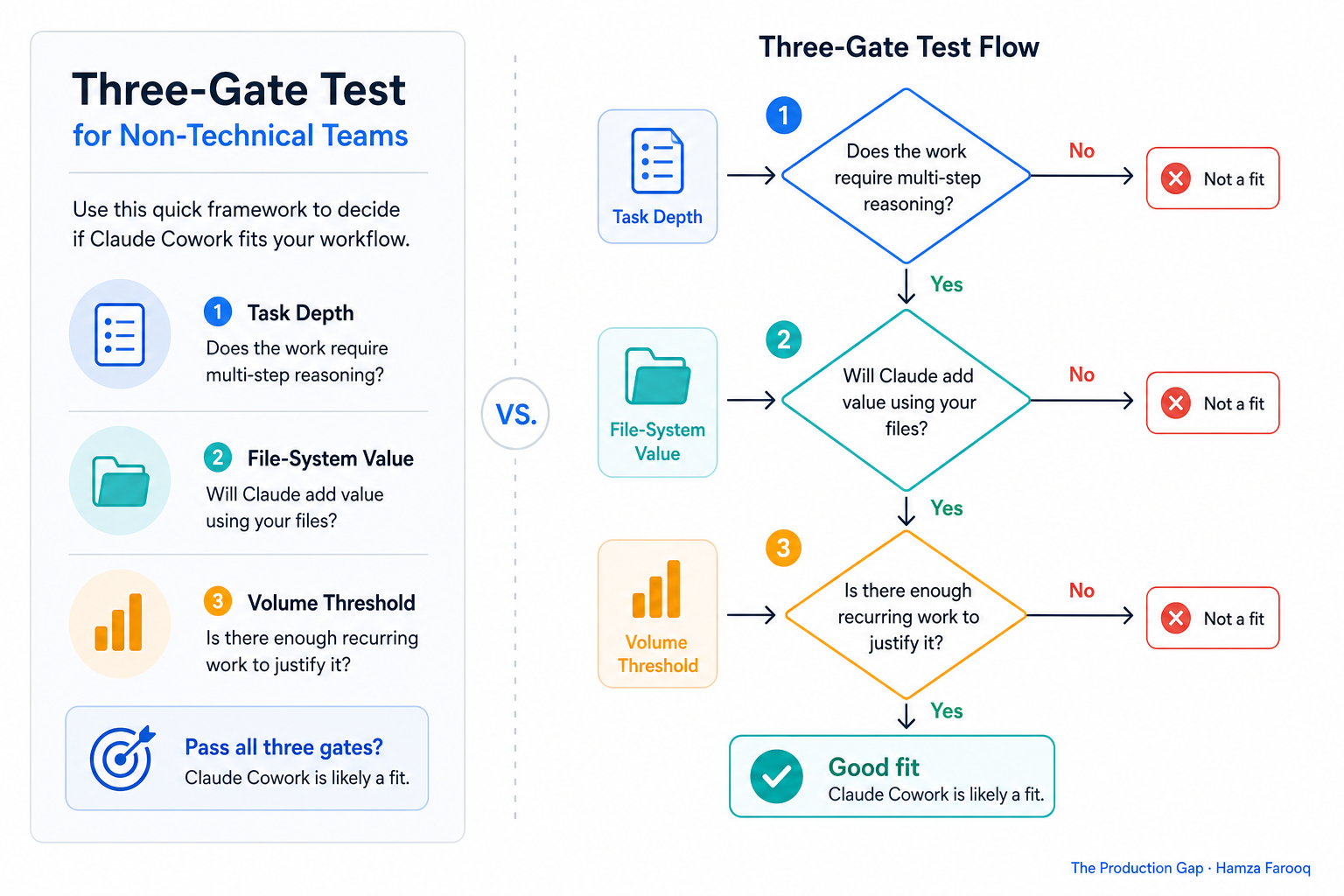
The clearest way to make that evaluation, as a practical rule of thumb used in this guide, is a three-gate readiness test that operations leads can run quickly against any candidate workflow. This framework is author synthesis and is not drawn from an external study.
The Cowork Readiness Test
Gate 1, Task depth: Does your team regularly complete work spanning more than three sequential steps, such as researching, then synthesizing, then drafting, then organizing?
Gate 2, File-system value: Does your team's output live in documents that an agent with file-system access could organize or route?
Gate 3, Volume threshold: Are these tasks recurring weekly at a volume where automation compounds meaningfully over time?
Pass all three gates and Cowork warrants a structured pilot. Pass one or two and it is situational. Pass none and it is not the right tool for now. Panaversity's AI Agent Factory curriculum teaches non-coding agent use cases alongside Cowork specifically, which signals that non-developer applicability has moved from niche to recognized.
Is the general-purpose work agent category already commoditized, and what does that mean for teams choosing tooling now?
The general-purpose work agent category is no longer differentiated by surface-level task capability; orchestration depth and file-system access scope are now the meaningful evaluation criteria.
Frequently asked questions
What tasks can Claude Cowork handle that don't involve writing or reviewing code?
Cowork is designed to handle multi-step research synthesis, document drafting, file organization, and workflow coordination, all without coding input. Its positioning as a non-coder automation tool is explicit across published sources.
How does Claude Cowork differ from Claude Code for non-technical users?
Claude Code is built for developers writing and reviewing software; Cowork uses the same engine for knowledge-worker tasks like research, drafting, and coordination. Non-technical users interact with Cowork through standard interfaces without touching a terminal or IDE.
Why do so many non-technical teams assume Cowork isn't for them?
The name association with Claude Code creates a developer-tool impression that does not reflect Cowork's actual design intent. The tools share an engine but are aimed at fundamentally different worker profiles, a distinction that the "Claude Code" name obscures for non-technical audiences.
Is Claude Cowork relevant for knowledge workers who never use a terminal?
Yes. Cowork is explicitly designed for non-coders and general knowledge-work contexts, making it directly applicable to non-engineering business teams doing research, drafting, and coordination work.
Conclusion
The coding label attached to Cowork's origin reflects where the infrastructure came from, not what the tool is designed to do. Published positioning across multiple sources consistently frames Cowork as a knowledge-work automation tool covering research, drafting, and coordination that happens to share an engine with a developer product.
The evaluation axis for non-technical teams, as argued throughout this guide, is orchestration depth and file-system access scope rather than whether a tool carries a coding-adjacent name. Run the Cowork Readiness Test against your team's most time-consuming recurring workflows. If two or more gates pass, a structured pilot is worth scheduling before tooling budgets are locked.
Learn from me
Claude Code in Practice, my Maven cohort. Master Claude Code from fundamentals to advanced orchestration: skills, subagents, hooks, MCP, and production automation. Join the next cohort →
Hire us
Traversaal.ai. We're a team of forward deployed engineers solving the toughest AI problems for Fortune 100 companies: document intelligence, agentic data platforms, and real-time web intelligence, deployed in production. Work with our team to deploy your next agentic ecosystem. Talk to Traversaal.ai →
Join us
Want to solve these problems with us? We're always looking for forward deployed engineers who want to ship production AI. jobs@traversaal.ai