AI Agent Liability Insurance: What the Emerging Risk-Transfer Market Signals About Enterprise Agent Deployment
AI agent liability insurance is real—learn how new coverage gaps, underwriting standards, and enterprise AI risk are reshaping autonomous agent deployment.

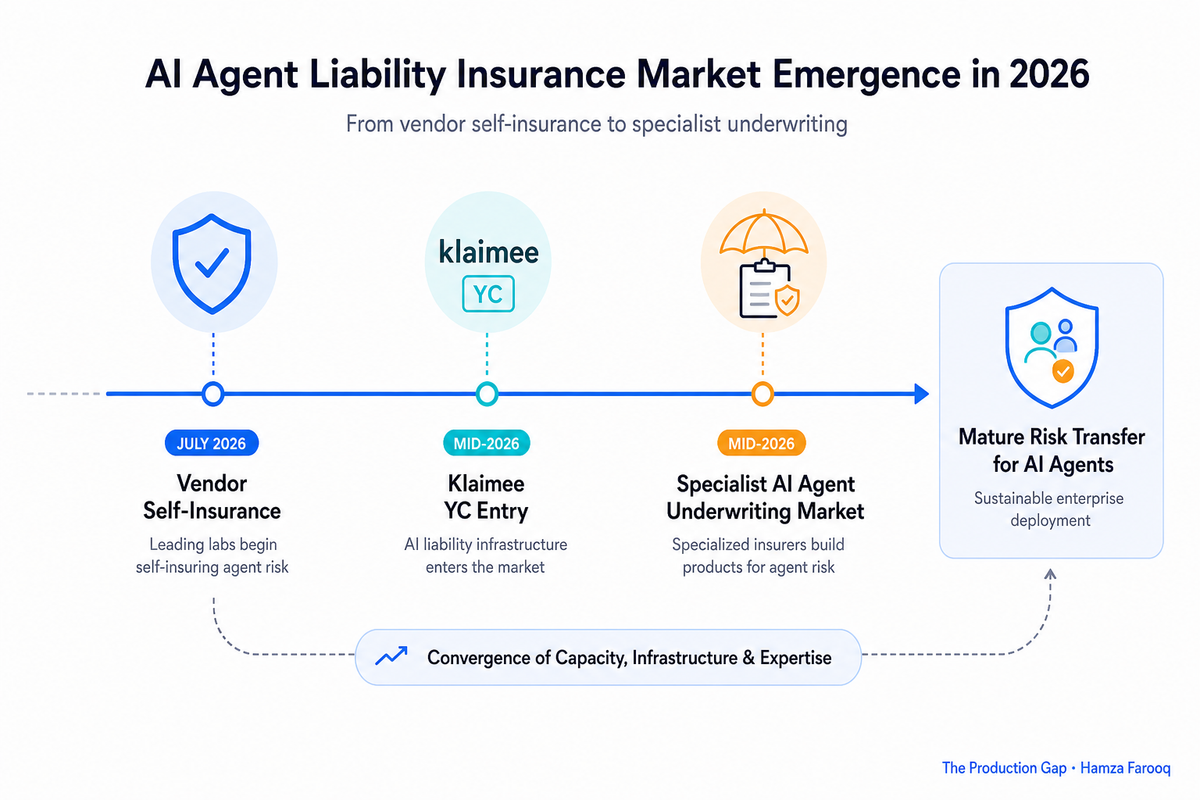
TL;DR: AI agent liability insurance is a commercially active category as of mid-2026, anchored by purpose-built entrants such as YC-backed Klaimee and a Fact.MR forecast extending to 2036. Standard E&O policies do not cover autonomous agent errors, hallucinations, or multi-step decision failures. Underwriting criteria are functioning as the first de facto performance standards for autonomous agents, arriving well ahead of settled regulation. Enterprise AI risk now carries a concrete price tag.
Key Takeaways
- Vendor self-insurance is a liability signal: financial backing of agent outputs shifts who accepts responsibility, and procurement teams should use it as contract leverage.
- Underwriting eligibility criteria are becoming de facto performance benchmarks: insurers' standards are the first financially grounded reliability requirements for autonomous systems.
- Standard E&O policies leave dangerous gaps: traditional professional liability was built for human decision-making, not autonomous multi-step agents.
- Regulated industries are driving early uptake: legal, financial services, and healthcare sectors are setting coverage terms that other sectors will follow.
- Insurers face hidden risk from their own AI use: companies offering agent coverage are simultaneously deploying agents internally, creating exposure they have not fully priced.
2026 has brought a convergence worth tracking. Klaimee, a YC-backed startup, launched with the positioning "You deploy agents, we cover you." Specialist underwriters entered the market in the same window. Academic research formally identified agentic AI as requiring its own insurance frameworks. The Fact.MR forecast extends to 2036, which signals that the market treats this as a durable commercial category, not a passing moment. Enterprise AI risk stopped being theoretical and started carrying a price tag, and the organizations setting that price may become de facto performance standard-setters well before any regulator does.
What does the new AI agent liability insurance market actually cover, and how does it differ from standard Errors and Omissions (E&O)?
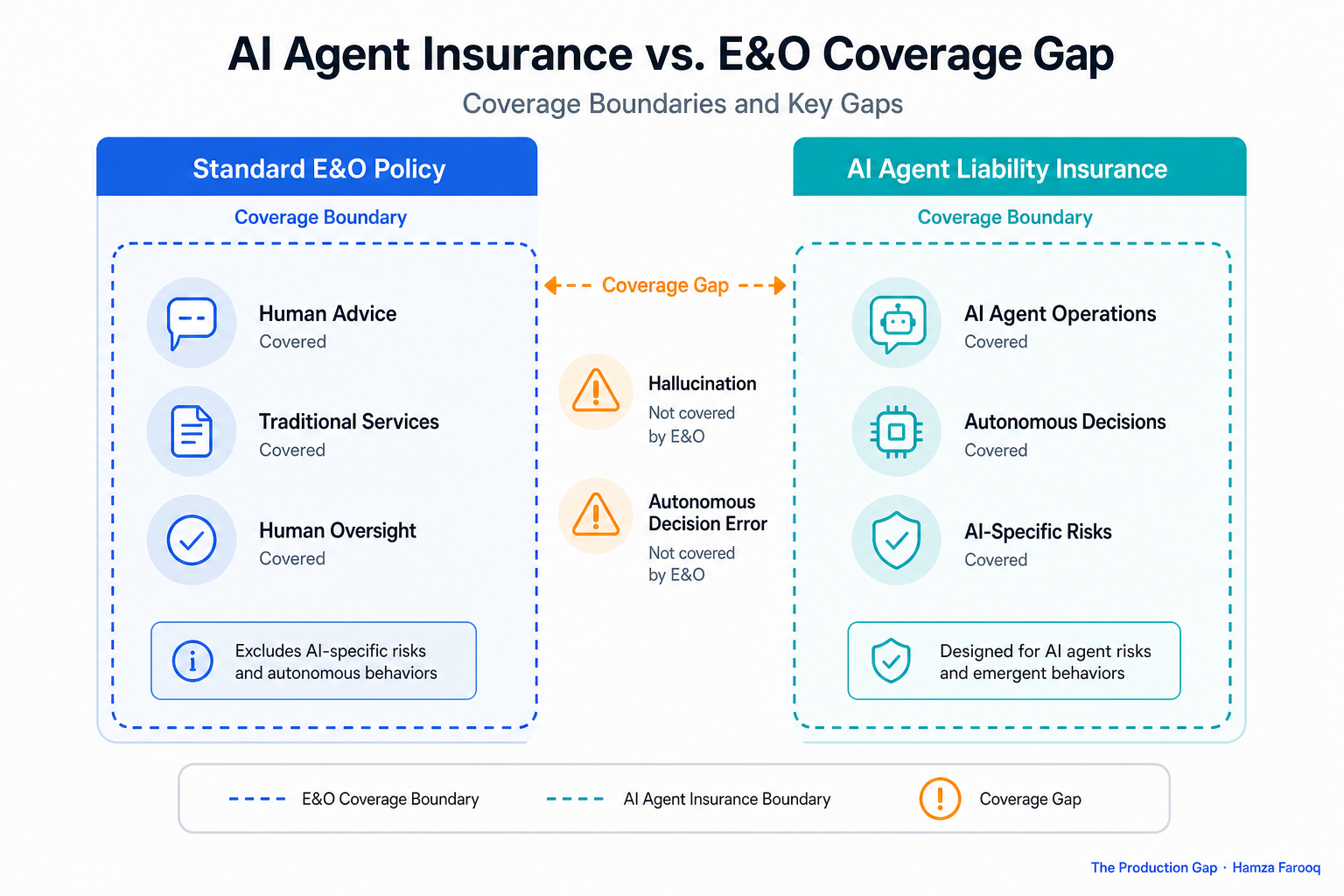
AI agent liability insurance covers losses caused by autonomous agent errors, including hallucinations, unauthorized actions, and flawed decisions, that standard E&O policies were never designed to address, because those policies assume a human professional made the relevant judgment call.
Traditional E&O breaks down in three specific ways when agents are involved: agents can fabricate factual claims with no traceable reasoning chain; no identifiable human decision-maker exists at each step in the workflow; and errors compound silently across multi-step action sequences. A 2026 arxiv paper argues these systems require entirely separate insurance frameworks. Klaimee's YC entry confirms that purpose-built agentic AI insurance is now commercially available.
Coverage Comparison: Standard E&O vs. AI Agent Liability Insurance
| Coverage Dimension | Standard E&O | Purpose-Built AI Agent Insurance |
|---|---|---|
| Assumed decision-maker | Licensed human professional | Autonomous software agent |
| Hallucination / factual error | Not covered | Explicitly covered |
| Multi-step autonomous action chains | Out of scope | Core coverage scenario |
| Vendor output indemnification | Rare; negotiated clause | Emerging standard feature |
| Underwriting criteria | Professional credentials, firm history | Agent architecture, audit logs, error rates |
| Market maturity (mid-2026) | Established, decades old | Nascent; specialist entrants active 2025-2026 |
What does vendor self-insurance signal about AI agent reliability?
When an AI vendor self-insures its own agent outputs, it attaches a market-derived price to agent reliability, a signal that tells enterprise buyers more about actual vendor confidence than any benchmark score or SLA guarantee.
A vendor backing outputs with its own capital has already done actuarial work: estimated error rates, loss distributions, and tail risk. A vendor SLA promising high accuracy costs nothing to write; self-insurance puts real capital at risk for every covered error. As Enterprise DNA notes, consulting firms deploying agents on behalf of clients carry layered liability that neither vendor contracts nor professional E&O cleanly captures. The same pattern applies across any enterprise where agents act on client data or produce client-facing outputs.
The practical action for procurement and field deployment engineers: ask in every AI vendor indemnification negotiation whether the product qualifies for third-party AI agent liability coverage and which underwriter has reviewed it. A vendor's eligibility, or their refusal to answer, is itself a due diligence signal.
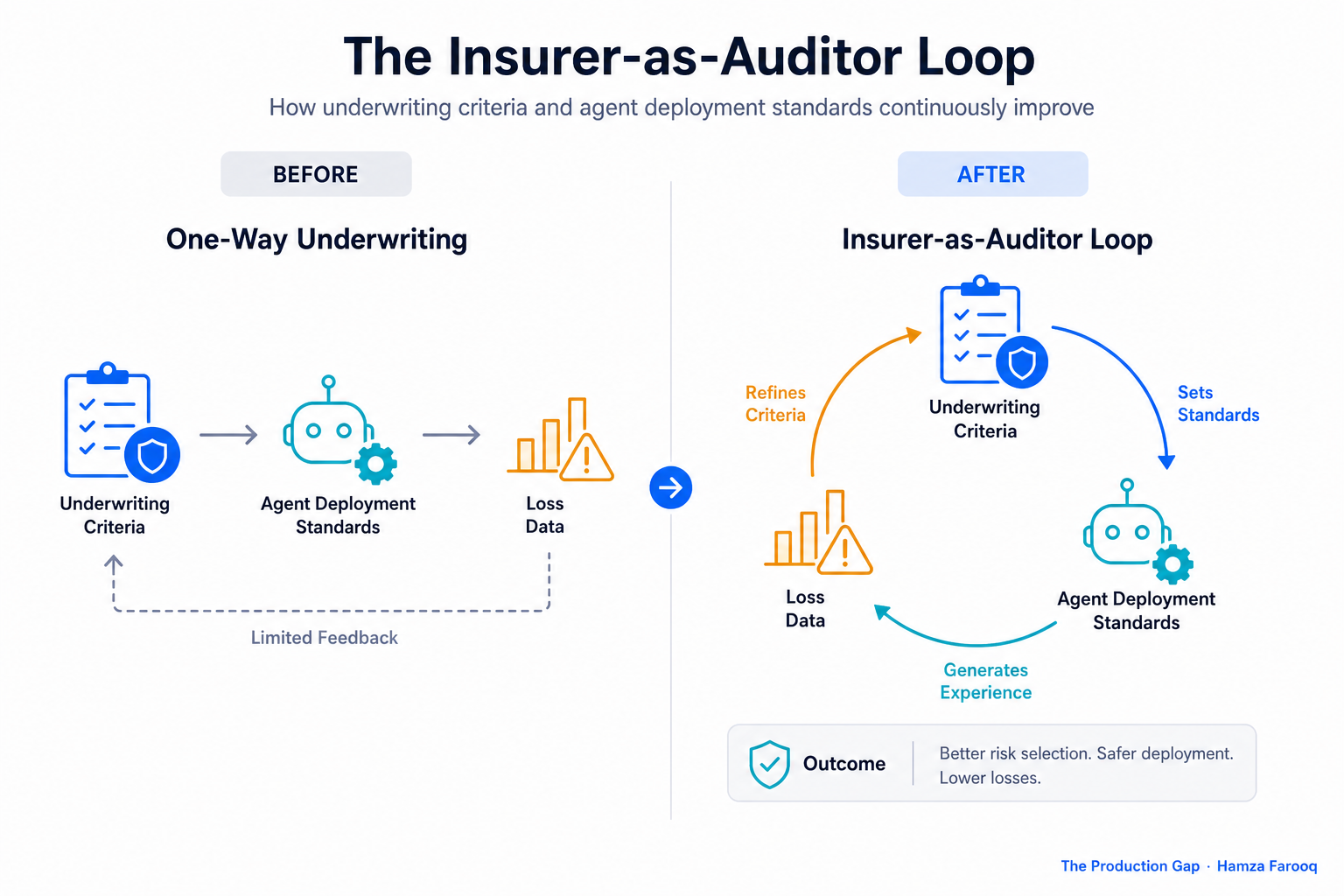
How are underwriting criteria functioning as de facto AI agent performance standards?
This creates a structural irony worth naming. Insurance Business Magazine reports that insurers deploying their own agents for claims processing and underwriting support are creating compounding exposure they have not fully priced. The institutions writing accountability criteria for autonomous agents may not yet meet those criteria themselves.
Which enterprise sectors face the most urgent AI agent insurance exposure?
Legal, financial services, and healthcare enterprises face the most urgent AI agent insurance exposure because agent errors in those contexts carry direct regulatory, fiduciary, and patient-safety consequences that existing liability coverage does not cleanly address.
In legal contexts, agentic workflows producing client-facing outputs create malpractice-adjacent exposure that existing professional liability coverage was not designed to cover. In financial services, agents involved in client-facing recommendations or compliance filings raise liability questions the moment they act without documented human sign-off. Pearl Health's "missing market" framing maps most directly to healthcare, where clinical decision support agents create exposure no existing coverage category captures adequately.
Where are the hidden AI agent liability risks that enterprises overlook?
The least visible AI agent liability risk may sit inside insurance companies themselves, precisely the institutions now positioning to cover everyone else.
Companies now offering AI agent coverage are simultaneously deploying agents internally for claims processing, underwriting support, and customer service, and have not fully modeled their own compounding exposure. This is not author inference: Insurance Business Magazine reports the pattern directly. Enterprises evaluating AI agent insurance should treat an insurer's own internal governance posture as a relevant signal about how seriously that institution understands the risk it is underwriting.
Frequently Asked Questions
What is AI agent liability insurance and who needs it?
AI agent liability insurance covers financial losses from autonomous AI agent errors, including hallucinations, unauthorized actions, and flawed multi-step decisions. Any enterprise where agents take real-world actions, submit filings, generate client-facing content, or execute transactions should evaluate this coverage. Legal, financial services, and healthcare organizations face the highest urgency given regulatory and fiduciary stakes.
Does standard professional liability or E&O insurance cover AI agent errors?
Standard E&O does not cover AI agent errors in most cases. Those policies assume a human professional made the relevant decision, which leaves gaps around hallucination liability, autonomous action chains, and compounding multi-step errors. The arxiv paper 2606.05449 argues agentic AI requires entirely separate frameworks, a position now supported by dedicated market entrants offering purpose-built coverage.
What does vendor self-insurance mean for contract risk allocation?
Vendor self-insurance shifts financial liability for covered errors from the enterprise buyer to the vendor. Procurement teams should cross-reference any self-insurance commitment with the indemnification scope and liability caps in the vendor contract to confirm the coverage is substantive rather than nominal.
Conclusion
The AI agent insurance market is doing one concrete thing: attaching a price to how much a financially accountable third party actually trusts a given agent. That price reflects capital at risk, which makes it a categorically different signal from an SLA negotiated without financial skin in the game.
The organizations setting real performance standards for autonomous agents right now are not regulatory bodies still working through comment periods. They are underwriters and purpose-built startups like Klaimee, whose eligibility decisions cost them money when they are wrong. That financial accountability is, as a practical rule of thumb used in this guide, the most reliable proxy available for autonomous agent trustworthiness until formal standards arrive.
Add one question to every AI agent vendor RFP: "Has your product been reviewed for AI agent liability insurance eligibility, and by which underwriter?" The answer, or the refusal to answer, is itself due diligence.
Learn from me
Forward Deployed Engineering Bootcamp for Full-Stack Developers, my Maven cohort. Build and ship complete AI products end to end, from React and Node.js frontends to deployed models with caching and observability. Join the next cohort →
Hire us
Traversaal.ai. We're a team of forward deployed engineers solving the toughest AI problems for Fortune 100 companies: document intelligence, agentic data platforms, and real-time web intelligence, deployed in production. Work with our team to deploy your next agentic ecosystem. Talk to Traversaal.ai →
Join us
Want to solve these problems with us? We're always looking for forward deployed engineers who want to ship production AI. jobs@traversaal.ai