GPU Cluster MCP Server: How to Wrap Internal Model-Serving Infrastructure as a Production-Grade Agent Tool
GPU cluster MCP server patterns for wrapping vLLM or Triton endpoints with auth, rate limiting, and queuing your agents can actually use.

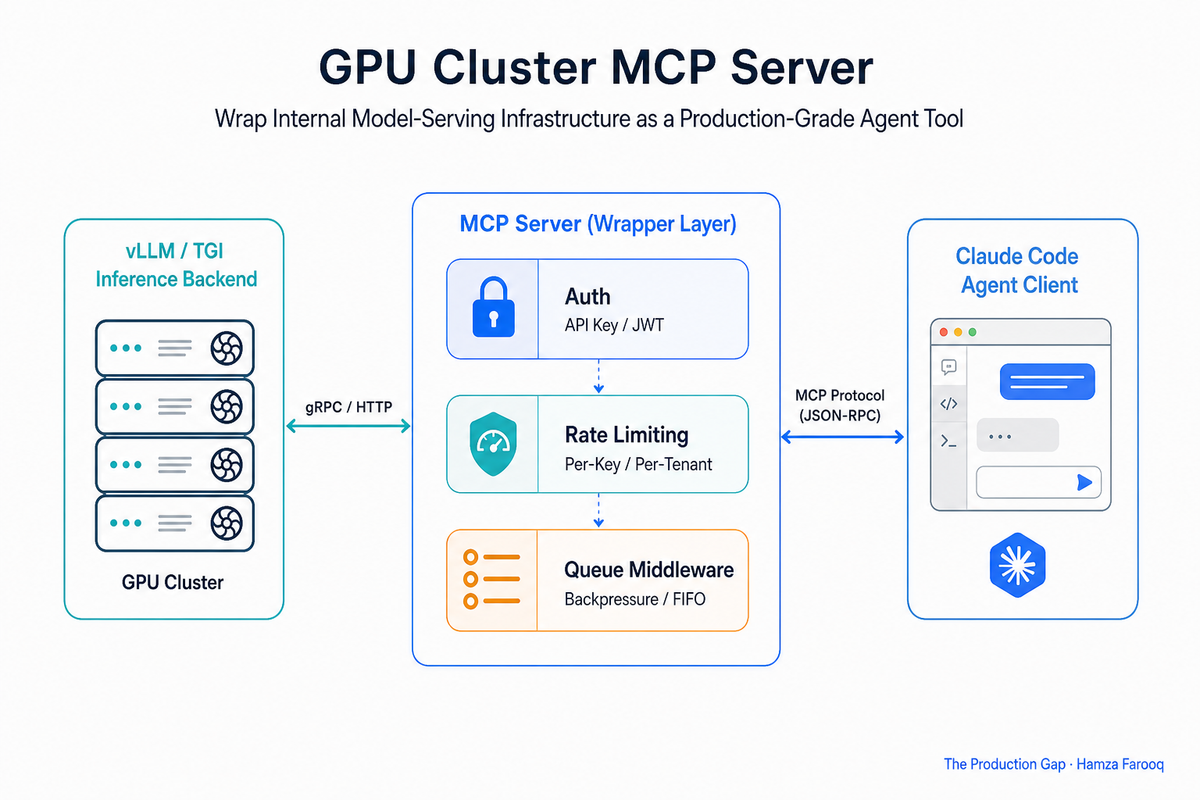
TL;DR: A GPU cluster MCP server wraps a private vLLM, TGI, or Triton endpoint in a typed, agent-readable interface that enforces auth, rate limiting, and queuing without modifying the inference backend. The pattern requires three ordered middleware stages before any request reaches a GPU process. Choose MCP over a plain REST endpoint when agents need tool introspection, multi-step orchestration, or dynamic capability discovery at runtime.
Key Takeaways
- MCP beats a plain REST URL: Agents get typed schemas, structured errors, and a standard calling convention raw HTTP cannot provide.
- Auth lives at the MCP wrapper layer: One enforcement point, not spread across every inference endpoint.
- Rate limiting prevents cluster starvation: Per-team caps stop concurrent agent sessions from saturating GPU memory.
- Request queuing matters at scale: Backpressure-aware queuing keeps the cluster stable when demand spikes.
- Tool schema design shapes the error surface: Named failure modes let agents recover programmatically instead of failing silently.
- The ARQ middleware stack is still the hard part: Run:ai and Runpod ship MCP support, but designing auth, queuing, and routing for multi-tenant clusters requires deliberate architecture work.
Introduction
A GPU cluster MCP server wraps a private vLLM, TGI, or Triton endpoint in a typed, agent-readable interface that enforces auth, rate limiting, and queuing without modifying the inference backend, closing the gap between "we have a model-serving cluster" and "our agents can use it safely at scale."
Run:ai ships MCP server support in its official getting-started guide; Runpod has published a production deployment guide as well. The pattern is established. What is not well documented is how to handle auth, queuing, and semantic routing for multi-tenant clusters, and that is what this guide addresses.
Why does a plain REST endpoint fail agents where an MCP wrapper succeeds?
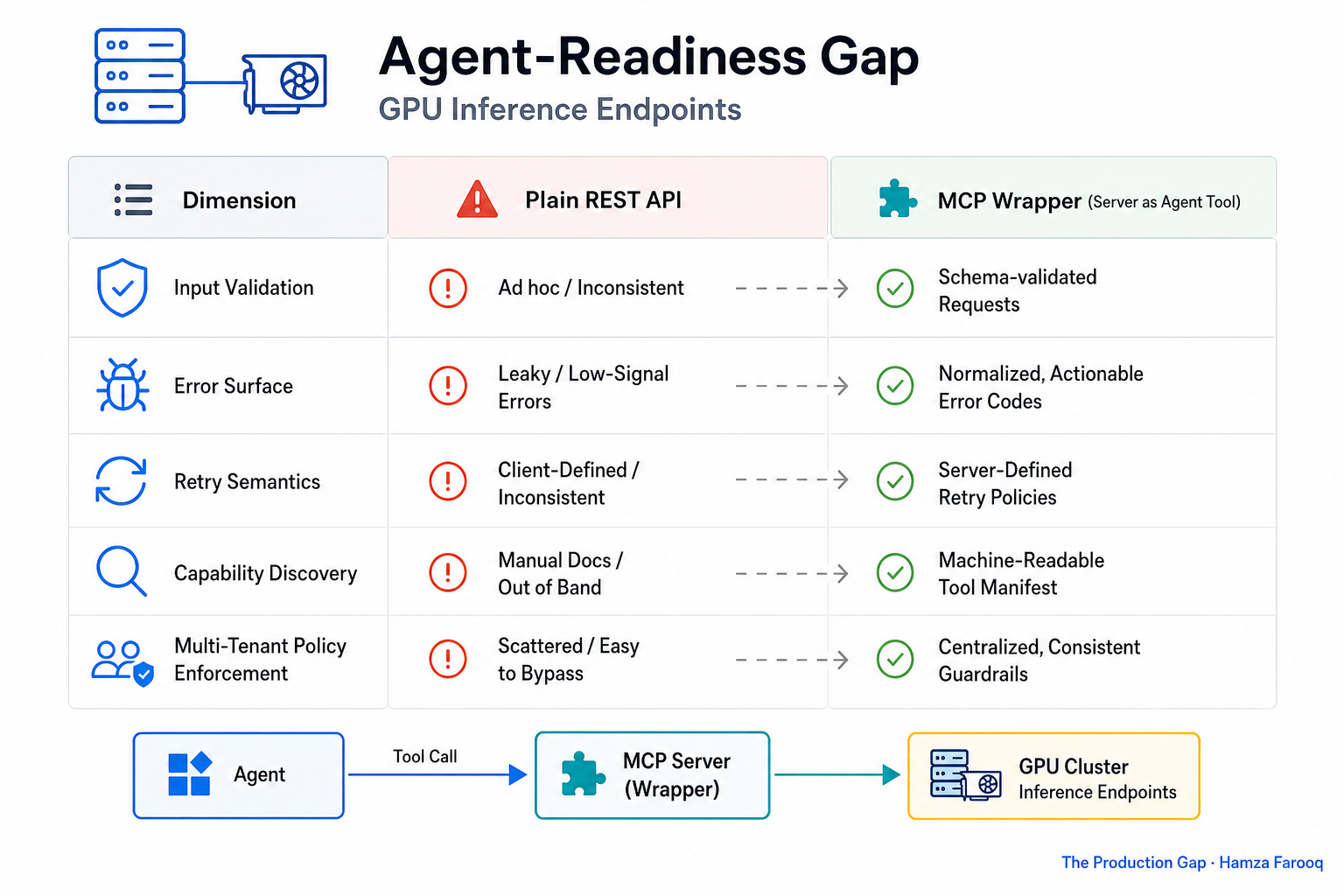
A plain REST endpoint gives an agent a URL and an HTTP status code; an MCP wrapper gives it a typed schema, structured error variants, and a calling convention every MCP-compatible client already understands.
With raw REST, errors are untyped. An agent hitting a 503 from a saturated vLLM instance cannot tell whether the cluster is full or whether auth failed, and there is no standard retry signal either way. An MCP tool definition encodes that signal explicitly as a named error variant with a retry_after field. The gpu-bridge/mcp-server project illustrates the point: it exposes AI services as MCP tools rather than raw endpoints because the schema layer is what makes them composable inside agent graphs.
The agent-readiness gap: plain REST vs. MCP wrapper
| Dimension | Plain REST endpoint | MCP wrapper |
|---|---|---|
| Input validation | None before GPU round-trip; malformed requests fail expensively | Schema-validated at wrapper boundary; invalid inputs rejected before GPU resources are consumed |
| Error surface | HTTP status codes only; agent cannot distinguish capacity failure from auth failure | Named variants (rate_limit_exceeded, model_not_loaded) that agent runtimes act on programmatically |
| Retry semantics | No standard signal; agent guesses or implements custom backoff | Structured retry_after hint in tool error payload |
| Capability discovery | Agent must know URL, method, and body shape ahead of time | MCP manifest describes inputs, outputs, and constraints at runtime |
| Multi-tenant policy | Policy lives in backend config; inconsistent and hard to audit | Auth, rate limiting, and routing enforced centrally; auditable without touching the inference backend |
How do you structure auth, rate limiting, and request queuing in the MCP wrapper layer?
The MCP wrapper must enforce authentication, per-team rate limits, and backpressure-aware queuing as three distinct, ordered middleware stages before any request reaches a GPU process, the Auth-Rate-Queue (ARQ) middleware stack.
ARQ Layer 1: Auth at the gate
The MCP server is the single enforcement point for API key validation, JWT verification, or mTLS, the inference backend handles none of this. Pushing auth into vLLM or TGI means every new team integration requires a backend config change. The wrapper holds identity context and passes a stripped, trusted request downstream.
ARQ Layer 2: Per-team rate limiting
Resolve team identity from the auth token established in Layer 1, then apply a token-bucket or sliding-window limiter keyed to that identity, with state stored in Redis for consistency across MCP instances. When a team exceeds its cap, return a rate_limit_exceeded tool error with a retry_after value in seconds, not a raw 429. Without explicit per-team caps, a single agent session can saturate GPU memory for every other tenant.
ARQ Layer 3: Backpressure queue
A bounded async queue between the wrapper and the inference backend absorbs demand spikes without dropping requests. When queue depth hits its ceiling, return a structured tool_error with a retry_after hint. A raw REST 503 cannot do this reliably, which leaves agent runtimes guessing whether to retry immediately or back off.
How should you design the MCP tool schema for a model-serving endpoint?
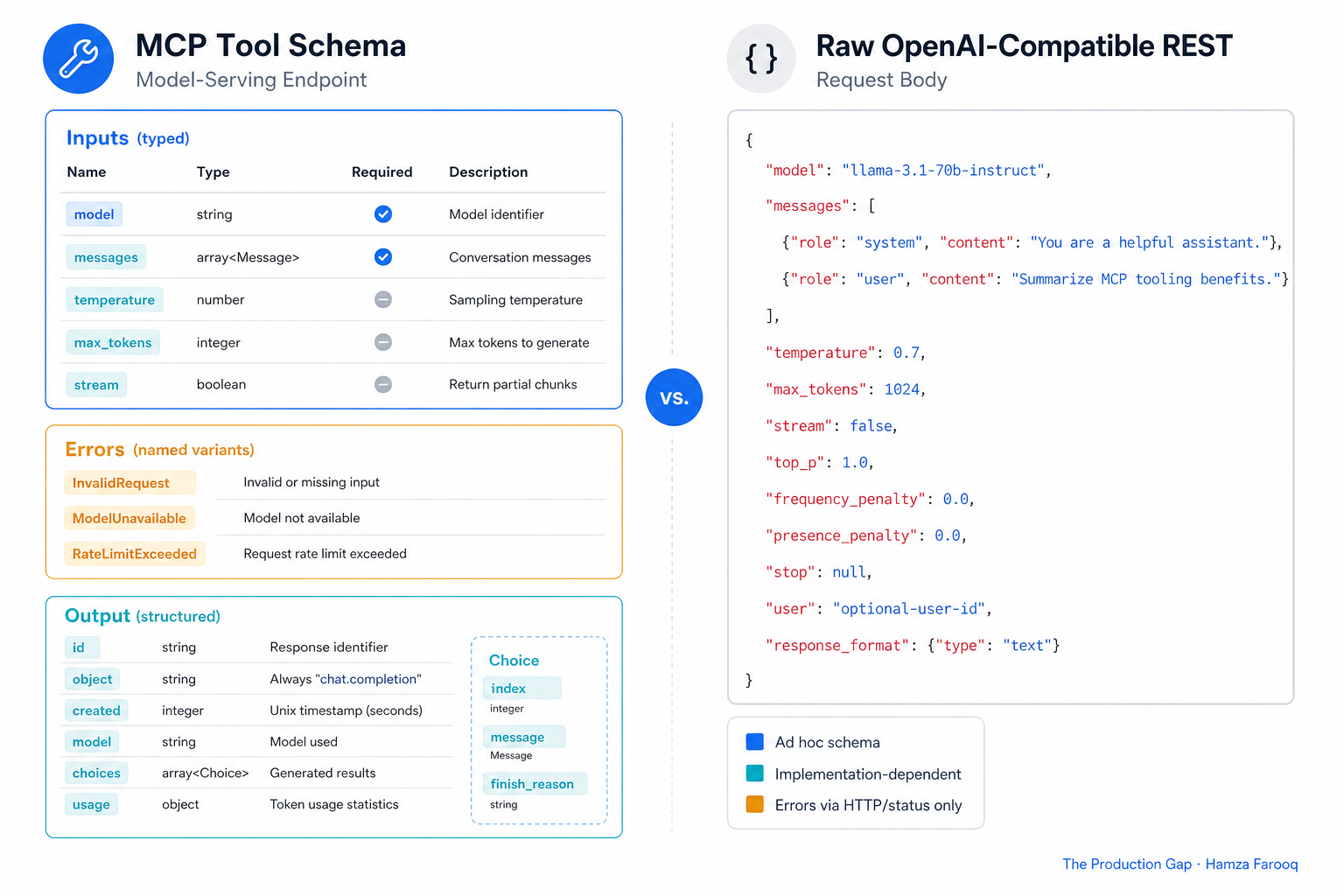
Your MCP tool schema should define exact input fields, enumerate every failure mode as a named error variant, and never expose implementation details (like GPU node IDs or backend routing keys) that tie the agent to your cluster's internal topology.
The most common mistake is copying the OpenAI /v1/chat/completions body directly into the input schema, leaking backend-specific fields (logprobs, stream, seed) that produce unpredictable behavior when the underlying model does not support them.
Inputs: prompt (string, required), max_tokens (integer, bounded), task_type (enum: generation | summarization | embedding).
Outputs: content, model_used, tokens_consumed, latency_ms, observable feedback without exposing node internals.
Error surface: Named variants (rate_limit_exceeded, capacity_unavailable, input_too_long, model_not_loaded), each with a machine-readable code and a human-readable message.
Every field you expose carelessly creates a coupling between the agent and your cluster's internals.
How does the MCP wrapper layer become a semantic router, not just a traffic cop?
When task_type is summarization, the ARQ wrapper routes the request to a smaller, cheaper model; when task_type is generation, it targets a larger model on higher-memory hardware, all without the agent knowing the difference. This is what separates a semantic router from a simple traffic proxy.
Because MCP tool calls carry semantic metadata via the task_type field, the wrapper can inspect intent before dispatching rather than forwarding every request blindly. The gpu-mcp-server project provides real-time GPU utilization, memory, and power metrics via MCP, the telemetry that makes routing decisions data-driven rather than static config.
Frequently asked questions
Q: How do I expose a vLLM endpoint on a private GPU cluster as an MCP tool that Claude Code can call?
Deploy an MCP server process that registers a tool definition matching your vLLM endpoint's input contract, handles auth and schema validation, and proxies validated requests to vLLM's /v1/chat/completions. Claude Code discovers the tool via the MCP manifest with no direct network access to the GPU node required.
Q: What does the MCP wrapper handle that a plain REST endpoint does not?
Three things: structured error variants agents can act on programmatically; input schema validation before a GPU round-trip is wasted; and a standard retry_after signal telling the agent exactly how long to wait when capacity is unavailable.
Q: How do I implement per-team rate limiting in an MCP server fronting shared GPU infrastructure?
Resolve team identity from the auth token in ARQ Layer 1, apply a token-bucket or sliding-window limiter keyed to that identity stored in Redis, and return a rate_limit_exceeded tool error with a retry_after value in seconds, not a raw 429.
Q: When does wrapping my GPU cluster as an MCP server provide more control than giving agents a REST URL?
Once you have more than one team, model, or task type on the same cluster. The ARQ stack centralizes auth, rate limiting, queuing, schema validation, and semantic routing, all auditable without touching the inference backend.
Conclusion
The distance between "we have a vLLM cluster" and "our agents can use it safely at scale" is a middleware problem, and the GPU cluster MCP server is where it gets solved. The ARQ stack (auth at the gate, per-team rate limiting, backpressure queuing) is the framework. Name your error variants so agents recover programmatically. Build task_type into your schema from the start, because semantic routing is what separates a cluster that holds up under concurrent agent load from one that generates incident reviews.
The MCP tool boundary is not just a translation layer. It is a scheduling policy layer.
Next step: Instrument your existing vLLM endpoint with the gpu-mcp-server metrics tool to establish a utilization baseline, then draft your first tool schema using the input/output/error structure above.
Learn from me
Forward Deployed Engineering Bootcamp for Full-Stack Developers, my Maven cohort. Build and ship complete AI products end to end, from React and Node.js frontends to deployed models with caching and observability. Join the next cohort →
Hire us
Traversaal.ai. We're a team of forward deployed engineers solving the toughest AI problems for Fortune 100 companies: document intelligence, agentic data platforms, and real-time web intelligence, deployed in production. Work with our team to deploy your next agentic ecosystem. Talk to Traversaal.ai →
Join us
Want to solve these problems with us? We're always looking for forward deployed engineers who want to ship production AI. jobs@traversaal.ai