Ontology-Driven AI Agents: Why a Shared Knowledge Graph Beats Thick Hand-Wired Agents in Enterprise Systems
Ontology-driven AI agents using a shared knowledge graph eliminate coordination drift and hallucinations. Learn how to build auditable enterprise AI systems.

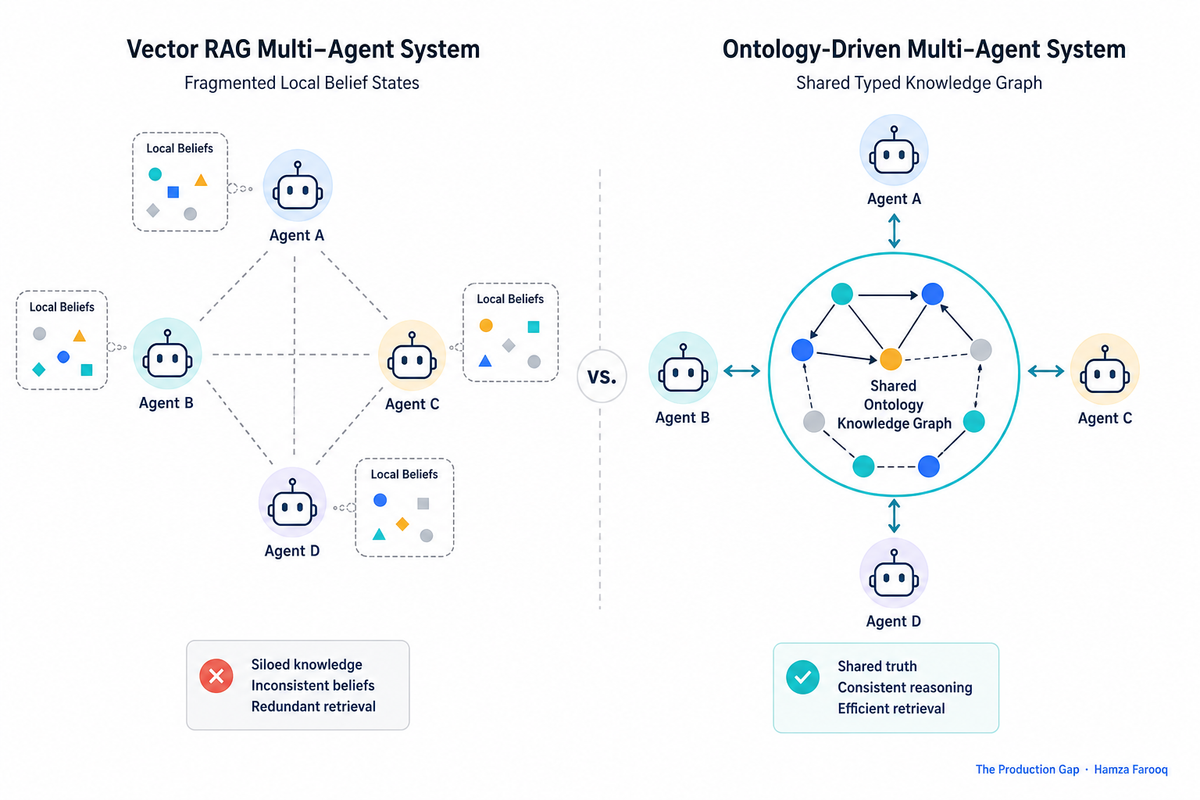
TL;DR: An ontology-driven AI agent is an AI system that uses a formal knowledge graph as its sole source of domain facts. In enterprise multi-agent systems, a shared ontology replaces scattered local belief states, eliminates coordination drift, and makes every agent's reasoning auditable. The architectural tradeoff is real: you gain precision and consistency, and you take on versioned graph governance with human review gates.
Key takeaways
- An ontology-driven agent is defined by its knowledge source: It queries a formal, typed graph rather than inferring relationships from raw text retrieval.
- Vector RAG breaks under enterprise coordination demands: Retrieving unstructured text chunks without a shared domain map produces hallucinated relationships that compound silently across agent pipelines.
- A shared knowledge graph enforces a common vocabulary: Every agent queries the same typed graph, which prevents the independent local belief states that cause coordination drift.
- Typed tool calls are more precise and auditable than free-text search: Structured graph queries carry defined input types, output schemas, and logged results that free-text retrieval cannot produce.
- LLM-assisted authoring may lower the barrier to bootstrapping an ontology: A language model can help draft candidate entity types and relationships from existing documents, though the depth of expert review required will vary by domain complexity.
- Ontological constraints block invalid reasoning paths at the domain logic layer: Rules baked into the graph make structurally impossible inferences unreachable before a bad output is produced.
- Agent-proposed graph edits require a human review gate: Allowing agents to update the shared ontology without review introduces fleet-wide drift, a coordination failure qualitatively worse than a single agent hallucinating in isolation.
Why does vector RAG fail when enterprise agents need to agree?
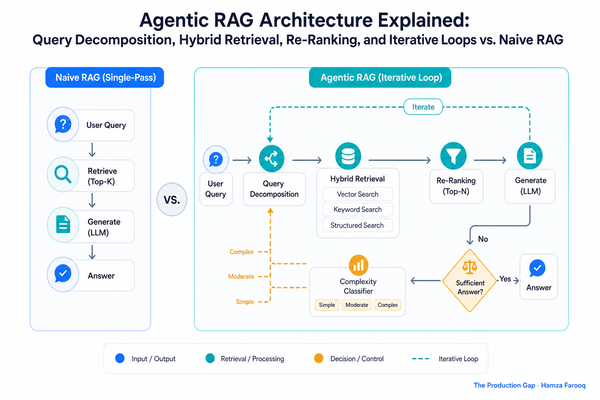
Vector RAG fails in enterprise multi-agent systems because raw text retrieval produces no shared vocabulary, no typed relationships, and no logical constraints, so each agent independently infers different facts about the same domain.
Vector similarity finds plausible chunks, not correct relationships. A chunk about "Supplier A" and one about "Contract 47" may both score highly on the same query without the retrieval system knowing whether those entities are related. The model infers the connection, and often it is wrong.
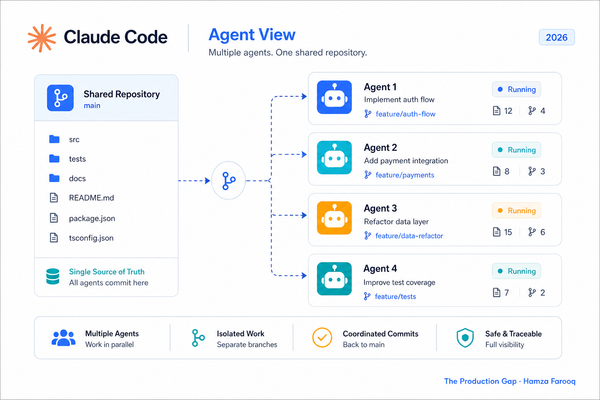
When Agent 1 and Agent 2 run independent retrieval, they build contradicting local belief states. That contradiction compounds in a pipeline: one agent feeds a wrong relationship to the next, and the error travels invisibly until an auditor catches it three steps downstream. Ontology for AI agents is the formal definition of a domain's entities, properties, relationships, and constraints, exactly what vector retrieval strips out. This is an architectural failure, not a tuning problem.
How has LLM-assisted authoring made ontology-driven agents more practical?
LLM-assisted ontology authoring makes knowledge graph architectures more accessible by helping teams bootstrap domain ontologies from existing documents and usage data, reducing reliance on dedicated knowledge engineering resources, though scope and required review depth will vary by domain.
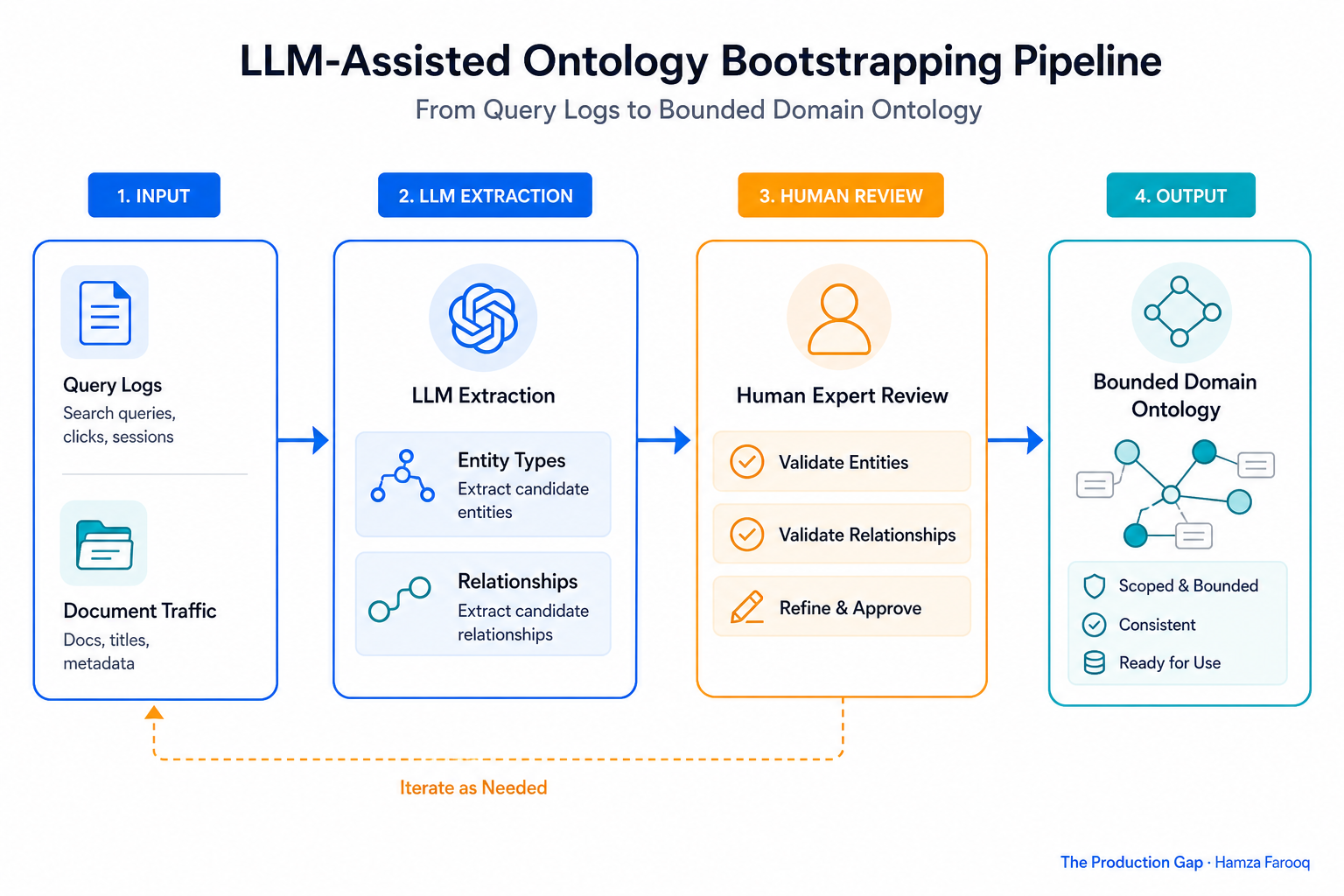
Traditional knowledge engineering required dedicated ontologists and committee consensus that rarely shipped on schedule. A bottom-up workflow using LLMs can shift some of that burden. The following sequence is a practical rule of thumb used as the framework in this guide, not an externally measured standard:
- Feed query logs and high-frequency document traffic into an LLM.
- The LLM extracts candidate entity types, properties, and relationships in OWL/RDF-compatible structure.
- A domain expert reviews and approves a bounded draft before any graph enters production.
- The graph grows incrementally; new entity types enter only when traffic demands them.
Ontologies ground AI agents in symbolic knowledge and structured meaning, making them more reliable and governable, but that value was historically locked behind significant resourcing. LLM-assisted authoring may reduce that barrier for teams willing to invest in rigorous expert review. The degree of reduction depends on domain complexity and the quality of existing documentation.
What does a typed tool call over a knowledge graph actually look like?
A typed graph tool call is a bounded function with defined input types and output schemas; it produces results that are precise, auditable, and constrained by domain logic, none of which free-text retrieval can guarantee.
An agent calls get_contract_parties(contract_id: "C-4712") and receives {party_name: str, role: ContractRole, jurisdiction: Jurisdiction}. The ontology defines what ContractRole can be, so the agent cannot hallucinate a role that does not exist in the schema. Compare that to the same agent firing search("parties in contract 4712"), receiving text chunks of varying relevance, interpreting conflicting entity names, and leaving no audit trail. An ontology organizes information so computers can understand and use it to make decisions; that structure is what makes the typed call trustworthy.
| Dimension | Free-text retrieval | Typed graph tool call |
|---|---|---|
| Input format | Natural language string | Typed function signature |
| Output format | Ranked text chunks | Structured objects matching ontology schema |
| Entity disambiguation | None; agent interprets | Resolved at query time by graph |
| Auditability | Cosine score and chunk | Logged structured query and typed result |
| Hallucination surface | High; agent infers relationships | Low; relationships defined by ontology |
| Invalid reasoning paths | Unconstrained | Blocked by ontological constraints |
How do you prevent ontology drift when agents can propose their own graph edits?
Ontology drift occurs when agent-proposed edits bypass review and silently corrupt the shared belief state across an entire agent fleet; it is a first-class governance problem that should be designed for before deployment, not after.
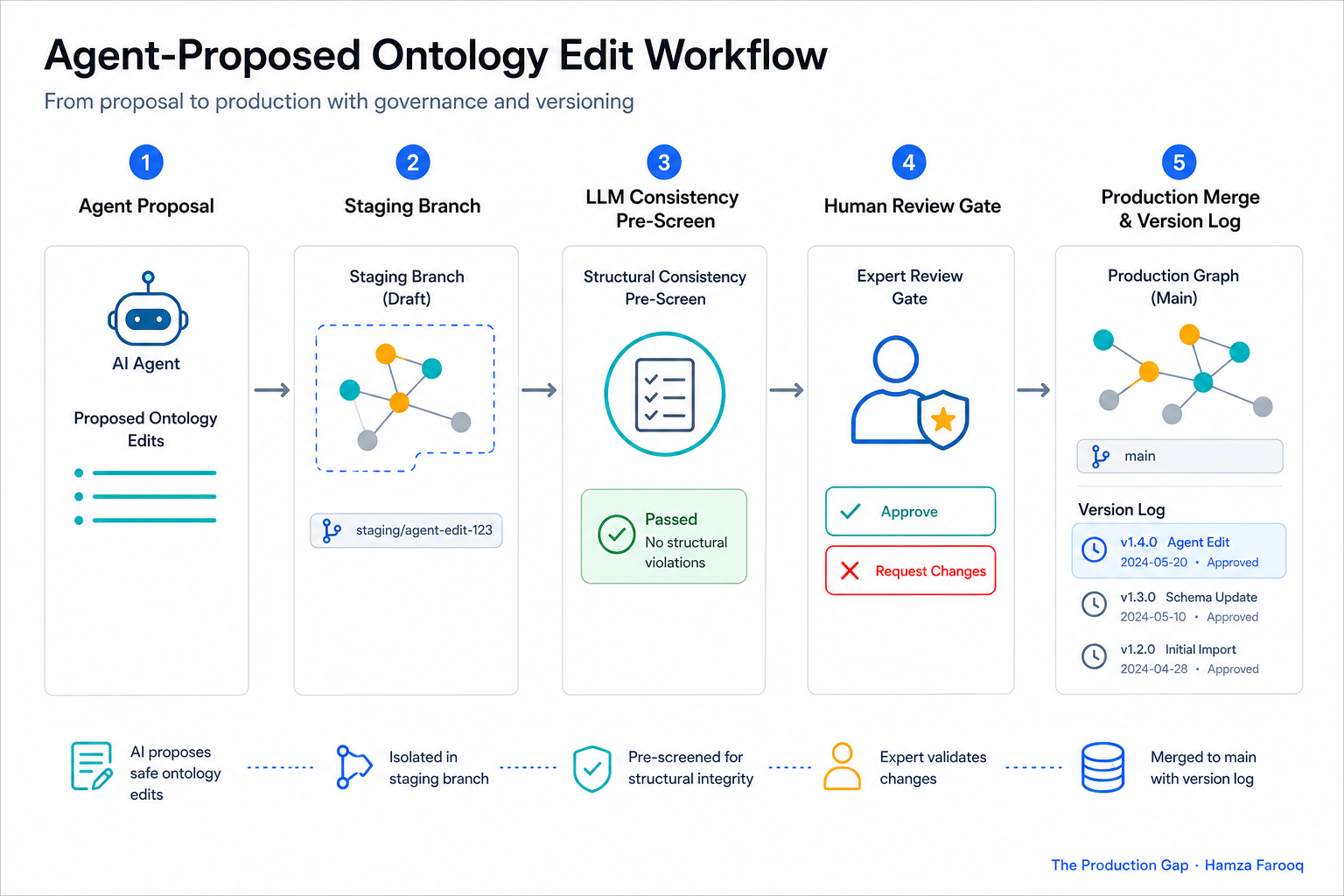
When an agent proposes an edit that bypasses review, that edit propagates instantly to every agent querying the same graph. That is a shared error baked into infrastructure, qualitatively worse than a single agent hallucinating in isolation. As agents move from answering questions to supporting decisions, the ontology must represent more operational context, meaning the stakes of a bad edit scale directly with agent authority. A responsible gate, presented here as the framework used in this guide, looks like this:
- Agent proposals land in a versioned staging branch.
- An LLM pre-screens for structural consistency against existing constraints.
- A human domain expert approves before any merge to the production graph.
- All proposals are logged with agent ID, triggering query, and reasoning trace.
Treat the graph as a versioned, reviewed artifact, not a live scratchpad.
Frequently asked questions
How does an ontology-driven agent differ from a RAG agent in production behavior? A RAG agent retrieves text chunks and infers relationships; an ontology-driven agent queries a typed graph where relationships are formally defined, so it cannot hallucinate a connection that does not exist in the schema. The result is consistent answers across agents and a full audit trail on every query.
How do you bootstrap a domain ontology without a dedicated ontologist? Feed query logs and document traffic into an LLM, prompt it to extract entity types and relationships in OWL/RDF-compatible structure, then have a domain expert review a bounded draft. The graph grows incrementally from real usage. The depth of review required will vary with domain complexity.
What is shared belief state in a multi-agent system and why does it matter? Shared belief state means every agent queries the same authoritative source of domain facts rather than its own private retrieval index. Without it, agents develop inconsistent local models that produce contradictory outputs; a shared ontology is a practical mechanism for aligning agent reasoning across a fleet, though it requires ongoing governance to remain effective.
How do ontological constraints function as logical guardrails for agent reasoning? Constraints, for example that a Contract must have exactly one GoverningLaw of type Jurisdiction, make certain reasoning paths structurally impossible. This catches invalid inferences at the domain logic layer before a bad output reaches downstream systems or end users.
Conclusion
A shared ontology gives every agent in a fleet the same typed map of your domain, replacing scattered local belief states with a single authoritative source of facts. LLM-assisted authoring has made bootstrapping that ontology more accessible than it was when dedicated knowledge engineers were the only path forward. The tradeoff is straightforward: you gain precision, auditability, and logical guardrails; you take on versioned ontology governance with a human review gate on every agent-proposed edit. Bypassing that gate risks a coordination failure worse than the problem you started with.
Three questions worth auditing against your current architecture: Do your agents share a common vocabulary, or does each build its own local belief state from independent retrieval? Are tool calls typed, logged, and schema-constrained? Does any agent have write access to a shared knowledge store without a review gate? Each gap is a concrete starting point for improvement.
References
Learn from me
Agent Engineering Bootcamp: Developers Edition, my Maven cohort. Advanced agentic RAG, multi-agent orchestration, memory, evals, and guardrails. Take agents from prototype to production. Join the next cohort →
Hire us
Traversaal.ai. We're a team of forward deployed engineers solving the toughest AI problems for Fortune 100 companies: document intelligence, agentic data platforms, and real-time web intelligence, deployed in production. Work with our team to deploy your next agentic ecosystem. Talk to Traversaal.ai →
Join us
Want to solve these problems with us? We're always looking for forward deployed engineers who want to ship production AI. jobs@traversaal.ai